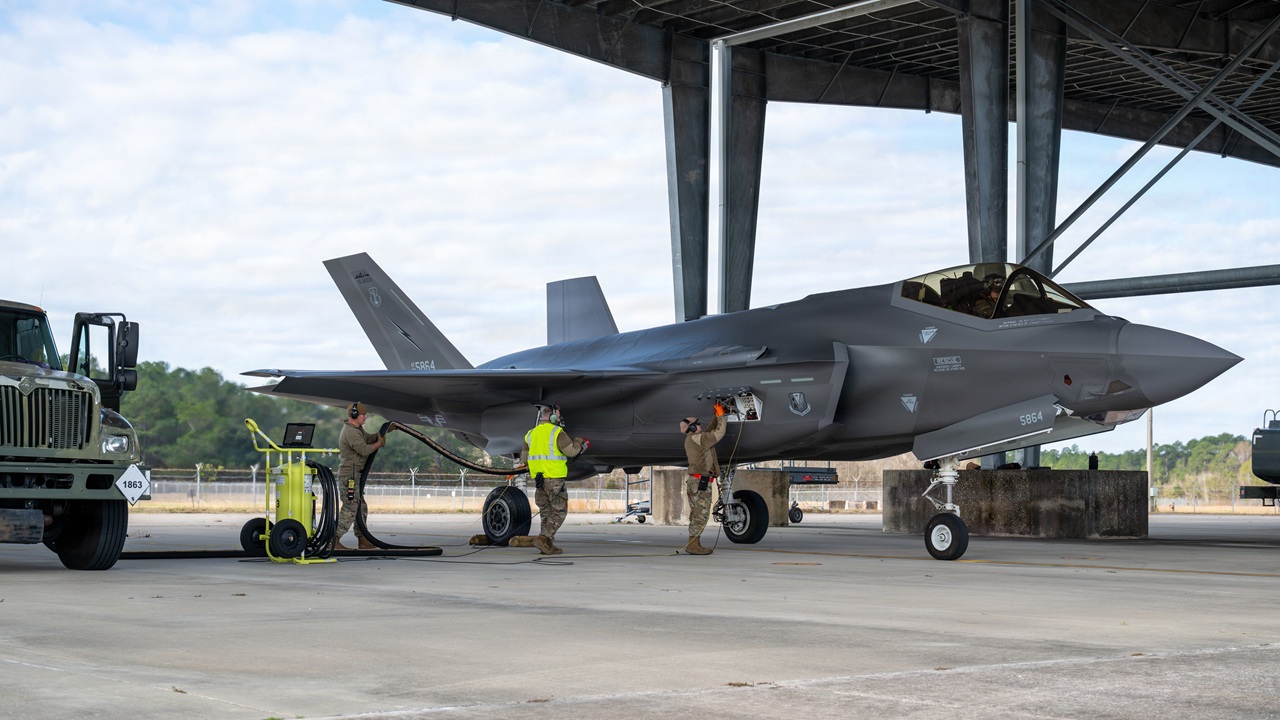
F-35 manufacturer Lockheed Martin has failed to deliver regular upgrades for the aircraft—and its most recent upgrade package was implemented disastrously, according to an internal Pentagon report.
The F-35 Lightning II has long been cited by some critics of the Pentagon as a horror story of government bloat and defense contractor ineptitude. Altogether, the program has cost $2 trillion over its lifetime, with a per-unit cost of new F-35s of up to $109 million.
Criticisms of the F-35 have quieted somewhat as the aircraft entered full-scale production, then regular service with the United States and around 20 other allied nations. Indeed, as the ongoing combat operations over Iran have shown, the F-35 is among the most advanced combat aircraft in service today—and a key part of its appeal is that it was developed to be upgradable, ensuring it will retain its edge for decades to come.
However, according to an internal report from the Pentagon, these updates are not coming as expected.
Software upgrades have “stagnated,” Bloomberg reported, quoting the report—noting that “no new combat capability was delivered last year.”
The TR-3 Upgrade Package Is Still a Giant Mess
The testing office reportedly described the long-touted Technology Refresh-3 (TR-3) as “predominantly unusable… due to stability problems, shortfalls in capability and the ongoing discovery of efficiencies,” according to Bloomberg.
This is a remarkable turnaround from last fall, when the United States Air Force began flight testing an F-35A, the conventional takeoff and landing (CTOL) variant, and claimed it was making significant progress.
Far more than a mere software patch or hardware tweak, F-35 prime contractor Lockheed Martin has described the TR-3 package as the “most aggressive upgrade in any fighter in history.” It is a critical component for the Block 4 models, offering improvements in the aircraft’s sensors, artificial intelligence (AI), and combat capability.
According to the F-35 Joint Program Office (JPO), the TR-3 provides “the computational horsepower to support modernized Block 4 capabilities for the F-35, including: new sensor suites, more long-range precision weapons, improved electronic warfare features, more powerful data fusion, and increased cross-platform interoperability.”
Lockheed Martin first began development of the F-35’s TR-3 in 2021, with the initial goal of completing it by April 2023.
Instead, however, there were significant delays with the software, and the first test flight was only conducted in January 2023. Due to those delays, in July 2023, the Pentagon halted acceptance of Lightning IIs until the upgrade was completed. Deliveries of the F-35 resumed in the summer of 2024 when a truncated version of the TR-3 upgrade was released.
The Department of Defense has continued to “face challenges in delivering reliable, fully functional software,” the Pentagon report warned. “The F-35 program continues to show no improvement in meeting schedule and performance timelines for developing and testing software, failing to deliver on the expectations of its agile development framework, [as] the process of addressing deficiencies and adding new capabilities has stagnated.”
The delays have been due to the software’s complexity, but decisions at the Pentagon haven’t exactly helped matters.
“Defense Secretary Pete Hegseth cut staff last year from the Pentagon test office that produces the congressionally mandated report each year,” Bloomberg wrote.
The Old Version of the F-35 Is Still Getting the Job Done
Despite the ongoing issues with the TR-3, the F-35 Lightning II was used in last June’s Operation Midnight Hammer, the US airstrikes on Iran’s nuclear program, and the fifth-generation multirole stealth fighter continues to be employed in the ongoing Operation Epic Fury. It is notable that the jets in use in the current Operation Epic Fury are using the TR-2 software, and have not yet been upgraded to TR-3.
At least 50 US F-35s are operating in the Middle East, alongside F-22 Raptor and F-16 Fighting Falcon aircraft. The F-35s and F-22s have been credited with blinding Iran’s air defenses, taking out radar facilities, and striking anti-aircraft platforms.
An Israel Air Force F-35I Adir was also credited with the first confirmed air-to-air kill of a manned fighter, after downing an Iranian Air Force Yak-130 (NATO reporting name “Mitten”) light attack aircraft. A Royal Air Force F-35B scored another aerial victory earlier this month after it downed multiple Iranian drones over Jordan.
About the Author: Peter Suciu
Peter Suciu has contributed to dozens of newspapers, magazines and websites over a 30-year career in journalism. He regularly writes about military hardware, firearms history, cybersecurity, politics, and international affairs. Peter is also a contributing writer for Forbes and Clearance Jobs. He is based in Michigan. You can follow him on Twitter: @PeterSuciu. You can email the author: [email protected].