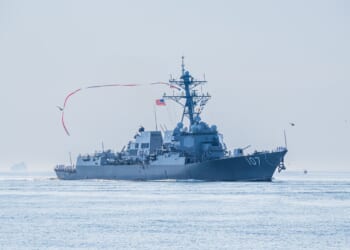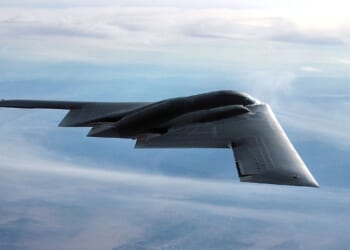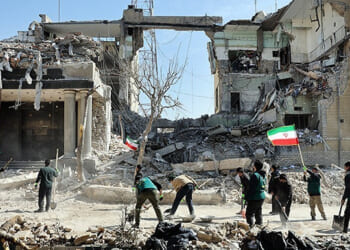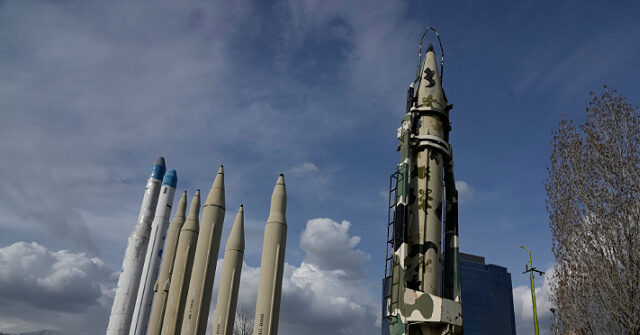
While more than 90 percent of Iranian missiles and drones have been intercepted by the United States, Israel, and allied forces, experts are reportedly warning that the cost of defense is quietly draining allied stockpiles across the region.
The vast majority of Iranian projectiles have been intercepted during the war, according to a report by the Jewish Institute for National Security of America (JINSA), obtained by Fox News.
However, the analysis warns that beneath that success exists a growing imbalance that could affect the next phase of the conflict, citing Iran’s least expensive weapons as the most troublesome in the war, draining high-cost U.S. and Israeli interceptors.
“More than 9,000 enemy targets have been struck to date,” White House Press Secretary Karoline Leavitt said during a press briefing on Wednesday. “Iran’s ballistic missile attacks and drone attacks are down by roughly 90 percent.”
Leavitt added that U.S. forces have also destroyed more than 140 Iranian naval vessels, including nearly 50 mine layers.
While a surge of U.S. assets before the war helped absorb Iran’s opening artillery and continues executing high interception rates, Ari Cicurel, associate director of foreign policy at JINSA, told Fox News that focusing only on the percentage of interceptions fails to look at the bigger picture.
“Overall high missile and drone interception rates have been important, but only tell part of the story,” Cicurel said. “Iran came into this war with a deliberate plan to dismantle the architecture that makes those intercepts possible.”
“It has struck energy infrastructure to upset markets and used cluster munitions to achieve higher hit rates,” Cicurel, who is also the author of the JINSA report, added.
Meanwhile, Danny Citrinowicz, a Middle East and national security expert at the Institute for National Security Studies, stressed that this disparity is at the heart of the problem.
“There needs to be a change in the equation,” Citrinowicz told Fox News. “The Iranians are launching drones that cost around $30,000, and we are using missiles that cost millions of dollars to intercept them. That gap is a very problematic one.”
Citrinowicz, who also serves as a nonresident fellow at the Atlantic Council, added that “building a missile in Iran may cost a few hundred thousand dollars, while the interceptor costs millions, especially when we talk about systems like Arrow.”
“It’s easier and quicker to produce missiles than it is to build interceptors,” he said. “That’s not a secret.”
The JINSA report also warns that some Gulf states have used a significant portion of their interceptor stockpile, estimating Bahrain may have expended up to 87 percent of its missiles, with the United Arab Emirates and Kuwait having used around 75 percent, and Qatar using about 40 percent.
And while Israeli officials have not confirmed their inventory, the JINSA report mentioned signs of rationing, as well as decisions not to intercept certain cluster-munition threats for conservation purposes.
“We are now several weeks into the war, and even if the salvos are limited, the issue of interceptors becomes more significant over time,” Citrinowicz said.
On Monday, Ukraine’s President Volodymyr Zelensky noted he has a “very bad feeling” about what the war in Iran means for his own prospects, and worries that Middle Eastern countries carelessly burning through cutting-edge air defense missiles is going to cause a global shortage that Ukraine will suffer from the most.
Iran, meanwhile, has reportedly adapted its tactics, integrating strategies it learned from the war in Ukraine, as well as shifting from large barrages to smaller, more frequent attacks meant to keep constant pressure while slowly draining defensive resources.
These moves by the Islamic regime reportedly complicate interception timelines and increase the likelihood of successful strikes against U.S.-allied forces.
Nonetheless, Cicurel emphasized that “the defense architecture has held.”
“But the trajectory is moving in the wrong direction,” he told Fox News. “Reversing it requires moving assets to where the pressure is greatest, hunting Iranian launchers and drones more aggressively, and convoying ships through the Gulf.”
Notably, the JINSA report predicts a system under growing strain rather than failing defenses.
“As long as the war continues, the key question will be whether Iran can produce missiles faster than we can produce interceptors,” Citrinowicz said.
Alana Mastrangelo is a reporter for Breitbart News. You can follow her on Facebook and X at @ARmastrangelo, and on Instagram.