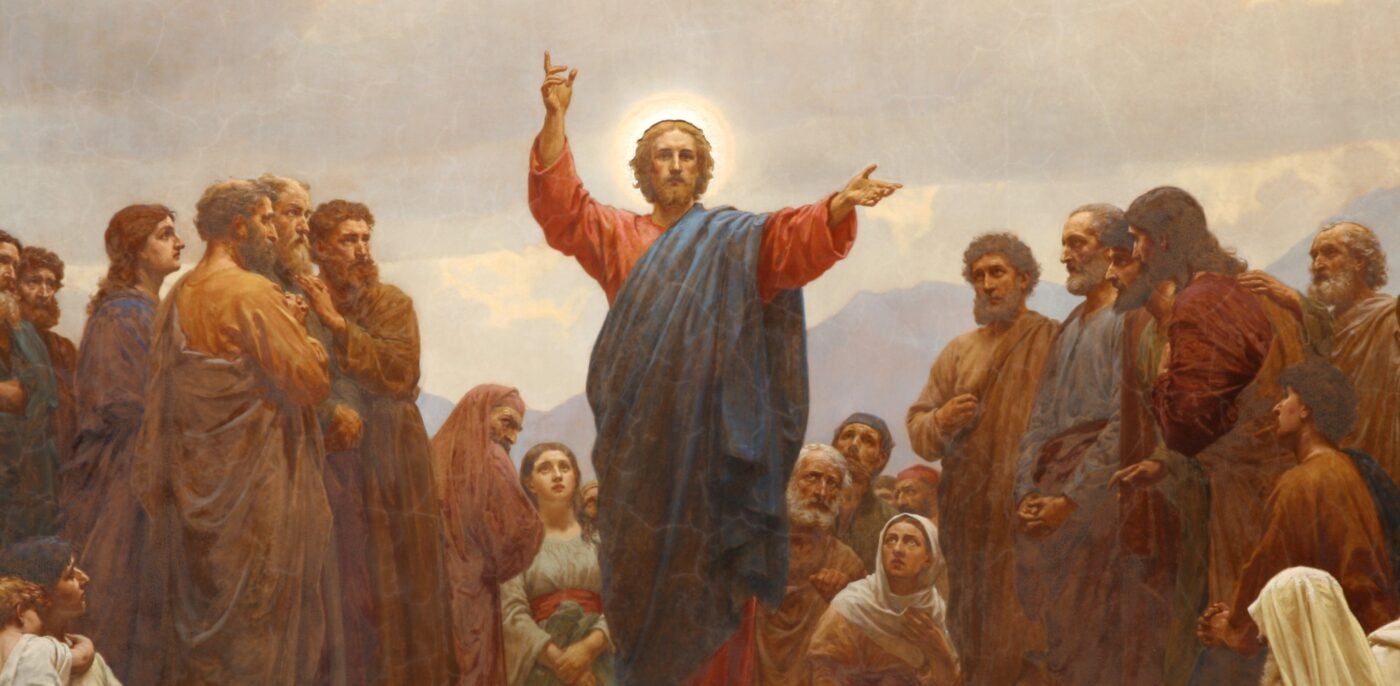
Some time ago, I had the practice of reading the Sermon on the Mount (Mt. 5-7) or the Last Discourse of John (Jn. 14-17) at least once a week. I did so because these passages are so fundamental to the Christian life. Regularly going through the Sermon on the Mount caused varying dimensions of the Sacred Page to come forth, such as seeing it in terms of Jesus, the Father, and the Holy Spirit in our life as Christians. Our Gospel this Sunday, on the Beatitudes, is a brief, introductory summary of the whole sermon and so gets us to the heart of the Sermon on the Mount.
Learning the Heart of Jesus
Jesus practices what He preaches more than anyone else does. He perfectly lives out the Beatitudes and the Sermon of the Mount. This causes Pope Benedict XVI to approach the Beatitudes as “a spiritual portrait” of Jesus’ interior character, a sketch of Jesus’ meek and humble heart. The Beatitudes help make up Jesus’ cruciform existence in their poverty of spirit, mourning, meekness, hungering and thirsting, mercy, purity of heart, peace-making, and being persecuted for righteousness’ sake. The Sermon on the Mount opens up for us Jesus’ interior life and His character. And as we contemplate the beauty of His heart, we are drawn to cry out to Him to “make our hearts like unto thine.”
Learning How to Be a Son/Daughter
Reading through the Sermon repeatedly, I began to notice how frequently the word Father shows up—seventeen times in three chapters. So not only do we learn about the heart of Christ, but also about the Father. Jesus is directing us to the Father with all the dispositions of soul we need in that turning to Him—from humility to radical trust, from meekness to great strength. The Sermon on the Mount teaches us how to be sons and daughters in the Son and how to pray and relate to our Father in heaven. It is no mistake that, structurally, the centerpiece of the Sermon of the Mount is precisely the Our Father (Mt. 6:9-13).
The Our Father is not just about lipping the words; it involves having a similar interior disposition to the Son in relation to our Father in heaven. This necessitates (1) radical trust in Divine Providence and in our good heavenly Father (Mt. 6:25-34, 7:7-11); (2) a decisive orientation to the things of heaven (6:19-24); (3) an other-centered stance through a life of almsgiving, prayer, and fasting (6:1-18); (4) an integrity between an external observance of God’s law and one’s interiority (5:17-42); (5) love and mercy for others even for one’s enemies like our perfect Father in heaven (5:43-38); and (6) a building of one’s life on the word of God and the Word who is the Rock (7:24-27).
The Sermon on the Mount is not simply a standard we try to live up to. It is the portrait of a life of grace, a life in the Spirit. It is the righteous response to the gift given to us, the gift of our identity in Christ as adopted sons and daughters. The Sermon sketches the interior heart of Jesus, the Son—a heart of humble dependence, receptivity, and faithfulness to the Father. And praying with the Sermon on the Mount helps build that heart in us, drawing our own hearts into a deeper correspondence with Jesus’ through His Spirit dwelling in us. “Because you are sons, God sent the Spirit of His Son into our hearts crying out, ‘Abba, Father!’” (cf. Gal 4:4-7).
The Beatitudes, A Foretaste of Heaven
With respect to the spiritual exegesis of Scripture, it is worth noting a certain parallel between the four steps of Lectio Divina and the four senses of Scripture: (1) lectio (reading)/literal sense, (2) meditatio/allegorical sense, (3) oratio (prayer)/moral sense, and (4) contemplatio/anagogical sense. Oratio, or prayer, corresponds to the moral sense because we are praying and begging for a given Scripture passage to be actualized and accomplished in our own lives. The anagogical sense is sometimes referred to as the mystical sense because it involves a contemplative foretaste of the eschaton in a full union with God and the full reconciliation throughout all of creation.
It has been noted that the Beatitudes cannot be fully realized in this life but point to our life beyond with an eschatological horizon. So we can also find in the Beatitudes a foretaste of what our interior disposition will be in heaven, among one another and God. And so our First Reading, in the whole context of Zephaniah 3:9-20, reveals the meek and humble heart of the Beatitudes, of those who will dwell on God’s Holy Mountain on the last day with none to afflict and disturb them. And we can understand why the poor of spirit are blessed, as it casts them more completely on our Rock Jesus, who is our “wisdom, righteousness, sanctification, and redemption” (1 Cor. 1:30, Second Reading).
Editor’s Note: This is the fifth article of a CE series on “Exegesis of the Word” by Fr. Ignatius Schweitzer, breaking open each Sunday’s readings for eight consecutive weeks. Catch up on previous articles here!
Image from Wikimedia Commons