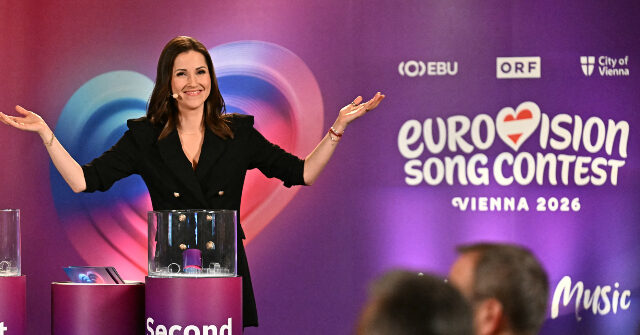
The European Broadcast Union (EBU), the organization that runs the Eurovision Song Contest, announced on Tuesday that tickets for the 2026 competition in Vienna, Austria, have sold out in record time – news defying the calls by leftist celebrities and activists to boycott the event in protest of Israel’s participation.
Eurovision is the world’s largest live music event; the EBU estimated that 100,000 people attended the 2025 contest in Basel, Switzerland, throughout the various semi-finals, rehearsal performances, and the Grand Final, where a champion is crowned. The contest, conceived of as a way to bring the continent together after World War II, will be celebrating its 70th edition this year. Israel has participated in the competition since 1974 and won four times, making it a consistent presence in the contest. It is among several states not technically on the European continent that form part of the Eurovision family; Australia is the competitor furthest from the geographic heart of the contest and its participation is not widely considered controversial.
Pro-Hamas and leftist groups, including prominent celebrities and Eurovision competitors, began calling for the EBU to expel Israel from the competition in the aftermath of Hamas’s genocidal attack on Israel on October 7, 2023. Throngs of leftist protesters mobbed the venues of both the 2024 and 2025 contests, in some cases threatening the Israeli competitor at those events, but the pressure has failed to convince the EBU to expel Israel. In addition to protesters, several leftist governments, including Spain and Ireland, threatened to walk out of the contest if Israel received an invitation in 2026. Ultimately, the EBU refused to expel Israel, and Spain, Ireland, the Netherlands, Iceland, and Slovenia all announced they would boycott the contest this year. The national broadcasters of Bulgaria, Romania, and Moldova announced they would return to the contest this year, however, meaning this year’s iteration will only have two fewer competitors than 2025.
That controversy did not appear to result in any damage to ticket sales for the event. According to the EBU, it successfully sold every ticket to the nine 2026 performances in record time. Tickets to the Grand Final sold out in 14 minutes and all tickets sold out within an hour. The vast majority of the countries competing have not yet chosen a performer or song to send, so fans are essentially buying tickets blind to the event.
“The response has been phenomenal,” Eurovision Song Contest Director Martin Green declared on Tuesday. “To see every single show sell out so quickly is a powerful reminder of what the Eurovision Song Contest represents — joy, togetherness, and shared experience at a time when that feels more important than ever.”
While the song contest has long attempted to impose a “no politics” rule on participants and the event generally, it has struggled in the past decade to avoid pressure to address political issues. In 2022, the EBU officially expelled Russia and Belarus from Eurovision in response to Russia’s invasion of another competitor, Ukraine. Ukraine won the 2021 contest but could not host the following year’s, as is the custom, due to the war, prompting the United Kingdom to step in.
Anti-Israel activists have attempted to argue that Israel’s self-defense operations against Hamas after October 7 are analogous to Russia’s invasion of Ukraine, echoing a similarly unsuccessful attempt to expel Israel from the contest following the country’s victory in 2018. In 2024, the contest was hosted in Malmö, Sweden, home to a large Muslim population, many of whom attended massive rallies to call for Israel’s expulsion. Among the thousands of protesters surrounding the event venue was Swedish environmentalist Greta Thunberg.
Inside the 2024 contest, Israeli singer Eden Golan reportedly endured substantial discrimination from her fellow competitors. Irish “non-binary” pagan singer Bambie Thug claimed to cry after Golan qualified to compete in the Grand Final. At a press conference after the semi-final performance, Greek singer Marina Satti appeared to pretend to fall asleep while Golan spoke, while Dutch performer Joost Klein loudly yelled “Why not?” when an organizer said Golan did not have to answer a question appearing to accuse her of creating a security risk for other performers. Klein was ultimately disqualified over a behind-the-scenes altercation all sides publicly stated did not involve Israel and went on to release a song called “Why Not?”
The winner of the 2024 song contest, Swiss “non-binary” singer-rapper Nemo, dramatically announced disapproval in December of the EBU’s decision to allow Israel to continue competing. Nemo filmed a video packing his Eurovision trophy to purportedly mail it back to the EBU, rejecting association with the organization for its ties to Israel.
The 2025 contest winner, Austria opera singer JJ, explicitly stated he did not want Israel in next year’s competition following the win.
“It is very disappointing to see Israel still participating in the contest. I would like the next Eurovision to be held in Vienna and without Israel,” JJ said in May following his win. Contrary to the artist’s opinion, the Austrian public broadcaster hosting in 2026 announced that Austria would boycott Eurovision if Israel were to be expelled from the contest.
The EBU vote on expelling Israel was canceled after President Donald Trump brokered a peace agreement in Gaza, formally ending the active period of self-defense against Hamas.