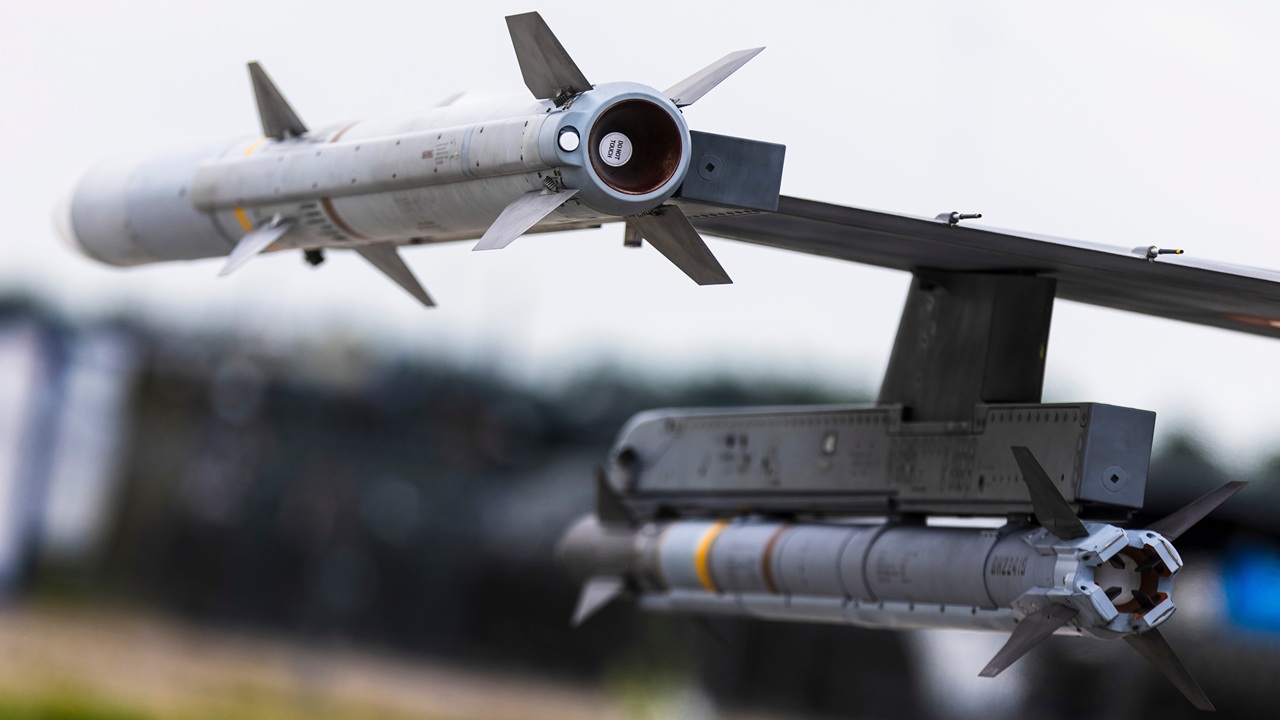
Though the two air-to-air missiles are broadly similar, one has a decisive advantage in aerial kills, thanks to its far larger “no-escape zone.”
With BVR (beyond-visual-range) combat increasingly defining modern air warfare, missiles not airframes often decide outcomes. The MBDA Meteor and AIM-120 AMRAAM represent two different options for BVR combat. Both are networked missiles, with fire-and-forget capability—but they differ sharply in propulsion, energy management, and employment philosophy.
Why the Meteor Is Deadlier than the AMRAAM
The AIM-120 AMRAAM was developed during the late Cold War to replace the aging Sparrow air-to-air missile, and was built around reliability and compatibility. It entered service in the early 1990s, following the Soviet Union’s collapse and the decisive American victory in the 1991 Gulf War.
The Meteor concept emerged slightly later, in the late 1990s and early 2000s, as a European response to perceived AMRAAM limitations. The Meteor was built from lessons learned during BVR exercises and modeling. The two missiles, built half a generation apart, reflect a specific time period’s assumptions about air combat.
How are the two missiles different? For starters, the AMRAAM uses a solid-fuel rocket motor, which burns briefly after launch before coasting to the target; its energy drops sharply at long range. By contrast, the Meteor has a throttle-able solid-fuel ramjet that sustains thrust throughout flight. The key difference here is endgame energy: the Meteor maintains high speed and high maneuverability, while the AMRAAM relies heavily on launch conditions. This is the core technical distinction between the two missiles.
Both missiles have a maximum range that remains classified, but is understood to be similar for each. But range can be a misleading figure. A better metric is the “no-escape zone” (NEZ), the engagement area where a target aircraft cannot outmaneuver or outrun a missile after it’s fired—even if the target performs maximum evasive maneuvers like turning 180 degrees. Basically, the NEZ is the missile’s true lethal range, defining the distance at which its seeker and performance guarantee a high probability of kill (whereas the range metric assumes no evasion).
Here, the Meteor shines. It has a much larger NEZ than the AMRAAM, thanks to its sustained thrust, making for harder endgame maneuvers. The AMRAAM’s NEZ is much smaller, especially against maneuvering targets, making the Meteor far deadlier at long range. Still, the AMRAAM remains lethal at medium distances.
Both missiles use active radar seekers, which support midcourse updates. The AMRAAM is deeply integrated with US networks, like AWACS and datalinks. The Meteor is designed for cooperative engagement, too, with two-way datalink that allows for target updates deep into flight. Networking is critical for both missiles.
The AMRAAM Has a Longer Service Record
America’s AMRAAM doctrine is built around massed employment—a high shot count—and reliance on sensors and support. The Meteor doctrine is about taking fewer shots with higher confidence per launch. The Meteor engages early to enforce area denial, while the AMRAAM supports more flexible engagement. Both missiles are designed to shape enemy behavior, not just to score kills but influence the battle space through mere presence.
Of the two missiles, the AMRAAM is more widely used. The United States has spread it across NATO nations, and also exported it to customers around the world; it has easy integration with existing American fighter jets including the F-15, F-16, F/A-18, F-22, and F-35. The UK, France, Germany, and Sweden use the Meteor—which is integrated on the Rafale, Eurofighter, and Gripen (and, very recently, the F-35).
To date, the AMRAAM has an extensive combat record with multiple confirmed kills, while the Meteor is still without a confirmed combat kill. But combat record does not equal superiority. Both missiles are highly effective, albeit with different priorities. The Meteor maximizes a lethal endgame; the AMRAAM maximizes flexibility and scale.
About the Author: Harrison Kass
Harrison Kass is a senior defense and national security writer at The National Interest. Kass is an attorney and former political candidate who joined the US Air Force as a pilot trainee before being medically discharged. He focuses on military strategy, aerospace, and global security affairs. He holds a JD from the University of Oregon and a master’s in Global Journalism and International Relations from NYU.
Image: Shutterstock / Karolis Kavolelis.