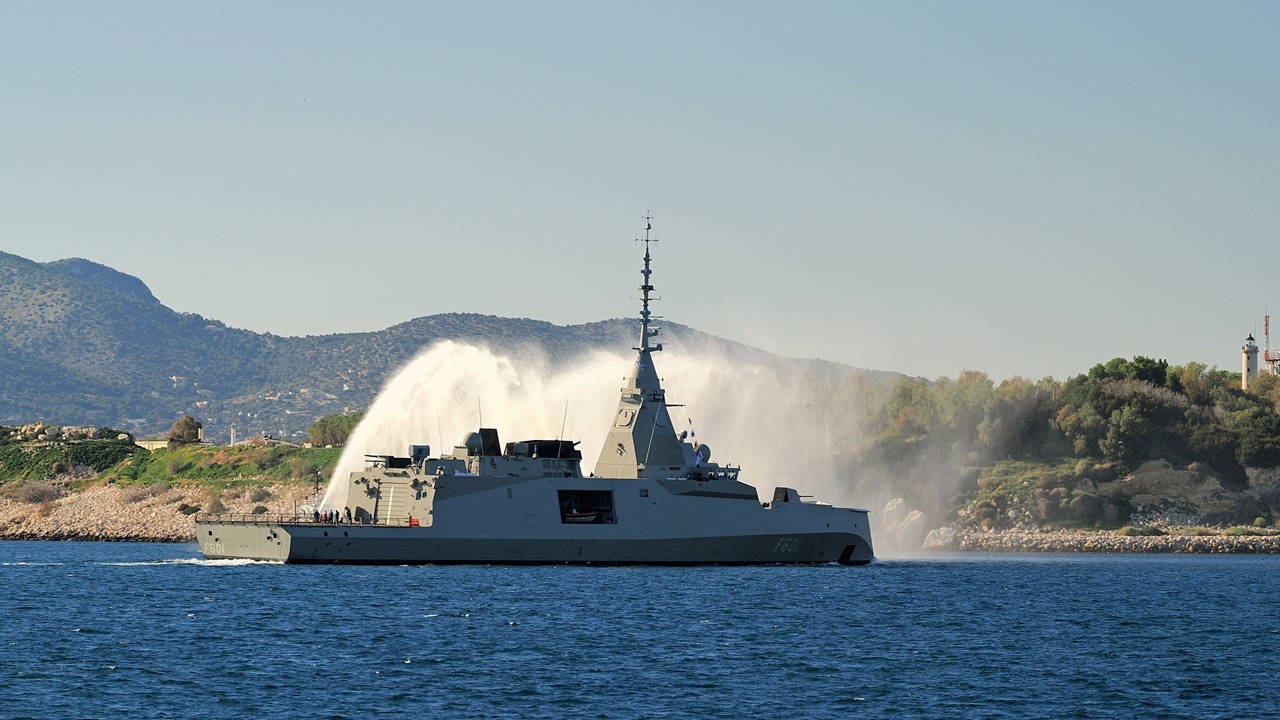
After Iran launched drones at Cyprus, the Hellenic Navy deployed to intercept them—marking the second time it has protected the island from Persia in the last 2,500 years.
On Monday morning, an Iranian Shahed kamikaze drone struck RAF Akrotiri, a British air base in Cyprus hosting F-35 Lightning II stealth fighter jets.
Two additional one-way attack unmanned aerial systems were intercepted heading toward Cyprus.
Moreover, the Islamic Revolutionary Guard Corps threatened the island nation with a salvo of ballistic missiles and kamikaze drones until US forces evacuated the area.
Why Iran Is Attacking Cyprus
IRGC general Sardar Jabbari said that Iran’s strikes on Cyprus would be more intense than before, given the American and British air and naval presence on the island.
“The Americans have relocated most of their aircraft to Cyprus. We will launch missiles at Cyprus so intensively that the Americans will be forced to leave this island,” Jabbari said in a recorded video message.
RAF Akrotiri is one of the UK’s largest air bases in the eastern Mediterranean. The United Kingdom initially blocked the US military from using its bases for offensive strikes against Iran. However, London subsequently relaxed its posture to allow sorties from British bases intended for defensive purposes. It is unclear whether RAF Akrotiri is being used as a transit hub for US aircraft.
Why Greece Is Defending Cyprus
Shortly after Iran announced its intent to attack Cyprus, Greek military leaders signaled that they would aid in the island’s defense. Greece has ancient political, cultural, and social ties to Cyprus, and many ethnically Greek Cypriots have sought formal unification of the island with Greece.
The two countries signed ajoint defense pact in 1993, obliging Greece to come to Cyprus’ defense in the event of future conflict.
“Following the unprovoked attacks on the territory of the Republic of Cyprus, I assured [Cypriot Minister of Defense Vasilis] Palmas that, throughout the current crisis, Greece will contribute in every possible way to the defence of the Republic of Cyprus in order to address threats and illegal actions on its territory,” Hellenic Minister of National Defence Nikos Dendias said in a press statement.
“Therefore, pursuant to the decision by the Government Council for National Security, Frigate Kimon and a second Greek frigate equipped with the Kentavros [anti-drone] system are promptly sent to the Republic of Cyprus,” the Hellenic Minister of National Defence added.
The Hellenic military is also deploying a pair of F-16 Fighting Falcons to accompany the ships.
Dendias and the chairman of the Hellenic chief of staff will also visit Cyprus.
The USS Gerald R. Ford aircraft carrier and its escort ships are also in the East Mediterranean, but closer to Israel than Cyprus. Still, their air defense umbrella is in the path of any Iranian munitions heading toward the strategic island.
Why Cyprus Matters
The incident highlights the strategic importance of Cyprus. Located on the fringes of Europe in the East Mediterranean, the island nation is a member of the European Union and enjoys increasingly closer ties with the United States. The British military maintains a constant presence on the island in RAF Akrotiri, a residue of Cyprus’s colonial past as a British crown colony. The island’s proximity to Israel, the Middle East, and North Africa presents an ideal base of operations.
Greece and Iran Are Renewing Their Ancient Conflict
In an interesting twist of history, HS Kimon, the Hellenic Navy’s new frigate, sailing toward Cyprus, is named after the Athenian general Kimon, son of Miltiades—who also sailed to Cyprus in 450 BC with 200 warships to fight the Persians during the Greco-Persian Wars.
Now, nearly 2,500 years later, Greek warships are sailing toward Cyprus to protect the island from Persian attack once again.
About the Author: Stavros Atlamazoglou
Stavros Atlamazoglouis a seasoned defense journalist specializing in special operationsand a Hellenic Army veteran (national service with the 575th Marine Battalion and Army HQ). He holds a BA from the Johns Hopkins University and an MA from the Johns Hopkins’ School of Advanced International Studies (SAIS). His work has been featured in Business Insider, Sandboxx, and SOFREP.