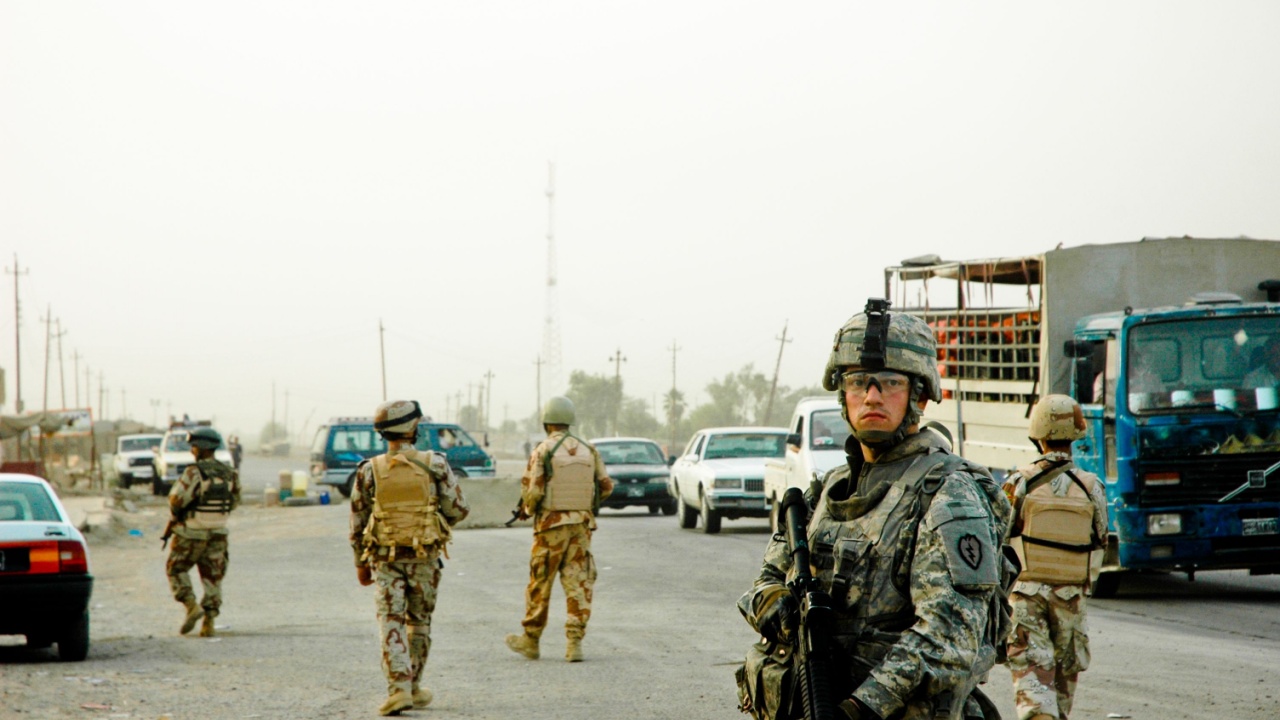
What destroyed Iraq after 2003 was not the war; it was the failure to plan for the post-war order. Iran could turn out the same way.
The lights went out in Baghdad in April 2003 and stayed out for years. Not because the grid was bombed—it remained largely intact—but because the people who knew how to run it had been removed. Coalition Provisional Authority Administrator Paul Bremer’s decision to dissolve the Iraqi army and purge the Ba’ath Party from the civil service in a single week in May 2003 stripped the country of the engineers, administrators, and officers who maintained whatever order existed. Four hundred thousand of those men, armed and suddenly without pay or purpose, had nowhere to go and every reason to be angry.
The insurgency that followed was not a surprise to anyone who had thought about it. Almost nobody in the occupation’s upper ranks had thought about it. Al Qaeda in Iraq and eventually the Islamic State grew as a result of that oversight. The proliferation of terrorist groups was not an ideological inevitability, but the spawn of a specific and avoidable failure of planning for the morning after a military victory.
Libya in 2011 was faster and in some ways worse. Libyan Dictator Muammar el-Qaddafi had hollowed out every institution in the country that might have rivalled him, which meant there was almost nothing beneath him when NATO removed him. The militias running Libya today are not an accident of Libyan culture or history. They are the direct inheritors of an intervention that destroyed a government, watched the country fragment, and left.
The consistent lesson across seven decades of Western military action in the Middle East is not that intervention fails on the battlefield. It rarely does. The failure lies in the gap between military victory and legitimate authority—the gap filled by whoever was organized and armed enough to wait in the wings.
Iran is a harder version of this problem in almost every respect. While the Trump administration has not specified what kind of “regime change” it wants or how it seeks to achieve it, it is clear that it wants significant changes to Iran’s internal government and policies.
Iraq’s borders were drawn by a British official named Mark Sykes in 1916, on a map he’d never studied carefully, in a negotiation with François Georges-Picot, a French diplomat who had his own interests. The national identity that was supposed to hold Iraq together was always contested and in important ways remains so. Iran is a civilization that has governed itself in one form or another for more than two thousand years.
When Iranians take to the streets—as they did in 2009, 2019, 2022, and in January 2026, when the regime killed at least 30,000 of them—they are arguing over what kind of Iran they want. The existence of Iran is not in question in the way the existence of Iraq as a coherent unit has always been in question.
That matters because it means there is a state to redirect rather than a vacuum to fill. The engineers running Tehran’s water infrastructure are not, for the most part, people who believe in the Islamic Republic. They are people who made their accommodation with it and kept working. A transition must preserve those people. Baghdad lost its electricity because Bremer removed the only class of people who knew how to keep it on. Tehran does not have to repeat that.
Because the Islamic Revolutionary Guard Corps (IRGC) regional architecture makes Iran’s day-after problem unlike anything that has come before it, Hezbollah has its own revenues, its own hospitals, its own seats in the Lebanese parliament, thirty years of institutional development that has nothing to do with who is running Iran on any given day. The Houthis, the Popular Mobilization Forces in Iraq, the network of commanders embedded across Syria—these organizations were built with Iranian money and direction. Still, they have grown their own roots and often pursue their own objectives. When the connection to Tehran is cut, they will lose the constraints that came with Iranian patronage as much as they lose the support. They may become autonomous, competitive, and unpredictable in already unstable countries.
And then there is the uranium. The Isfahan enrichment facility was hit in the US-Israeli strikes of June 2025. How much weapons-grade uranium survived, and where it is now, is impossible to say. The same strikes that destroyed the centrifuges destroyed the monitoring equipment that would have told us. No previous target of Western military action had as advanced a nuclear program as Iran. The question of what happens to the enriched uranium during a governance transition is not a technical detail that can be addressed later. It is a question that must guide US strategy going forward.
Meanwhile, the Strait of Hormuz, 21 miles wide at its narrowest, is effectively closed. Iran does not need to sink tankers to achieve that—the threat of mines and missiles is enough to make insurance prohibitive, which keeps the ships at anchor. The Brent crude oil price has risen to $112 as of March 27. In the United States, that is a political headache. But, in Pakistan, Bangladesh, or across the Sahel, the same price movement means people go hungry.
There is a democratic opposition in Iran that has been built at a real cost over many years. The post-2009 Green Movement generation has maintained resistance despite the 2022 and 2026 crackdowns. Diaspora networks in London, Los Angeles, and Berlin maintained connections to the interior. In 2003, the Iraqi liberals who hoped to build a democratic Iraq after Saddam Hussein’s dictatorship were also serious people.
Most of them were overwhelmed not by their own failures but by the conditions the occupation created: the security vacuum, the militias Iran funded into that vacuum, the basic inability of the Coalition Provisional Authority to establish circumstances in which civilian politics could function. The conditions matter more than the people, and the conditions depend on decisions being made right now by an administration that has given no public sign of having thought them through.
The question hanging over the Iran War is the same one that went unanswered in Iraq. Is the United States prepared for what comes next? In Iraq, it took 20 years and hundreds of thousands of lives to answer that question.
About the Author: Eric Alter
Eric Alter is the dean of the Anwar Gargash Diplomatic Academy in Abu Dhabi and a professor of international law and diplomacy, as well as a member of the Council on Foreign Relations. A former United Nations civil servant and a senior consultant/team leader with various international organizations such as the WTO, the World Bank, IFC, UNDP, UNEP, and FAO. Professor Alter has been seconded abroad and worked with embassies in an advisory capacity, in particular in Aden, Beirut, and Cairo. He received his PhD from Paris I Pantheon-Sorbonne. Follow him on X: @eralter_eric.