As the so-called “rules-based international order” fades, the old narrative of “might makes right” has taken hold of Russian state news broadcasts. Do the US raid in Venezuela and the Russian Oreshnik strike in Ukraine signal a return to raw power politics?
The weekly Russian news program Vesti Nedeli has delivered a blunt message to the proponents of the “rules-based international order”: power is once again the primary currency of global politics. In a series of rapid-fire events spanning from the Caribbean to the Arctic and to Western Ukraine, Washington and Moscow have pivoted toward a doctrine of pravo sil’nogo, the “right of the strong.”
The most dramatic development occurred on January 3 with “Operation Absolute Resolve,” a 30-minute lightning strike by US Delta Force commandos that captured Venezuelan President Nicolás Maduro and his wife in Caracas. Supported by over 150 aircraft, the operation is the latest move in the Trump administration’s aggressive reassertion of the Monroe Doctrine, using overwhelming force to effectively decapitate a hostile regime in America’s backyard. The message from President Trump following the operation was unambiguous: “American dominance in the Western Hemisphere will never be questioned again.”
On January 9, the Kremlin conducted its own “kinetic diplomacy” in Europe, launching its Oreshnik hypersonic missile at the Ukrainian city of Lviv, near the Polish border. The strike, which featured six warheads traveling at Mach 10, was a calculated signal to NATO: Russia can launch nuclear-capable missiles that Western air defenses cannot intercept. While the warheads used were reportedly inert “dummies,” the message was a blunt reminder of Moscow’s escalatory capacity.
Despite its goal of asserting Russian dominance, this latest aggression took place against the backdrop of grinding attrition on the frontlines. Russia has now been at full-scale war in Ukraine for longer than the Soviet Union’s war with Nazi Germany in World War II, which ended with the Red Army in Berlin. Today, even with Russia’s deployment of drones and hypersonic technology, the frontlines remain largely static, with both sides settling into a “meat grinder” conflict that has also exhausted the efficacy of Western weapon deliveries like the Abrams tank and HIMARS systems.
Meanwhile, the US continues to signal further territorial ambitions in the Arctic, vowing that the US will acquire the Danish territory of Greenland. “I would like to make a deal, you know, the easy way. But if we don’t do it the easy way, we’re going to do it the hard way,” Trump recently said at a press conference.
Was Trump’s Venezuela raid simply the first move in a global trade-off between Washington and Moscow? Is the Oreshnik strike a genuine threat from Moscow or a desperate signal to an unpredictable Trump administration? In the latest episode of Russia Decoded, Andy Kuchins and Chris Monday unpack how Vladimir Putin and Russian elites understand the world, and how they seek to influence it.
Listen to the new episode now on Apple, Spotify, or wherever you get your podcasts.
About the Speakers: Andy Kuchins and Chris Monday
Andrew C. Kuchins is currently a senior fellow at the Center for the National Interest and an adjunct professor at the Johns Hopkins University School of Advanced International Studies. He has served as President of the American University of Central Asia and the Director of the Carnegie Moscow Center as well as the Russia and Eurasia Programs at the Carnegie Endowment for International Peace and the Center for Strategic and International Studies. He is the author or editor of 7 books and published columns for The Wall Street Journal, The New York Times, The Washington Post, and many other media outlets.
Chris Monday is an associate professor of economics at Dongseo University in Busan, South Korea.
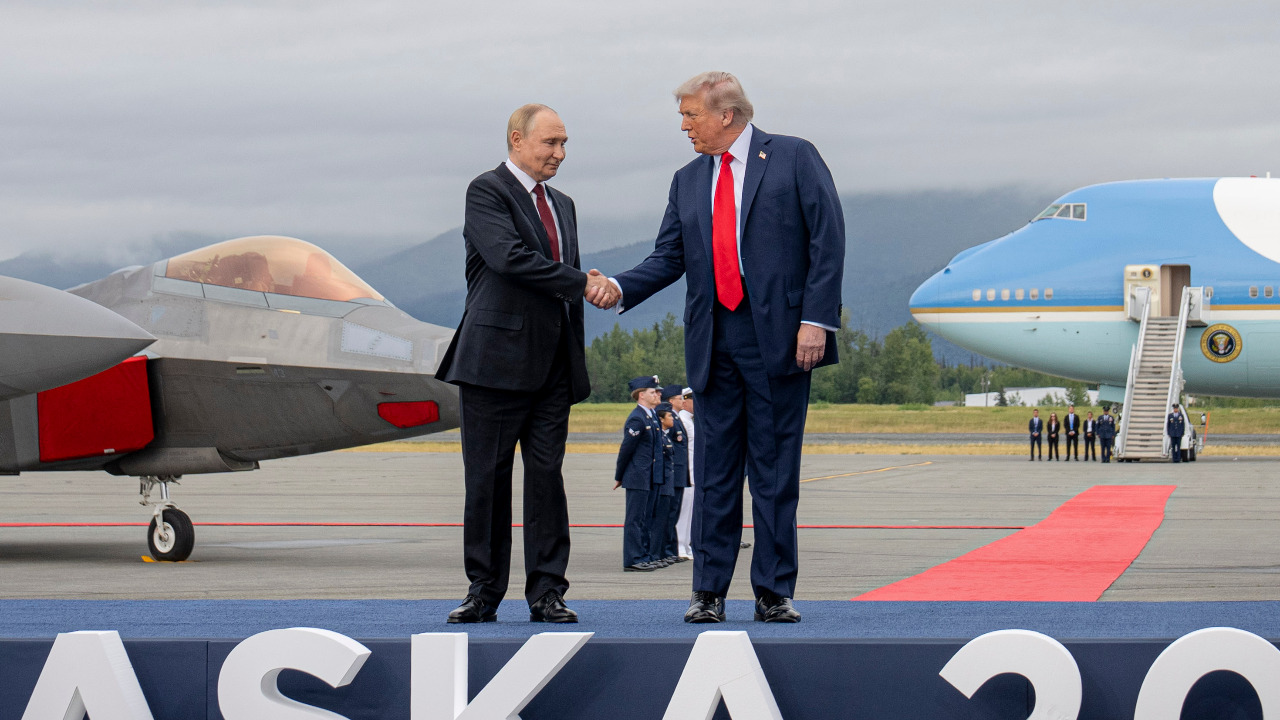
Image: President Donald Trump welcomes Russian President Vladimir Putin in Anchorage, Alaska, August 15, 2025 (DoD photo by Benjamin Applebaum).