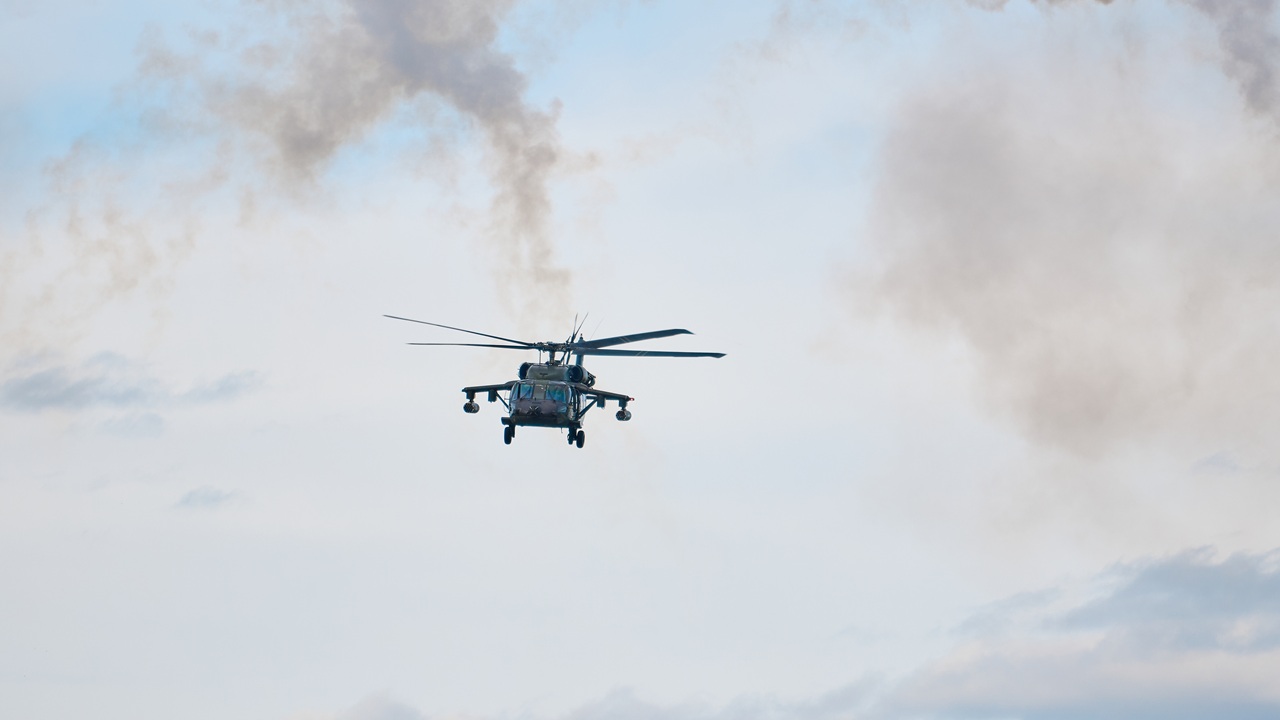
Helicopters have few ways to fight back against incoming fighter aircraft. Surprisingly, though, it is far harder to shoot down a helicopter from a plane than one might imagine.
Fighters against helicopters sounds like an extreme combat mismatch—but it does happen from time to time. Fighters do occasionally target rotary-wing aircraft, although this is uncommon and highly dependent on context. Most documented cases of fighter-on-helicopter combat have taken place in low-intensity conflicts or border/intercept scenarios. Fighters almost never hunt helicopters as a primary mission.
A Short History of Fighter-Helicopter Combat
Documented and credible examples of fighters v helicopters do exist.
During the Iran-Iraq War, fighter aircraft on both sides periodically engaged attack helicopters operating near the front lines. One example in 1980 marked the first ever combat kill for the F-14A Tomcat, when one of the aircraft in Iranian service—inherited from the Shah’s pro-Western government following the 1979 revolution—was used to shoot down an Iraqi Mil Mi-25 gunship during a border skirmish at the outset of the war. A decade later, US fighter jets shot down multiple Iraqi Mi-24 “Hind” helicopters during the 1991 Gulf War. In one tragic incident in 1994, US jets misidentified two US Army Black Hawk helicopters flying over northern Iraq as enemy helicopters and fired on them, killing 26 people.
In modern air policing, fighters intercept military or paramilitary helicopters violating airspace. The key takeaway here: fighter vs. helicopter engagements are situational, arising organically—not doctrinal.
When a fighter chooses to engage a helicopter, it is because the helicopter is operating in contested airspace. For example, an armed attack helicopter threatening ground forces, operating without air cover, could prompt a fighter intervention; in that case, the fighter would be already airborne and operating nearby, meaning the opportunity cost for pursuit is low. Assuming the rules of engagement permit engagement, this is a scenario where the fighter is likely to engage the helicopter.
Fighter Jets Don’t Always Perform Well Against Helicopters
For a fast-moving fighter, engaging a helicopter is much harder than it sounds. Helicopters move very low and very slow, and are often masked by terrain. Fighters, meanwhile, are optimized for high speed and medium-to-high altitude, where they usually engage fast-moving targets. The result is that fighter tracking and weapons employment are calibrated differently—in a way that makes it very difficult to target helicopters.
To engage a helicopter, a fighter would usually use an infrared-guided missile, as the helicopter engine produces a strong heat signature. However, these missiles are designed for use against other aircraft, and a helicopter’s low speed and low-altitude background clutter complicate the lock. Picking up a helicopter on radar can be difficult, too—again because of ground clutter at low altitude, and because the helicopter has a small radar cross-section. The fighter could also employ guns, but this can be risky due to closure rates and the possibility of an overshoot.
Tactical scenarios where engaging a helicopter makes sense might include where a fighter is already descending to strafe or perform a close air support (CAS) role against a fixed or slow-moving target; where a helicopter is caught transiting between areas; during night operations, where IR sensors dominate; or the helicopter is hovering or climbing and is far from the ground and hence fully exposed.
Can Helicopters Fight Back Against Fighter Jets?
Not really.
Once detected, a helicopter is extremely vulnerable to any fighter, lacking any meaningful ability to evade a jet kinetically. Survivability depends primarily on not being seen, as outmaneuvering is not an option. Helicopter countermeasures and precautions include terrain masking as a primary defense, low-altitude flight, operating under friendly air defense umbrellas, and, if possible MANPADS teams nearby for deterrence. Helicopters can also use flares as a missile countermeasure, which can help, albeit with limited effect.
Fortunately for helicopters, they are not typically a priority for helicopters. The main concerns for helicopter pilots remain MANPADS, small arms, and SAMs, not fighter jets. The fact is, fighters can kill helicopters and sometimes do. But this is an edge case stemming from specific circumstances, not design.
About the Author: Harrison Kass
Harrison Kass is a senior defense and national security writer at The National Interest. Kass is an attorney and former political candidate who joined the US Air Force as a pilot trainee before being medically discharged. He focuses on military strategy, aerospace, and global security affairs. He holds a JD from the University of Oregon and a master’s in Global Journalism and International Relations from NYU.
Image: Shutterstock / Andres ricardo gonzalez.