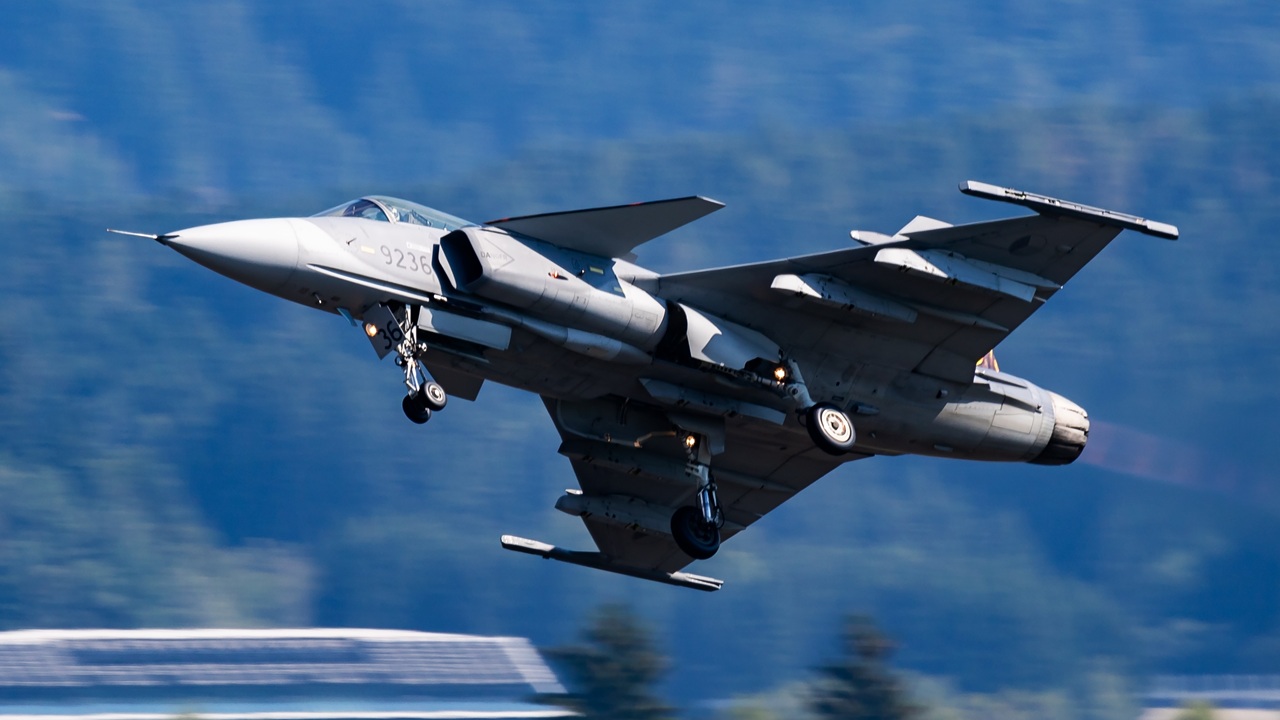
Trump’s recent spat with Colombia may have contributed to Bogota’s decision to buy the JAS 39 Gripen fighter jet from Sweden—beating out the American F-16.
Last week, President Donald Trump lavished praise on Saudi Arabia’s Crown Prince Mohammed bin Salman (MBS) during his visit to the White House. The president defended the de facto Saudi ruler when pressed on the 2018 murder of Washington Post columnist Jamal Khashoggi, a murder that the CIA concluded at the time that MBS had personally ordered. The White House also agreed to sell nearly $142 billion in arms to the Middle Eastern nation, including the Lockheed Martin F-35 Lightning II stealth fighter. It is a follow-up to an even larger deal announced in May.
However, Trump’s criticism of a key South American ally contributed to another deal falling through.
Also last week, Colombia’s President Gustavo Petro, who last month Trump called a “thug and bad guy,” announced that his nation would adopt the Swedish-made Saab JAS-39 Gripen over the American-made F-16 Fighting Falcon.
The announcement caused Saab’s shares to soar by 7.9 percent on Monday, reflecting the strong market reaction to the deal. Shares of Saab have more than doubled in the past year, The Wall Street Journal noted.
The JAS 39 Gripen’s Specifications
- Year Introduced: 1996
- Number Built: ~300
- Length: 14.9 m (48 ft 11 in) JAS 39C/E / 15.6 m (51 ft) JAS 39D/F
- Wingspan: ~8.4 m (27 ft 6 in)
- Weight (MTOW): 14,000 kg (30,865 lb)
- Engines: One GE F414G afterburning turbofan (E/F variants)
- Top Speed: 2,100 km/h (1,300 mph) / Mach 2
- Range: 800 km (500 mi, 430 nmi)
- Service Ceiling: 15,240 m (50,000 ft)
- Loadout: 27 mm Mauser BK-27 cannon (omitted on the two-seat variants), including air-to-air missiles such as the AIM-9 Sidewinder, air-to-ground missiles such as the AGM-65 Maverick, and anti-ship missiles such as the RBS-15
- Aircrew: 1–2, depending on variant
How Colombia’s Gripen Deal Fell into Place
According to Saab, the deal will include 15 Gripen E single-seat combat aircraft and 2 Gripen F twin-seat fighter/trainers, along with spare parts, training, and services, as well as undisclosed ordnance for the aircraft. Saab will further partner with Bogotá on several programs in aeronautics, cybersecurity, health, sustainable energy, and water purification.
“I am honored that Colombia has chosen Gripen E/F to enhance its air defence capabilities and delighted to welcome Colombia into the Gripen family,” said Micael Johansson, President and CEO of Saab. “This marks the beginning of a strong and long-term partnership that will strengthen Colombia’s defence and security, benefit its people, and boost the nation’s innovation power.”
Colombia is now the latest Latin American nation to adopt the Gripen, following Brazil, which selected the Swedish-made fighter more than a decade ago. The aircraft, designated the F-39E Gripen, entered service with the Brazilian Air Force (FAB) at Wing 2 in Anápolis in December 2022.
Until this fall, it wasn’t clear if Bogotá would select the Saab JAS 39 over the F-16 Fighting Falcon and the French-made Dassault Rafale to replace its aging fleet of Israeli-made Kfir fighters. Odds may have favored the Gripen.
Interest in the Rafale from the Middle East and India has led to a significant backlog at Dassault, which is struggling to meet its scheduled deliveries. Similarly, Lockheed Martin has faced backorders for the Block 70/72 models for international clients while modernizing existing fleets for other nations.
Saab has fewer orders of record for the Gripen, meaning that Colombia could get the fighter sooner as a result.
Those factors could also push another South American nation, namely Peru, towards the JAS 39 Gripen E. Moreover, Peru has a limited military budget, making the F-16’s high operating costs an issue. The Dassault Rafale has similar costs.
Yet Colombia may no longer see the US as a trusted ally and has opted to give its business to Sweden.
About the Author: Peter Suciu
Peter Suciu has contributed over 3,200 published pieces to more than four dozen magazines and websites over a 30-year career in journalism. He regularly writes about military hardware, firearms history, cybersecurity, politics, and international affairs. Peter is also a contributing writer for Forbes and Clearance Jobs. He is based in Michigan. You can follow him on Twitter: @PeterSuciu. You can email the author: [email protected].
Image: Shutterstock / Soos Jozsef.