Japan has picked a fight with China on the assumption that the United States would back it up. In the Trump era, this may have been an unwise bet.
Tokyo’s new government appears intent on starting a major conflict in the Indo-Pacific—at a time when neither they nor their American allies can afford such a war. This time, the conflict is over Taiwan. Rather, the United States, having lost the Global War on Terror and about to lose the proxy war it provoked with Russia, is readying to pick another losing proxy war between Japan (and Taiwan) and China.
To be clear: the People’s Republic of China is an adversary nation. But the way to challenge and beat the Chinese on the global stage is not via the military domain. It is in the realm of geoeconomics. The United States and its regional allies must use their considerable economic tools to craft competitive strategies—such as leverage trade, investment, and other financial activities—to create positive conditions for their overall geopolitical objectives.
Alas, the West has abandoned economic statecraft in favor of brute force. Just as the Soviet Union ultimately did. And, like the USSR before it, the United States will lose any such fight (proxy or otherwise) against China, just as it is losing to Russia in Ukraine.
Washington’s New Proxy War Fantasy in Asia
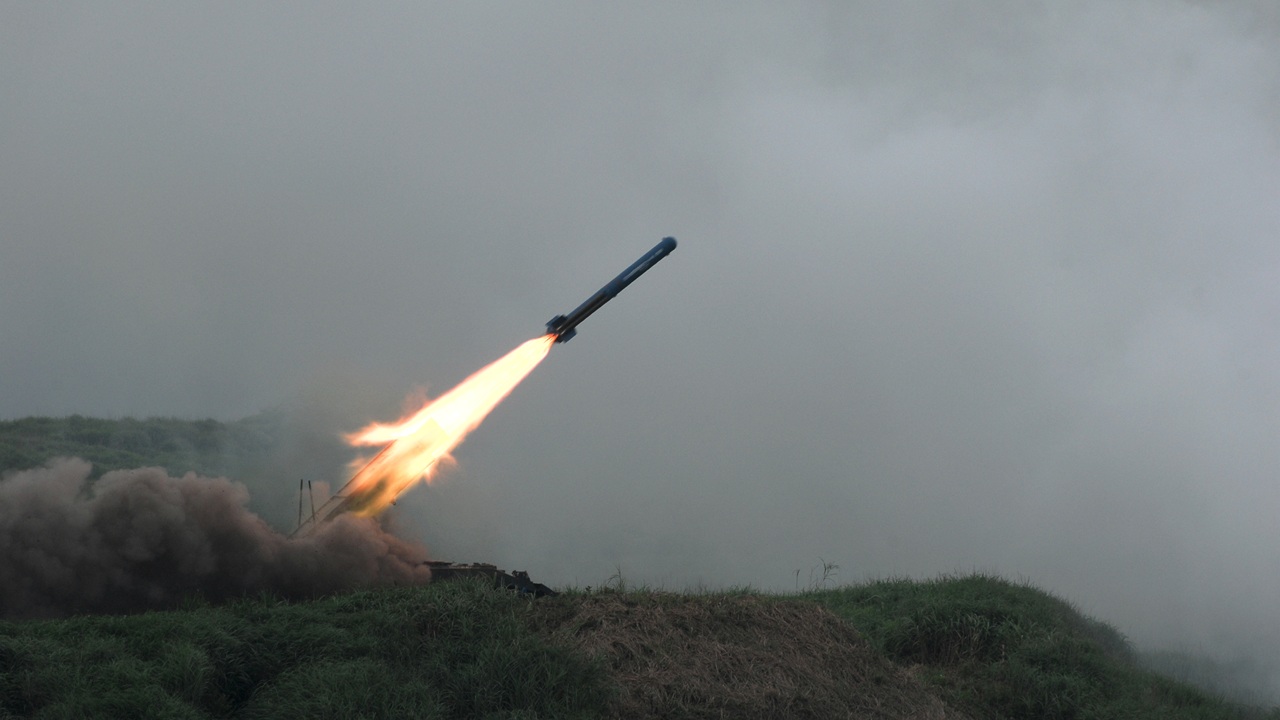
Japan’s Ministry of Defense confirmed recent reports that claimed Tokyo intended to deploy a medium-range surface-to-air missile unit on the island of Yonaguni, which lies around 68 miles from the coast of Taiwan.
That’s because it is assumed (and likely true) that, if China attacks Taiwan, their ultimate objective would be to use Taiwan as a place from where they can ultimately strangle Japan more fully—and assert overall dominance over what’s known as the “First Island Chain.”
It is part of a larger Japanese mission of bolstering their southwestern defenses (including along the Okinawa-region islands) amidst what is rightly perceived as rising Chinese military pressure in the region. The system appears to involve the Type 03 Chū-Surface-to-Air Missile (SAM) system and similar systems oriented toward air defense (AD) rather than outward strike.
Nevertheless, Beijing views it as a provocative act and part of a larger movement by the Americans and their regional allies to further squeeze Beijing at a time when China’s economy is ailing and its political system may be in flux.
Beijing’s view is likely accurate in this matter—especially considering how bad the West looks after having essentially lost the Global War on Terror, being pushed out of the Middle East (while being made to play nice with the Islamists who attacked them on 9/11), and having essentially lost Ukraine.
America and its proxies need what they think is both a win—and a nice distraction from the string of strategic failures they have experienced in recent months.
Japan’s Missile Gamble on Yonaguni
Yonaguni is Japan’s westernmost major inhabited island, and its proximity to Taiwan likely means any conflict over Taiwan will have serious implications for cross-Tawian Strait dynamics. Japan is understandably framing the deployment as defensive. According to Tokyo they’re merely protecting their own territory and thereby contributing to stability in a potential Taiwan Strait contingency.
Yet, escalation risks abound at a time when no Western power can afford a major war (let alone most of the people in the West not wanting a major conflict at this time). China strongly objects, labeling the deployment as “extremely dangerous,” and accusing Japan of provoking military confrontation. Of course, it should be noted that China has had no problem rattling its saber at Taiwan and Japan in recent months.
This move by Japan could provoke a devastating conflict. The very conflict that Japan and its allies believe are deterring. As for Taiwan, the people on the island are deeply divided (as are the Japanese themselves) by these moves.
After all, Taiwan is keenly aware that such a move by Japan is so provocative it might prompt China into a “use-it-or-lose-it” mentality precipitating a war that will utterly devastate democratic Taiwan and significantly damage Japan.
Japan’s Miscalculation Could Ignite the Indo-Pacific
While Japan likely does believe its actions are justified in the face of growing Chinese brinkmanship in the region. Tokyo must take care not to fall into the false belief that Ukraine has fallen into—mainly that, because it is a close ally of the United States, it can rely upon the Americans to do exactly as it wants.
In fact, such miscalculations on the part of Tokyo’s gung-ho leaders could lead to the very breakdown of the current regional order they are so desperately trying to avoid.
About the Author: Brandon J. Weichert
Brandon J. Weichert is a senior national security editor at The National Interest. Recently, Weichert became the host of The National Security Hour on America Outloud News and iHeartRadio, where he discusses national security policy every Wednesday at 8pm Eastern. Weichert hosts a companion book talk series on Rumble entitled “National Security Talk.” He is also a contributor at Popular Mechanics and has consulted regularly with various government institutions and private organizations on geopolitical issues. Weichert’s writings have appeared in multiple publications, including The Washington Times, National Review, The American Spectator, MSN, and the Asia Times. His books include Winning Space: How America Remains a Superpower, Biohacked: China’s Race to Control Life, and The Shadow War: Iran’s Quest for Supremacy. His newest book, A Disaster of Our Own Making: How the West Lost Ukraine is available for purchase wherever books are sold. He can be followed via Twitter @WeTheBrandon.
Image: Shutterstock / viper-zero.