Rene Descartes, a skeptic who sought a new method by which to know all that is humanly possible to know, was at the same time a devout Catholic. In fact, through his logical deductions, he came to justify his original belief in “a supreme God, eternal, infinite, immutable, omniscient, omnipotent, and the creator of all things.” As more of an experimentalist, Blaise Pascal disagreed with Descartes on much, but regarding his utter faith in and piety toward God, he agreed.
These seventeenth-century scientists maintained a piety toward the Creator as the basis for their scientific and mathematical ruminations. This basis followed the same course that the sixteenth-century Roman Catholic philosopher Michel de Montaigne charted—that humans reach a limit in their knowledge beyond which only faith can satisfy the yearning to know. This was the view of the Medieval Nominalists, and most Medieval and Renaissance religious philosophers as well.
Movements Away from Piety
In the seventeenth century, however, European science was overturning the old prejudices of the Medieval worldview and the erroneous conclusions of the ancient world. It was steering toward the direction of our own twenty-first century worldview, where science is supreme.
The “victory of science over religion” was a step-by-step movement, starting five hundred years ago with Copernicus and Galileo. Descartes is usually considered one of these steps because of his skepticism, his method of doubting all traditions and starting over from scratch. At the same time, in England, Francis Bacon was declaring independence from ancient and medieval science, thus ushering in the new age of empiricism.
Descartes’ Meditations
Descartes was not sure what to believe, what was real, what was true. He was a doubter, a questioner, a skeptic. He was one of those who refuse to believe something just because it was taught to him. He needed absolute proof before he would commit himself to a system of thought. In his quest for knowledge and truth, he decided to reduce his search to whatever he could know for certain, without any doubt.
In Meditations on First Philosophy, Descartes follows the pattern that Montaigne had established fifty years before: doubting all to reach a fundamental awareness of a simple truth—that of the self. One can doubt everything but the self, because one has self-awareness and can recognize one’s body, one’s thoughts, one’s very being.
The beginning of Descartes’ philosophy was that of a simple premise, that of existence. Existence can be known through understanding and thought, which involves doubting, willing, apprehending, and imagining.
Descartes uses wax as a metaphor, which by heating and cooling can be molded and shaped in countless ways that could confuse the senses but not the mind. The mind ultimately understands that all the shapes of wax (and all of the various phenomena of existence) might fool our eyes and sense of touch, but not our mind, which knows that wax is wax.
A human is a human, and though I might dream one way and fantasize another, at rock bottom, I am aware of reality, my existence. And if I know my existence, perhaps I know Existence itself…
I Think, Therefore I Am
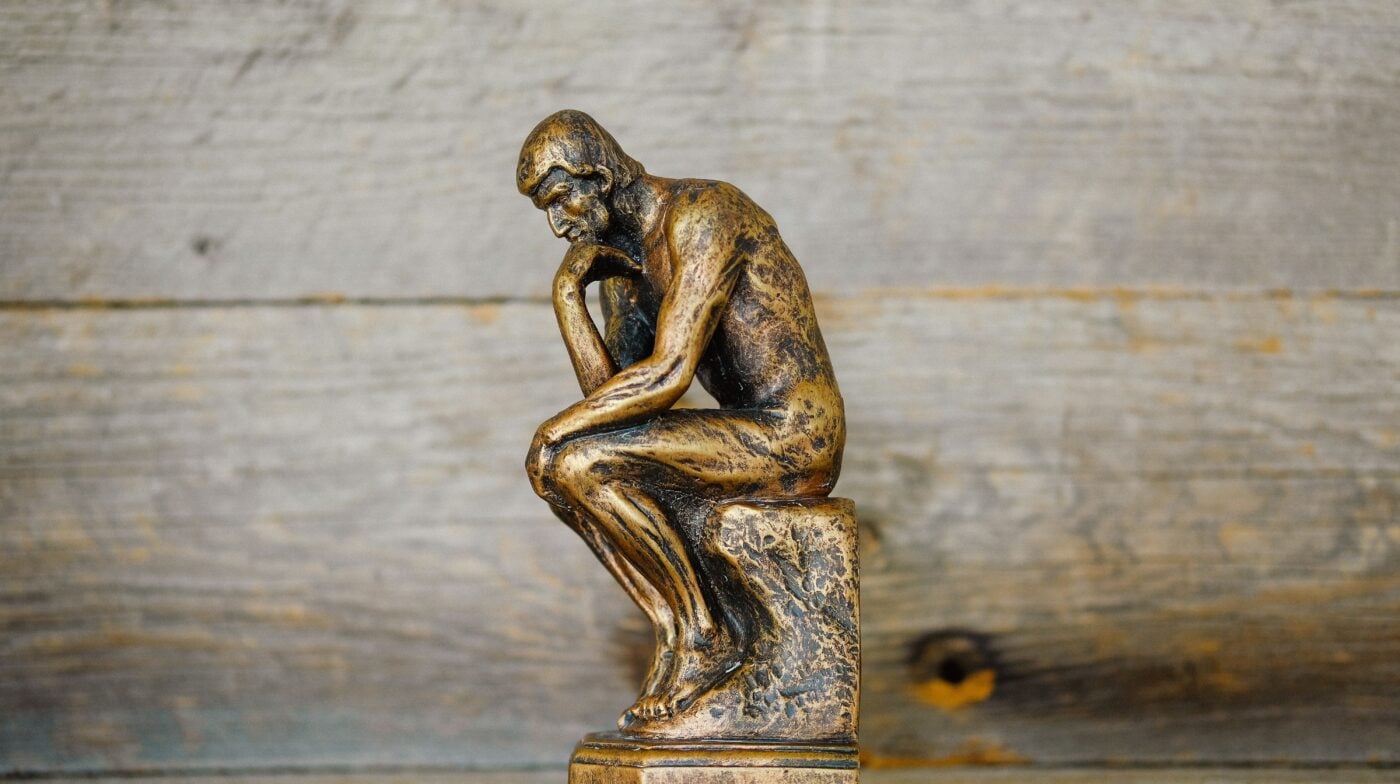
“I think, therefore I am.” Consider this proclamation. There are two things that we all share, two things of which we are certain. We are thinkers. We exist. What does it mean, to think? Descartes wrote:
What then is it that I am? A thinking thing. What is a thinking thing? It is a thing that doubts, understands, affirms, denies, wills, abstains from willing, that also can be aware of images and sensations.
As a thinker, he was able to consider, to conceptualize, to analyze, to objectify, to observe, to seek, to question, to answer. To think, to be aware of existence, is to consider time, to reflect upon the past, to anticipate the future, to be aware of action in the present. Thinkers continually examine what is outside themselves according to what is on the inside, that is, they judge the “other” according to the “self.”
The Great “I Am”
When Moses climbed Mt. Sinai, God introduced Himself as “I am that I am.” When the Jews doubted Jesus, Jesus responded, “before Abraham was, I am.” When Descartes reached the ultimate limit of his doubt, he understood intuitively that because he thinks “therefore I am.”
God proclaimed His existence, Jesus proclaimed His existence, and Descartes proclaimed his existence. In a sense, they are the same—existence is a fundamental awareness of being, and if a person can sense that awesome sense of being, which is connected to all Being, then that person senses God. This is what Descartes argued.
Thinking allows us to approximate who we are, where we came from, and where we are going. Thinking allows us to transcend the moment, to consider not just the present but the past and the future as well. Thinking gives us the ability to begin to see what is transcendent, what is divine, within us.
Pascal’s Thoughts
A near contemporary of Descartes was Blaise Pascal, famous not only as a diverse and creative mathematician and empirical scientist, but also for his book, Thoughts.
Pascal was a true pious scientist, able to see that his wonderings and approximations about nature next to God are but work close to nothing. “What is human next to God, the infinite?” he asked. Nothing. Yet, he thought, if a human contrasts him/herself with an amoeba, then the amoeba appears to be Nothing, and Human appears to be All.
For in fact what is man in nature? A Nothing in comparison with the Infinite, and All in comparison with the Nothing, a mean between nothing and everything. Since he is infinitely removed from comprehending the extremes, the end of things and their beginning are hopelessly hidden from him in an impenetrable secret.
He wrote further: “All things proceed from the Nothing, and are borne towards the Infinite. Who will follow these marvelous processes? The Author of these wonders understands them. None others can do so.” Science, Pascal argued, is unable to approach the Infinite. It never will be able to.
Pascal, who lived a comparatively short life of illness, faced death with open eyes. Life astonished him because he could not quite understand the ins and outs of how he came about from the Nothing, and how he was related to the Infinite. “It is incomprehensible that God should exist,” he wrote, “and it is incomprehensible that He should not exist.”
Love and Piety
Pascal was a thinking thing, but he knew his limits.
Descartes also put aside all of the great proclamations of others to wonder what he might know as a thinker.
Montaigne simply asked, “What can I know?”
Thinkers are able to break from the concern of only satisfying their own needs; they are able to break from selfishness; they are able to reach out to others, to learn from them, to understand them. Thinkers can consider the foreign without fear. Thinkers can break from fear of the unknown, to start to make it known.
As the Apostle John said in his first epistle, “love knows no fear.” In short, the more one thinks, the more one loves.
Science today is uncomfortable with piety, because piety is, in short, love. Simple love for God. And what can the great scientific institutions of today, as they approach the secrets of the brain, the intricacies of the origins of life and the universe, the most minute particles that make up all things, the dark holes of the universe and the human mind, do with such a thing as love?
Editor’s Note: Read the previous installments of The Pious Scientist series here.
Photo by Kenny Eliason on Unsplash