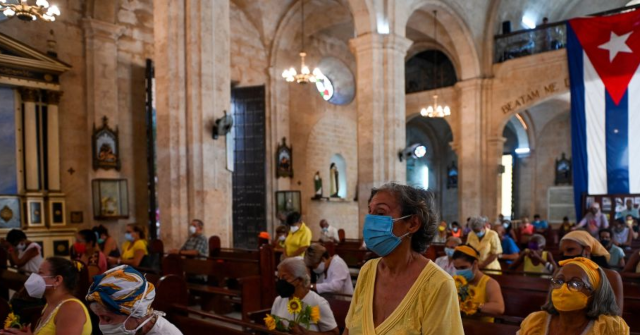
The U.S.-based Cuban news outlet Martí Noticias reported on Thursday that the Communist Party on the island has ordered the expulsion of Father José Ramírez, a priest stationed in Havana who rang the bells of his church on Monday in solidarity with protesters who had taken to the streets that night.
Cuba has seen nearly incessant waves of protest throughout the last decade, escalating significantly following the massive nationwide anti-communist protest on July 11, 2021 and subsequent violent crackdown on suspected dissidents. In addition to political opposition to the regime, these protests have been exacerbated by the Communist Party’s failure to address major infrastructure failures in the country, including the near-complete collapse of the power grid and the looming threat of crumbling buildings crushing and killing people, particularly in the capital.
Between Monday night and Tuesday morning, large numbers of residents of Havana took to the streets to protest yet another wave of blackouts in the capital, shouting “freedom!” and “down with communism!” While the Castro regime has traditionally attempted to keep Havana in serviceable shape to sustain its lucrative tourism industry, the collapse of the power grid has in past months proven too catastrophic to insulate the capital.
Among the protests that night, eyewitnesses filmed a church in the capital ringing its bells loudly, apparently in support of those calling for an end to the regime.
Martí Noticias reporter Mario Pentón reported on Thursday that the Communist Party appears to have identified the priest responsible and is ordering his expulsion from the country. According to unnamed sources apparently tied to the Catholic Church, the priest was identified as Father José Ramírez. Given his Mexican nationality, the Communist Party can withdraw its authorization for him to be in Cuba at any given time and has taken action to do so. The sources confirmed that Ramírez was intending to send a message in “in solidarity with the people after over 12 hours without electricity” and relayed that the Communist Party’s state security thugs personally intimidated Ramírez in addition to the bureaucracy ordering him out.
“Although the official Caridad Diego, the head of the Office of Religious Affairs of the Central Committee [of the Communist Party], avoided speaking openly of expulsion,” the report shared, “she did leave clear that the residency status of the priest will not be renewed, which implies his obligatory exit from the country once his documentation expires.”
The report claimed that overtly expelling the priest for supporting the Cuban people “would be a scandal” that could potentially fuel more social unrest.
The Cuban communist regime has a long history of Christian persecution tied to the Catholic Church and other Christian groups actively resisting the brutality of communism. Catholic priests — alongside members of the Jehovah’s Witnesses, Seventh-Day Adventists, and other nominal Christian groups — were notoriously imprisoned in Cuba’s “Military Units to Aid Production” (UMAPs), which are labor camps intended to enslave and kill social “undesirables” including artists, suspects gay people, and political dissidents. Fidel Castro moved rapidly to expel as many priests and nuns from Cuba as possible following the coup that led to his regime taking power in 1959, shutting down Catholic churches and religious institutions that did not allow themselves to be used for communist propaganda.
Castro regime efforts to silence Christian opposition have failed, however, and priests and nuns remain a prominent part of the anti-communist movement. Notably, during the July 11 protests, authorities “disappeared” a priest, Father Castor José Álvarez Devesa, who had walked alongside the protesters. He resurfaced days later with a prominent head injury and accused regime thugs of beating him in an attempt to silence opposition.
In 2024, Father Álvarez explained in an interview that he felt compelled to protest and “that resulted in them beating me, injuring me, detaining me at night in a jail cell, then they put a cautionary measure on me prohibiting my exit from the country — in addition [I needed] permission to leave the municipality and [could] leave the house only when necessary.”
“I think it is very important to help people understand that the Gospel of Christ can help deliver us from evil also in the fatherland, in society, in the country, in politics, and that influences, if we follow Christ, in a better economy, in the family, in all aspects of society,” he advised. Father Álvarez also continued to openly identify himself as an opponent of communism.
Speaking to Breitbart News in 2022, David Curry, the then-leader of the humanitarian Christian organization Open Doors, described a rapid increase in violent Christian persecution in Cuba following the July 11 protests.
“What you see is that there’s some sense of alignment between pastors and priests around individual freedoms and things which would challenge the ideology of the communist regime of Cuba,” Curry explained. “They would like to see them sort of stay out of these discussions and let the government do what they want. I think all of these dictators have a similar belief around that.”
“So they’re beginning to say ‘Look, if you’re going to speak out against the cruelties of the government, we are going to crack down on you and make it difficult for you to get registered officially,’” he added, “and those that are registered of course they have to toe the line. So that’s the game, a very dangerous game that’s being played in Cuba against the pastors and priests of that area.”
Follow Frances Martel on Facebook and Twitter.