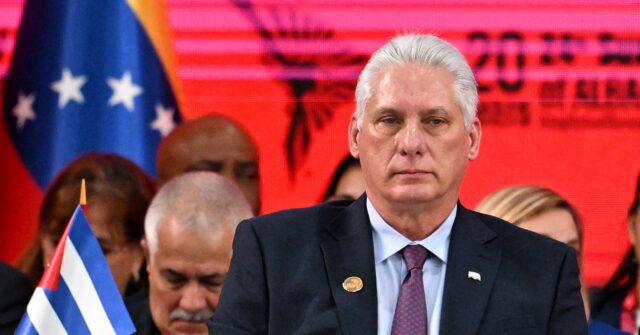
Miguel Díaz-Canel, the communist figurehead “president” of Cuba, admitted on Friday morning officials from the Castro regime have engaged in “sensible” talks with U.S government representatives
The talks, which Díaz-Canel did not disclose any specifics about, are allegedly aimed at “finding solutions through dialogue to the bilateral differences between our two nations.” Díaz-Canel did not reveal the names of the Cuban officials representing the regime at the talks.
Cuba is presently engulfed in a critical situation marked by abject misery, caused by the continued collapse of the island-nation as a result of 67 years of disastrous communist rule. The rogue communist regime has found itself in an extremely complex situation after it abruptly lost access to the virtually free oil that it received from socialist Venezuela following President Donald Trump’s decision to arrest Nicolás Maduro during a law enforcement operation in Caracas on January 3.
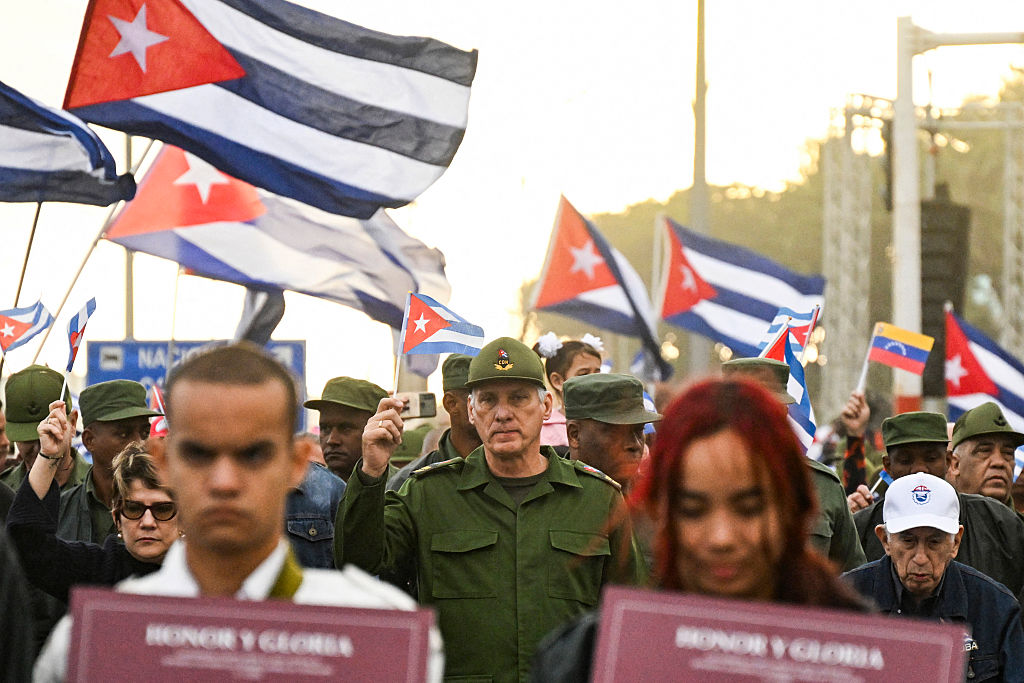
Cuba’s President Miguel Diaz-Canel (C) takes part in the “Anti-Imperialist” protest in front of the US Embassy against the US incursion in Venezuela, where 32 Cuban soldiers lost their lives, in Havana on January 16, 2026. (YAMIL LAGE / POOL / AFP via Getty Images)
For years, the Cuban regime largely relied on the Venezuelan oil lifeline to keep its ailing authoritarian regime afloat. Much like his predecessor, Hugo Chávez, Nicolás Maduro played a key role in sustaining his Cuban ideological mentors with constant shipments of oil in return for security and several other forms of assistance for his authoritarian regime.
President Trump has repeated over the past weeks that his administration has engaged in contact with Cuban officials as the crisis in Cuba worsened.
“The Cuban Government is talking with us. They’re in a big deal of trouble, as you know. They have no money; they have no anything right now, but they’re talking with us, and maybe we’ll have a friendly takeover of Cuba. We could very well end up having a friendly takeover of Cuba,” President Trump told reporters on late February.
The Cuban regime, however, had abstained from confirming the talks until Friday morning when Díaz-Canel, in a state television broadcast alongside other top ranking members of the regime, acknowledged that such talks have taken place between Cuba and the United States.
“In line with the consistent policy of the Cuban Revolution throughout its history, and guided by the Army General as the historic leader of our Revolution and by myself, and in coordination with the highest structures of the Party, State, and Government, Cuban officials have recently held talks with representatives of the Government of the United States,” Díaz-Canel said.
“These conversations have been aimed at seeking solutions, through dialogue, to bilateral differences that exist between the two nations. There are international factors that have facilitated these exchanges,” he continued.
Díaz-Canel did not address the worsening poverty situation in Cuba caused by the communist regime during his address, instead asserting that the purpose of the U.S.-Cuba talks is to “identify bilateral issues” that require solutions based on their “seriousness and impact,” as well as to “find solutions” to identified problems.
“Furthermore, the objective is to determine the willingness of both parties to undertake concrete actions for the benefit of the peoples of both countries,” Díaz-Canel said.
Additionally, the “figurehead” president claimed that the talks intend to identify areas of cooperation to “address threats” and ensure peace and security of both nations and the Latin American and Caribbean. Cuba is a U.S.-state sponsor of terror due to the Cuban regime’s decades-old support of international terrorism organizations. President Trump signed an executive order this year addressing the national security threats posed by the Cuban regime.
Díaz-Canel asserted that it is not customary for the Cuban communist regime to respond to “speculative campaigns,” an apparent reference to recent reports claiming that Cuban officials were in talks with the U.S. government. He emphasized that the ongoing talks are part of a “very sensitive process” that is being carried out with “seriousness and responsibility” and requires effort to find solutions and “create spaces for understanding that allow us to move away from confrontation.”
“During the exchanges that have taken place, the Cuban side has expressed its willingness to carry out this process on the basis of equality and respect for the political systems of both States, as well as for the sovereignty and self-determination of our Government,” Díaz-Canel said. “This has been stated taking into account a sense of reciprocity and adherence to international law.”
The White House has not publicly commented on Díaz-Canel’s announcement at press time.
RELATED — MARCO VS. CUBA?! Trump Hints at Huge News
President Trump addressed Cuba’s dramatic situation during his speech at the Shield of the Americas Summit in Florida last week and said that a “great change” would be soon coming to the country. President Trump also informed that the Cuban regime was in talks with Secretary of State Marco Rubio and emphasized that Cuba is “in its last moments of life, as it was.”
“As we achieve a historic transformation in Venezuela, we’re also looking forward to the great change that will soon be coming to Cuba,” President Trump said. “Cuba’s, at the end of the line. They’re very much at the end of the line. They have no money, they have no oil. They have a bad philosophy. They have a bad regime that’s been bad for a long time.”
A coalition of Cuban anti-communist organizations and members of its diaspora gathered this month to sign the “Agreement for the Liberation of Cuba,” a document with guidelines towards the establishment of a transition government for the country after 67 years of communism.
Christian K. Caruzo is a Venezuelan writer and documents life under socialism. You can follow him on Twitter here.