The Venezuelan Navy is designed for coastal defense and anti-smuggling operations—and would lose any full-scale fight against the US Navy in minutes.
As US warships congregate in the Caribbean, the Venezuelan military capabilities are being afforded extra scrutiny, the country’s relatively small navy included. The Bolivarian Navy of Venezuela is humble compared to the United States’, midsized by regional standards, and focused almost entirely on coastal defense and counter-smuggling operations—not blue-water global operations or open warfare against a major world power. The fleet has long suffered from underfunding, maintenance shortfalls, sanctions, and aging platforms. Still, despite its myriad shortcomings, the Venezuelan navy is a key part of the country’s regime preservation.
The Sorry State of the Venezuelan Navy
The Venezuelan Navy’s inventory is relatively modest.
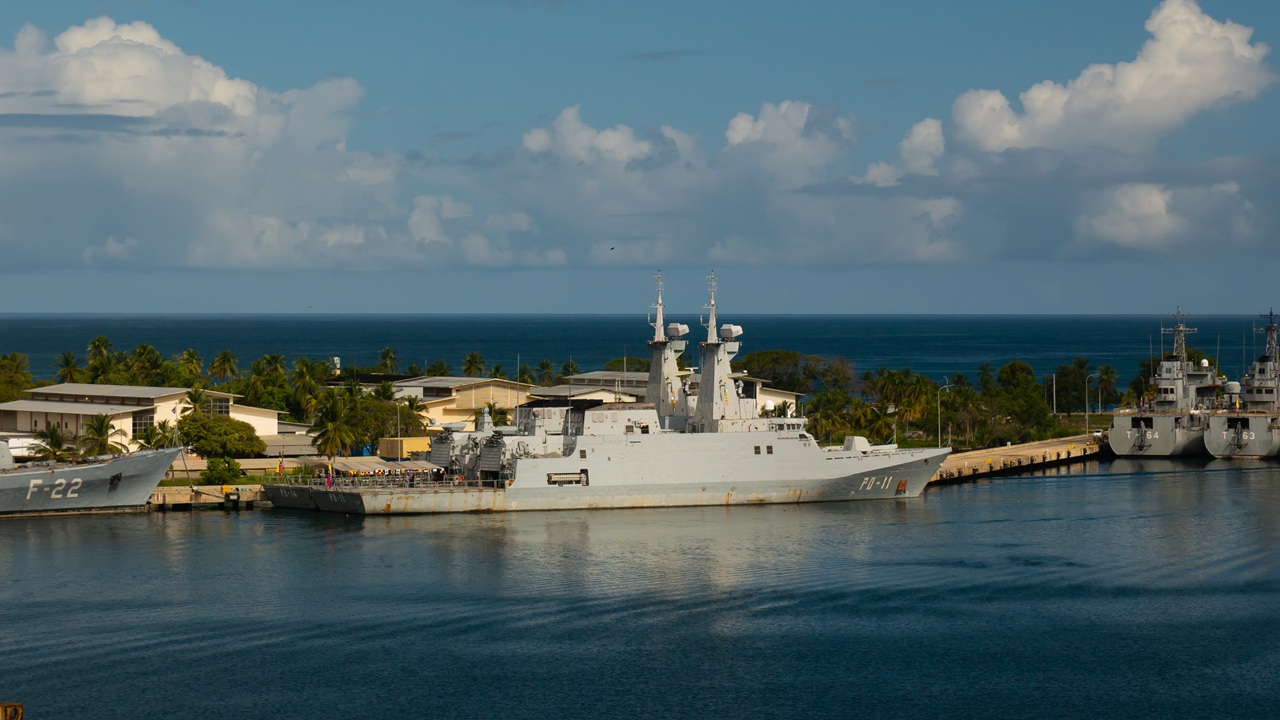
- The Lupo-class frigate is the Venezuelan Navy’s hallmark, despite being severely degraded. Procured from Italy in the 1980s, only one Venezuelan frigate is thought to remain in service. With a displacement of 2,500 tons, the frigate is armed with Otomat anti-ship missiles, 127-mm guns, torpedoes, and an ASW system.
- Venezuela also makes frequent use of their eight Gavilan– and Guaicamacuto-class Offshore Patrol Vessels (POVs). Built in Spain and delivered in the 2010s, the POVs are used for EEZ patrol, anti-smuggling, and the interception of illegal fishing.
- Two German-made Sabalo-class submarines, acquired in the mid-1970s, are still allegedly in service. One of the two vessels has reportedly been nonfunctional for years, meaning operational readiness is a pressing question. Regardless, the platform has limited ASW capability due to neglected maintenance.
- Venezuela also operates around a dozen Landing Ship Tank (LST) type vessels, mostly for logistics and marine infantry movement within territorial waters. It uses small boats are used for littoral patrol, counter-drug operations, and oil infrastructure security. These small boats are key for day-to-day enforcement.
- Last, the Venezuelan navy also has a limited flight-ready inventory of ASW helicopters, like the AB-212. Operationally, these helicopters offer very little, maybe some light SAR and utility work.
What Is the Venezuelan Navy Good For?
Venezuela uses their naval inventory for a variety of regional applications. The primary mission is to enforce territorial claims, monitor illegal fishing, and intercept illegal smugglers. Naturally, the navy is also used for regime protection—particularly securing ports used for oil exports, which are paramount to the regime’s economic survival. The navy can also support internal security by interdicting illicit maritime traffic. The navy is not blue-water capable, and, with no meaningful expeditionary capability, is limited strictly to regional posturing.
Strategically, Venezuela has a defensive navy without either the missile systems, sensors, or ships required for sustained naval combat, or for the projection of power beyond the immediate coastline. Dependence on aging platforms—submarines and frigates that are decades old—signals a serious readiness issue. Sanctions, blocking access to Western spares, only exacerbates the readiness issue. And domestic shipyards have limited ability to maintain complex combat-ready equipment.
Furthermore, the navy is inherently placed in a defensive posture due to the acute vulnerability of Venezuela’s offshore oil platforms and tankers. These are the country’s economic lifeline and the navy prioritizes their protection accordingly.
With the US amassing nearby, many wonder how the Venezuelan navy would match against the US Navy. The short answer is: it wouldn’t. The US Navy is a global blue-water superpower, while Venezuela’s is a coastal defender. Any confrontation between the two would be overwhelmingly one-sided. The US holds superiority in every meaningful category and would dominate in any form of conflict.
About the Author: Harrison Kass
Harrison Kass is a senior defense and national security writer at The National Interest. Kass is an attorney and former political candidate who joined the US Air Force as a pilot trainee before being medically discharged. He focuses on military strategy, aerospace, and global security affairs. He holds a JD from the University of Oregon and a master’s in Global Journalism and International Relations from NYU.
Image: Shutterstock / Maritime Art Blog.