Russia has heaped praise on its new S-500 missile system, but it is still unclear if it can actually build the systems in meaningful numbers.
Boasting about military capabilities is something that every nation has done for eons. It is meant to create a mystique to deter adversaries, and no country has done it better in the modern era than Russia. The actual capabilities haven’t always lived up to the claims.
The Sukhoi Su-57 (NATO reporting name “Felon”) is one example—an aircraft that can dazzle crowds at air shows yet has largely been absent in the ongoing war in Ukraine. Similarly, Russia’s T-14 Armata main battle tank (MBT) has been hyped up as the greatest armored vehicle ever to enter service—but fewer than two dozen have ever rolled off the assembly line, and none of those have been put into action, either.
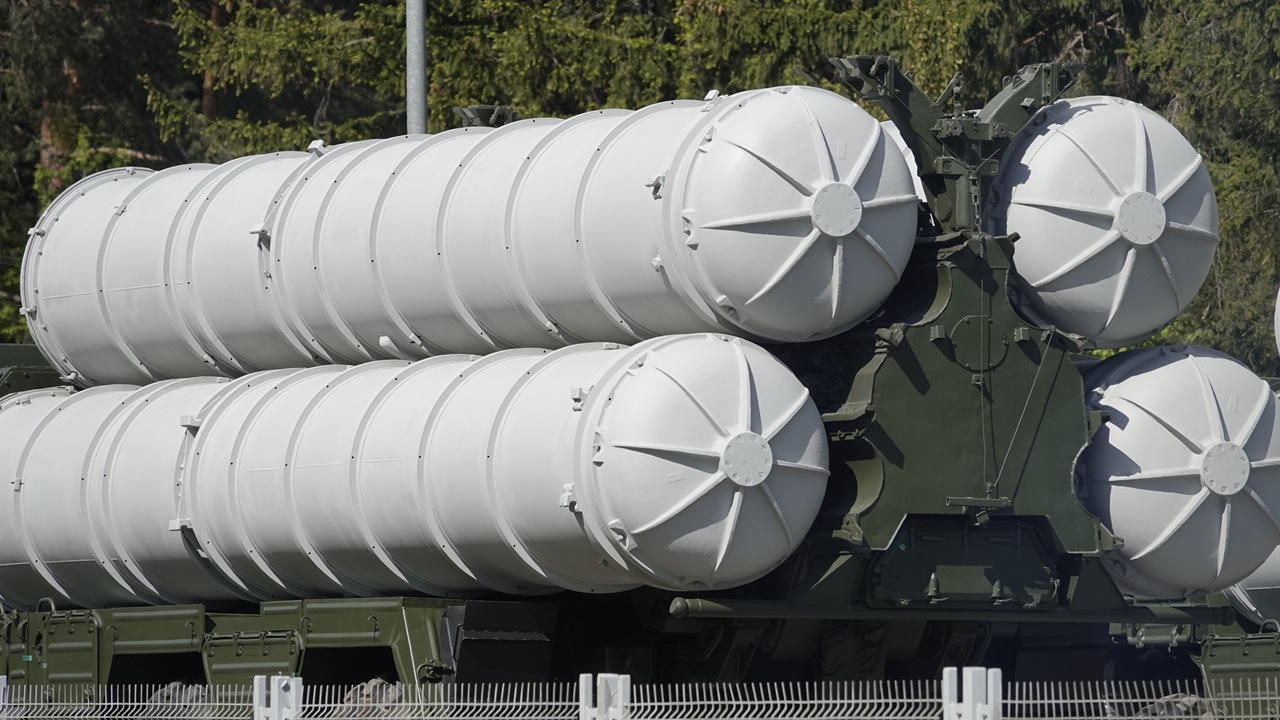
Another platform that has received adulation within Russia is the S-500 Prometheus air defense system—the successor to its S-400 Triumf, with a name so grandiose that one should expect it to possess technology and attributes that rival the Titans of ancient Greek mythology.
What Russia Wants You to Know About the S-500 Prometheus
In characteristic Russian fashion, the capabilities of the S-500 were hyped this month by Alexander Mikhailov, head of the Bureau of Military-Political Analysis.
“Our potential adversaries simply do not possess systems with the long-range missile capabilities of the S-500,” Mikhailov told state news agency TASS. “While they have long-range systems designed to intercept various offensive weapons, the specific characteristics of the Prometheus remain unrivaled by our closest competitors.”
Mikhailov also boasted that the Prometheus, named for the Greek Titan who gave fire, along with knowledge and civilization, to humanity, would be capable of intercepting NATO’s hypersonic missiles, including those still under development.
Beyond a missile interceptor, the Russian official claimed that the S-500 Prometheus could serve as a space defense system.
“It can detect targets up to 600 kilometers away and engage them with surface-to-air missiles at ranges reaching 500 kilometers. This includes not only ballistic missiles but also aerodynamic targets such as NATO’s supersonic aircraft, as well as various missile types. Notably, it can target medium-range missiles and low-orbit satellites involved in reconnaissance and communication,” Mikhailov added.
“With the deployment of the S-500, Russia has introduced a formidable new challenge to the American defense industry,” the official continued, suggesting it would put the US at a significant disadvantage.
It was also reported this month that the first regiment of the Russian Army’s air defense forces had been equipped with the S-500 system, but it is unclear how many batteries have been produced or deployed.
The Kremlin hasn’t released the full specifications of the S-500, but has acknowledged that the Prometheus could “fill a niche between military and strategic air defense and missile defense systems,” a second TASS report explained. “The new system will interact with medium-and long-range air defense systems,” including the S-300 and S-400 Triumf.
S-500 Prometheus vs. F-35 Lightning II: What Would Happen?
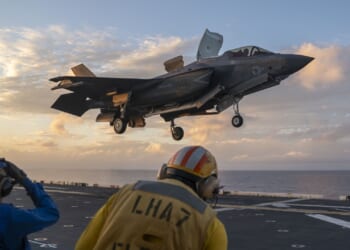
There have been repeated claims that the S-500, developed by Almaz-Antey, could track and target stealth aircraft, such as the Lockheed Martin F-35 Lightning II.
According to data from the Center for Strategic and International Studies, the S-500 can employ 40N6M long-range missiles to a range of up to approximately 400 km (250 miles), while 77N6 series interceptors can reach approximately 600 km (372 miles).
As with many Russian military systems, the S-500 Prometheus is likely highly capable, but whether it is as advanced as Moscow claims remains to be seen. There is no proof it can target the F-35 or other fifth-generation stealth fighters, and it is likely to be even less effective against sixth-generation systems, such as the Northrop Grumman B-21 Raider long-range bomber and the future Boeing F-47 fighter.
The final consideration regarding the overall effectiveness of the S-500 will be how many systems Almaz-Antey can actually produce. As with the Su-57 and T-14, even an advanced weapon is ineffective if only a handful are manufactured for frontline use—and there is no good information yet about Russia’s ability to churn out these impressive systems in meaningful numbers.
About the Author: Peter Suciu
Peter Suciu has contributed over 3,200 published pieces to more than four dozen magazines and websites over a 30-year career in journalism. He regularly writes about military hardware, firearms history, cybersecurity, politics, and international affairs. Peter is also a contributing writer for Forbes and Clearance Jobs. He is based in Michigan. You can follow him on Twitter: @PeterSuciu. You can email the author: [email protected].
Image: Shutterstock / VideoFromEveryWhere.