Though Japan has decommissioned its first Asagiri-class destroyer, the warship is far from antiquated—and could easily be transferred to an allied navy elsewhere in Asia.
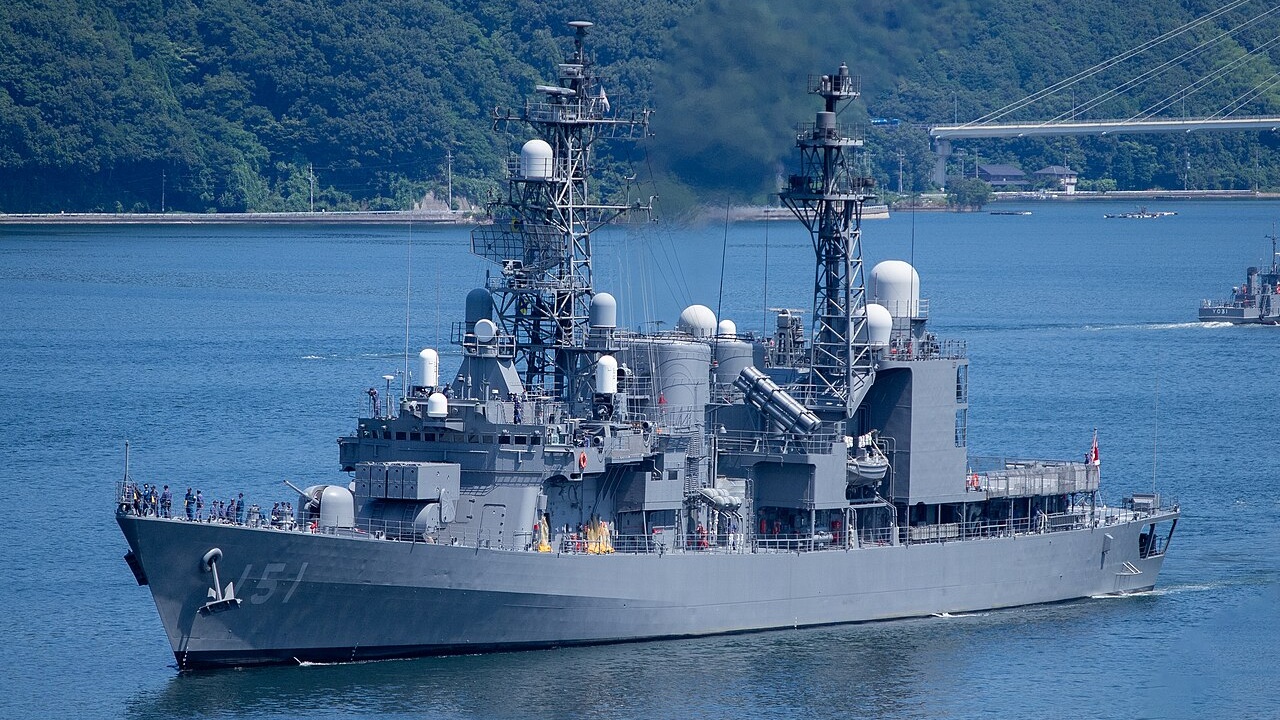
This month, the Japan Maritime Self-Defense Force (JMSDF) decommissioned the lead vessel of its Asagiri-class general-purpose destroyers. JS Asagiri (DD-151), commissioned in 1988 and previously used as a training ship before returning to front-line service, had been the oldest warship in service with the JMSDF. The destroyer was decommissioned at her home port of Maizuru, the Maizuru District headquarters.
About Japan’s Asagiri-Class Destroyers
- Year Introduced: 1988
- Number Built: 8 (6 in active service, 1 training ship, 1 decommissioned)
- Length: 137 m (449 ft 6 in)
- Beam (Width): 14.6 m (47 ft 11 in)
- Draft: 4.5 m (14 ft 9 in)
- Displacement: 3500 tons (standard) / 4900 tons (full load)
- Propulsion: COGAG (combined gas and gas) Four (4) x Kawasaki/Rolls-Royce Spey SM-1A gas turbines (54000 shp) 2 shafts / 2 controllable pitch propellers
- Speed: 30 knots (34.5 mph, 56 km/h)
- Range: 8000 nmi (9,200 mi, 14,800 km)
- Complement: 220
A total of eight warships were built for the JMSDF between 1986 and 1989 at the Ishikawajima‑Harima, Sumitomo, Mitsubishi, and Hitachi shipyards.
The second class of first-generation general-purpose destroyers designed and built for the JMSDF, the warships feature an enlarged hull based on that of the preceding Hatsuyuki-class. The Asagiri-class destroyers were designed primarily for defensive operations rather than offensive operations. The warships could be employed in anti-submarine warfare (ASW) and escort duties, protecting larger naval vessels and maintaining sea lines of communication.
The destroyers were armed with an eight‑cell Mk 112 anti-submarine rocket (ASROC) launcher, a Mk 29 launcher that could fire the Sea Sparrow surface‑to‑air missiles, and two four‑round Harpoon anti‑ship missile launchers. Additional armament included a 76mm Oto Melara main gun and two Platanx close-in weapon systems (CIWS). The warships were also outfitted with a flight deck hangar and carried a single SH-60J Seahawk ASW helicopter.
The JMSDF is replacing the aging destroyers with the small but more versatile Mogami-class frigates.
Japan Could Pass the Retiring Warship to the Philippines
Although the JS Asagiri has been decommissioned, it could still see additional service alongside the remaining destroyers of the class. Last summer, Japan explored transferring the warships to another power in the region, with the Philippine Navy “among the potential recipients of the vessels.”
Since reports first circulated, neither Tokyo nor Manila has commented on the matter, but as Zona-Militar reported, such a transfer “aligns with Japan’s increasingly proactive policy of strengthening military and defense cooperation with Southeast Asian countries, seen as a way to counter China’s growing expansion and influence in the region.”
The Philippines and China have overlapping claims to parts of the South China Sea and have seen several standoffs. Although the Asagiri-class has already been in service for nearly four decades, the warships could still increase Manila’s abilities to protect its littoral waters.
It was just over a year ago that the Asagiri-class destroyer JS Hamagiri (DD-155), accompanied by the Murasame-class destroyer JS Ariaka (DD-109), made a scheduled port visit to the Philippines.
Tokyo had previously considered transferring up to six Abukuma-class destroyers to the Philippines. It was “a clear signal of Tokyo’s intent to strengthen ties with Manila and other Southeast Asian navies,” Zona-Militar added.
About the Author: Peter Suciu
Peter Suciu has contributed to dozens of newspapers, magazines and websites over a 30-year career in journalism. He regularly writes about military hardware, firearms history, cybersecurity, politics, and international affairs. Peter is also a contributing writer for Forbes and Clearance Jobs. He is based in Michigan. You can follow him on Twitter: @PeterSuciu. You can email the author: [email protected].