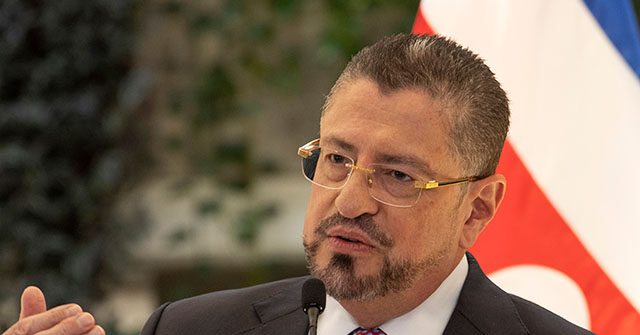
President of Costa Rica Rodrigo Chaves Robles announced on Wednesday that his country would cut all diplomatic ties to Cuba, shutting down its embassy in Havana and ordering all Cuban diplomats out of the country.
Chaves Robles, whose term is slated to end in May, explicitly stated that his opposition to socialism and communism – and an escalation in human rights abuses by the Cuban Communist Party at home – were the reason for his decision.
“We do not recognize the legitimacy of this government,” the president asserted on Wednesday. “We have to clean the hemisphere of communists. Simple as that.”
The decision follows a tense three months in Cuba, where the Communist Party lost a critical lifeline following the arrest of Venezuelan dictator Nicolás Maduro in January. The government of the United States arrested Maduro on January 3, along with wife Cilia Flores, in Caracas, executing a warrant on a litany of narco-terrorist charges. For over a decade, and beginning in the era of late dictator Hugo Chávez, Venezuela supplied Cuba with free or highly discounted oil, allowing the regime to maintain elite tourism resorts and hotels and sustain the lavish lifestyles of the Castro family while continuing to subjugate and impoverish the vast majority of the Cuban population. Following Maduro’s arrest, Venezuela stopped sending oil to Cuba, as did its leftist allies in Mexico, prompting a near-total collapse of the nation’s tourism industry, power grid, and material infrastructure.
In light of the routine blackouts and limited state security resources, Cubans have taken to the streets daily for over a week, in one case nearly burning down the Communist Party headquarters in Morón, Ciego de Ávila. Protesters have spray-painted anti-communist messages and carried signs reading “Viva Trump!” throughout the country, encouraging American intervention to end the 67-year-old regime.
Costa Rica’s incoming President-elect Laura Fernández Delgado, a conservative who won a landslide victory with Chaves Robles’s support, stated on Wednesday that she enthusiastically supports the new measures.
“It is a decision taken prioritizing the human dignity of the Cuban people,” Fernández Delgado said in an interview on Wednesday night. “Costa Rica is a nation that is global role model, we are lovers of liberty and of democracy; therefore, I was part of the decision taken to eliminate our embassy in Cuba and urge for the retirement of the one in our country.”
Fernández Delgado added that communist “destroys societies” and described the critical situation in Cuba as “an example for our country, for our youth, for our children, so that they see what the left – so that they see what a communist regime does to people.”
The Costa Rican Foreign Ministry explained the decision in more diplomatic terms, stating that San José was expressing “profound concern for the country [Cuba] over the sustained deterioration of the human rights situation on the island, as well as the increase in repressive acts against citizens, against activists and opposition members who legitimately exercise their rights to express themselves and participate in public life.”
Foreign Minister André Tinoco explained in comments on Wednesday that Costa Rica had already extracted all of its personnel from the Havana embassy, concluding the process on February 5. Costa Rica will reportedly tend to its citizens in Cuba through the aid of the Panamanian embassy on the island.
The Communist Party, through Cuba’s External Affairs Ministry, issued a statement on Wednesday blaming the administration of President Donald Trump for Costa Rica’s sovereign decision. Claiming that San José offered “no reason whatsoever” for the rupture, the ministry disparaged Costa Rica as having “a history of subordination to the policies of the United States against Cuba” and accused the country of being disrespectful towards Havana.
“The External Relations Ministry … categorically rejects the disrespectful declarations by the president of Costa Rica … when, trying to justify this unfriendly act by his government, crudely manipulated the history and reality of Cuba,” the Communist Party objected. The statement went on to accuse Costa Rica of “ignoring in a scandalous manner the direct responsibility” that the United States allegedly has in the current situation of Cuba – 67 years of abject poverty and misery under communism, which Washington has refused to endorse.
The lack of support from Venezuela – and notable lack of action on the part of supposed allies such as Russia and China – has left Cuba in an especially vulnerable economic and diplomatic state. As a result, the communist regime has openly admitted in the past month to negotiations with the White House in an attempt to improve relations and is welcoming investment from the Cuban diaspora – in other words, urging its victims that escaped to pay for the continuation of the regime that oppressed them.
The announcement on Monday of a new “paradigm” to allow Cuban exiles to invest in the communist regime was met, understandably, with outrage and disgust in the United States, where Cuban Americans described the plot as “abominable.”