WASHINGTON — Qatari Minister of State Dr. Mohammed bin Abdulaziz Al-Khulaifi told Breitbart News exclusively that a deal inked between Rwanda-backed M23 (AFC/M23) and the Democratic Republic of Congo (DRC) this weekend in Doha will help pave the way for lasting peace and a true end to one of the longest wars anywhere in the world.
This could all set the stage for a looming Oval Office visit to the White House for the presidents of both countries, where President Donald Trump aims to host Rwandan President Paul Kagame and DRC President Felix Tshisekedi soon to sign formal agreements that would usher in what all sides hope are a major economic boon in the Great Lakes region in Africa.
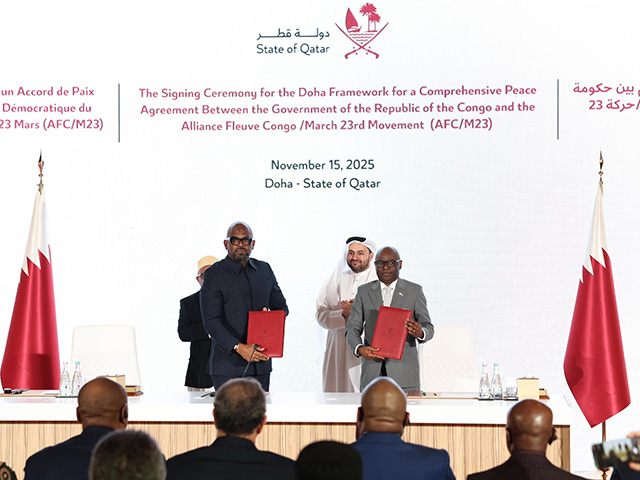
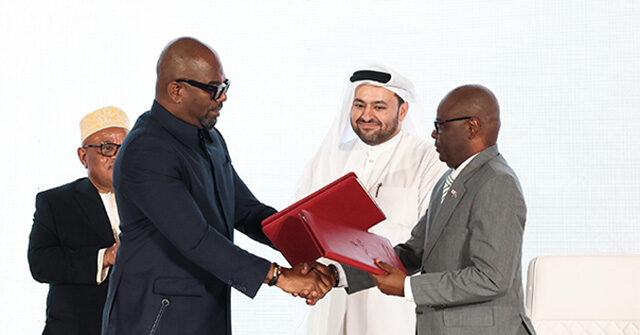
Qatari Minister of State and Qatar’s chief negotiator, Dr. Mohammed bin Abdulaziz Al-Khulaifi (C), Sumbu Sita Mambu (L), of the Democratic Republic of Congo (DRC) and Rwanda-backed armed group M23 executive secretary Benjamin Mbonimpa (R) during the signing ceremony of the Comprehensive Peace Agreement between the DRC Government and the Congo River Alliance/March 23 Movement at the Sheraton Hotel in Doha, on November 15, 2025. (Ministry of Foreign Affairs – Qatar)
“We’re glad to announce that Qatar, alongside its partners, managed two days ago to get the participating parties (the DRC government and AFC/M23)—to sign a framework agreement,” Al-Khulaifi said in an exclusive phone interview with Breitbart News on Monday morning. “A framework agreement is considered, in our view, a pivotal moment for peace and security in the Great Lakes region. We understand that this is known to be a very difficult job, a very hard negotiation between the disputing parties, because there is a tremendous lack of trust between the disputing parties. But gladly we’ve managed to facilitate concrete results. We considered a unique strategy when it comes to this conflict, to follow what I call step-by-step process. So not necessarily to get the parties in one session to go on the discussions of comprehensive peace agreements directly, but to take it step-by-step and phase it. So, we started with what we call the Declaration of Principles signed in April between Rwanda and DRC followed by the Washington Peace Agreement. Taking this into two phases between Rwanda and DRC was extremely critical. We followed the same approach in the Doha track between M23 and DRC, and like the first track, we continued our close collaboration with our strategic partner the United States. We started with the Declaration of Principles signed in July this year between the DRC government and AFC/M23. Now, two days ago, we’ve managed to get a framework agreement. With this now in place, we need to focus on the implementation protocols. So again, the strategy that we have followed is to take it into phases, Declaration of Principles, followed by framework agreement, ending with protocols and implementation, all of which the concerned parties respected to uphold. We had very thorough discussions and negotiation sessions in Doha for the past eight months.”
The framework signed this weekend in Doha was the latest in a long series of steps this year to end the conflict between Rwanda and DRC. The two countries’ foreign ministers had signed an agreement in Washington this summer and Trump welcomed both into the Oval Office after Secretary of State Marco Rubio oversaw the initial process alongside Massad Boulos, a senior adviser to Trump for African affairs. The remaining hurdle before an eventual lasting peace has been since then what to do about M23, a paramilitary group operating inside DRC. Talks have been ongoing for months in Doha, led by the Qataris and assisted by the Americans, to get the various sides to agree to this framework that was signed this weekend. Al-Khulaifi told Breitbart News that the “catalyst” for peace has been the Emir of Qatar, Tamim bin Hamad bin Khalifa Al Thani, who met the presidents of both Rwanda and DRC earlier this year and pushed for peace—and that Trump has been similarly personally engaged as well.
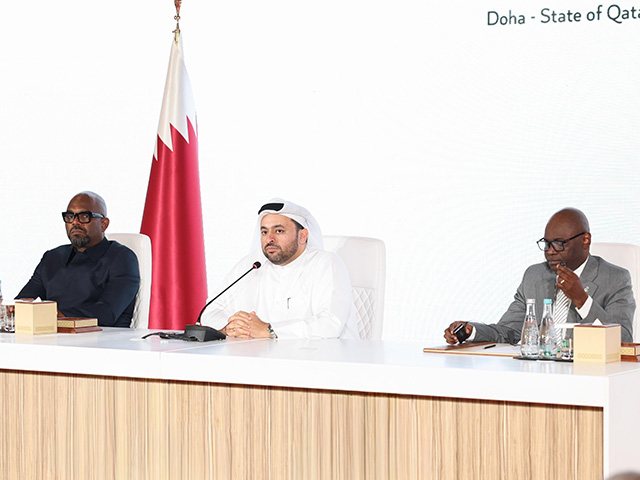
Qatari Minister of State and Qatar’s chief negotiator, Dr. Mohammed bin Abdulaziz Al-Khulaifi (C), Sumbu Sita Mambu (L), of the Democratic Republic of Congo (DRC) and Rwanda-backed armed group M23 executive secretary Benjamin Mbonimpa (R) during the signing ceremony of the Comprehensive Peace Agreement between the DRC Government and the Congo River Alliance/March 23 Movement at the Sheraton Hotel in Doha, on November 15, 2025. (Ministry of Foreign Affairs – Qatar)
“The catalyst for all this happened in March this year,” Al-Khulaifi told Breitbart News. “His Highness, the Emir, met both leaders, President Kagame and President Tshisekedi. They had not met each other for over three years before this meeting. His Highness, the Emir, managed to get both leaders in the same room speaking genuinely and directly about the importance of finding a long-lasting solution for stability in the Great Lakes Region. We welcomed the genuine interest by President Donald Trump and his team in the State Department after the Leaders’ meeting to cooperate, and since then they have worked with us, hand-in-hand, day after day, to achieve what we have accomplished so far, including the two important agreements, one signed in Washington between Rwanda and DRC and another one signed in Doha between DRC and AFC/M23.”
While this newly signed framework is a huge step, hurdles remain—and Al-Khulaifi detailed several of those in his interview on Monday with Breitbart News.
“To talk a little bit more about the framework that was signed two days ago, this framework reflects the core issues between the disputing parties,” he said. “So we managed to gather all of their concerns and reflect on them in a proposal that was accepted by the parties two days ago and signed here in Doha. This agreement needs to be followed by discussions and negotiations over six protocols. There are a total of eight, actually, but two of them have been already signed between the parties—one related to the prisoner release mechanism, and the second one is related to the ceasefire monitoring and verification mechanism. So we have six other protocols that we need to focus on, one related to the humanitarian access. This very tragic humanitarian situation for the people of Eastern DRC demands further engagement by all of us—not only the facilitators but also the international stakeholders who are willing to intensify their efforts in helping and supporting the people of eastern DRC. Another one is the restoration of the state authority. There is another protocol that covers the interim security agreement and the importance of strengthening the security level, avoiding any military clashes between the two disputing parties. And there is another protocol related to the refugees and the displaced persons. As you know, following the recent escalations in eastern DRC many of those civilians have been displaced and left their country and went to neighboring countries as refugees. So it is very important that this protocol will deal with this category of individuals and their dignified return. There are two other important protocols that we need also to cover, one related to the economic and social recovery for those areas and another one related to the justice and reconciliation to bring peace back again to these areas.”
This latest framework can all set the stage for that looming White House visit with Trump and the leaders of the nations involved here. Al-Khulaifi said that all sides are “looking forward” to that eventual summit, and the hope is this peace that is being ushered in in Africa will lead to major economic opportunity worldwide. He also said that Qatar has enjoyed working with Trump and his team on this matter and several others where the Qataris have helped the Americans achieve their objectives for peace and conflict resolution around the world.
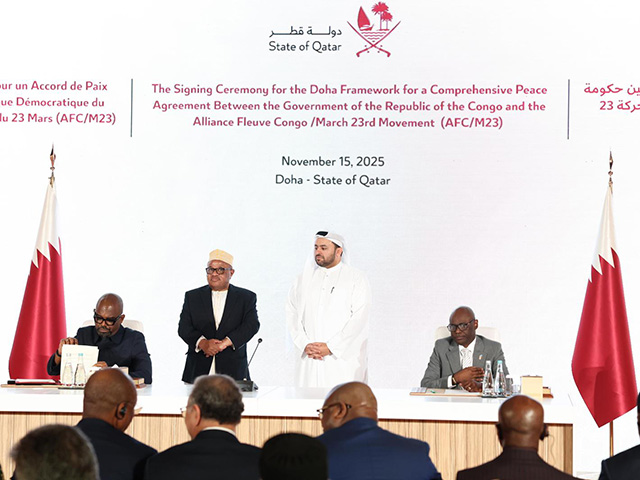
Qatari Minister of State and Qatar’s chief negotiator, Dr. Mohammed bin Abdulaziz Al-Khulaifi (C), during the signing ceremony of the Comprehensive Peace Agreement between the DRC Government and the Congo River Alliance/March 23 Movement at the Sheraton Hotel in Doha, on November 15, 2025. (Ministry of Foreign Affairs – Qatar)
“We are looking forward to President Trump’s leaders’ summit in Washington,” Al-Khulaifi said. “My expectation is that soon there should be a date to be announced by the White House calling for the leaders not only of the disputing parties but for the region. And I think this will be an important event not only for both parties of the agreement—the Washington agreement—but it will be important for the whole region. As you know, this conflict has directly or indirectly impacted a number of countries in the region. You have Burundi, Uganda, Kenya, and then you have other countries as well that have been impacted by either the number of refugees or lack of stability preventing valuable economic opportunities within those areas, as Dr. Boulos mentioned during his press conference two days ago. Honestly speaking, President Trump’s continued his dedicated efforts from the start of his Presidency, and his achievements have been remarkable in terms of the number of cases that have been resolved under his leadership and under his direct involvement as the President of the United States. For us as the state of Qatar, we are truly honored by this strong partnership—a strategic relationship that we obtained with the United States on several cases. The DRC is only one example where Qatar joins forces with the United States in bringing peace and stability for the Great Lakes region. There is also our joint work in Gaza, and Afghanistan. Truly, we enjoy working with his Excellency, President Trump, and his team on the different cases and without his strong leadership, we would not be able to accomplish what we have achieved today.”
Al-Khulaifi said that negotiating peace in this long-running war—Rwanda and DRC have been at war for decades—has been very difficult because the two sides have deep distrust of one another and also there have been multiple things happening on the battlefields during negotiations.
“There are difficulties. This case is extremely difficult for two main reasons: One, there is extreme lack of trust between the parties. The word trust does not exist in any of the disputed parties’ dictionaries,” Al-Khulaifi said. “This makes the task for the mediators extremely difficult to build bridges and fill the gaps between the two sides. Sometimes we tend not to have direct negotiation between the parties and keep them in separate rooms to be able to speak more to the parties about some of the good initiatives that will create breakthroughs in this conflict. The second main difficulty that we’re facing, honestly, an armed conflict. This is not only a political conflict, it is an armed conflict that is reflected on the battlefield while we’re negotiating. There are clashes and killing, and innocent civilians have been affected by this conflict. So you can imagine the difficulties that what is happening on the battlefield automatically reflected on the mediation table. I remember one night before the signing event, I was with Dr. Boulos in the Sheraton Hotel until 2 a.m., just finalizing these few lines of the draft agreement between the parties. The closer that you get to the end, the more difficult and challenging it will be. And it is obvious that each side wants to gain as much as possible out of the agreement. So we understand this is one of the challenges that we faced in the mediation. But we have put so much time and effort, to—at least to a certain extent—convince the disputing parties to trust the process that has been established. Let me tell you what is unique about this process in comparison with the previous processes. As you know, this is not the first time an agreement is drafted to address the conflict in the eastern DRC. But what is unique this time is that this has been described more comprehensively. So it does not only touch base on the political issues, but it covers also the economic, security and other important issues that are related to the root cause of the conflict itself. Also what is unique this time is that you have full dedication and commitment by the United States, Qatar, the African Union, and international partners. And that’s why I think an involvement by trustworthy international stakeholders is a unique element in any agreement. Is it going to be difficult to implement? Absolutely yes. Are we going to face challenges during the implementation? One hundred percent. However, there is a full dedication for all of us to continue working step by step with the parties towards lasting peace.”
The big prize for all parties concerned, though, is that after lasting peace is won there is the promise of economic opportunity in the region. DRC and Rwanda are both in what is called Africa’s “Great Lakes Region,” which is rich with natural resources and is also known as the world’s “Green Lung” given how it processes more carbon than anywhere else on the planet naturally per some estimates.
“From the first day, we had a very transparent discussions with the disputing parties,” Al-Khulaifi said. “We told them very clearly that the continuation of this fight will cause missed opportunities, including huge economic opportunities, not only for the DRC but the whole region. DRC is one of the countries in Africa that has a rich abundance of natural resources. Investing the time and effort to develop and bring more sustainable economic opportunities for the people of DRC has been always an important incentive —a future where security is preserved but also economical opportunities are gained and I think Dr. Boulos has reflected on this aspect in the press conference two days ago when he said the meeting with President Trump at the White House will not only be an opportunity for peace and security but also an economical opportunity for many of the African countries in the region to benefit from this peace and build upon it by bringing more economical initiatives that will benefit all.”
From here, he added, there is more work to be done.
“Our work is not done,” Al-Khulaifi said. “We will continue working with the parties right now on the protocols. The follow-up mechanisms that the Washington agreement created between DRC and Rwanda are active. We are having frequent meetings right now in Washington to continue monitoring and seizing the opportunities of peace and stability.”