Deep blue Colorado has agreed to a $6.1 million settlement after a court ruled last year against the state’s Democrat-led effort to ban pro-life pregnancy centers from offering abortion pill reversal.
The Centennial State is has agreed to pay the legal fees of two religious liberty organizations — Becket Fund for Religious Liberty and Alliance Defending Freedom (ADF) — who represented Bella Health and Wellness clinic and a pro-life nurse practitioner Chelsea Mynyk. The state has agreed to pay Becket $5.4 million and ADF $700,000 for attorneys fees and court costs, according to a settlement agreement obtained by The Colorado Sun.
A spokesperson for the Colorado Attorney General’s Office confirmed the settlement to the outlet but did not elaborate with any additional comment, according to the report.
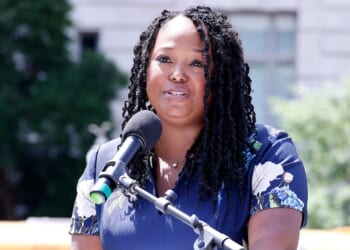
“At least 18 moms who received abortion pill reversal care at Bella just celebrated Christmas with babies born during this case,” said Rebekah Ricketts, senior counsel at Becket and an attorney for Bella Health and Wellness. “All Coloradans should celebrate those little miracles and the brave medical team at Bella that helped their moms when no one else would.”
A medication abortion is typically completed through a two-drug regimen within the first ten weeks of pregnancy. The first drug, mifepristone, blocks the action of the hormone progesterone, which the mother’s body produces to nourish the pregnancy. When progesterone is blocked, the lining of the mother’s uterus deteriorates, and blood and nourishment are cut off to the developing baby, who then dies inside the mother’s womb. The second drug, called misoprostol (also called Cytotec) then causes contractions and bleeding to expel the baby from the mother’s uterus. Medication abortions accounted for approximately 63 percent of abortions in the United States in 2023.
Proponents of the abortion pill reversal protocol say a woman may attempt to reverse her medication abortion after taking mifepristone, but before taking misoprostol, with providers prescribing the hormone progesterone in an attempt to overcome the progesterone-blocking effects of the mifepristone and maintain the pregnancy.
In 2023, Colorado passed a first-of-its-kind bill, SB23-190, making it “unprofessional conduct” for healthcare professionals to offer women progesterone when seeking to reverse the effects of the first abortion pill, called “abortion pill reversal.” The founders of Bella Health and Wellness, Catholic mother and daughter nurse practitioners Dede Chism and Abby Sinnett, immediately filed a lawsuit challenging the law and alleging that it violated their First Amendment religious and speech rights. Mynyk, a licensed nurse practitioner and certified nurse midwife represented by ADF, later intervened in the lawsuit.
Bella Health’s Becket attorneys stated in their original complaint that “as a matter of conscience, Bella and its providers cannot refuse to help a woman who desires to continue her pregnancy simply because she took mifepristone.”
“Consistent with their core religious beliefs in human dignity, Bella and its providers are religiously obligated to offer abortion pill reversal so long as they have the means and ability to do so,” the complaint states.
The state contended, citing its own experts and pro-abortion major medical industry bodies, that abortion pill reversal is unproven, ineffective, potentially unsafe, and relies on incomplete research.
Ultimately, Trump-appointed Judge Daniel Domenico ruled in favor of Bella Health and Mynyk in August 2025, finding that Colorado burdened plaintiffs’ religious exercise and specifically targeted pro-life pregnancy centers in passing the law.
“Motivated by what everyone in this case acknowledges is sincere religious belief, Plaintiffs provide medical services to pregnant women through what they consider ‘crisis pregnancy centers.’ The Colorado legislature, however, passed a bill in April 2023 targeting what it calls “anti-abortion centers,” including Plaintiffs’,” wrote Domenico for the U.S. District Court for the District of Colorado. “It is not disputed that by effectively prohibiting them from using a particular treatment for pregnant women, this law burdened Plaintiffs’ sincerely held religious beliefs and required the Defendants to satisfy the demands of strict scrutiny.”
“…[W]hile the clinical efficacy of abortion pill reversal remains debatable, nobody has been injured by the treatment and a number of women have successfully given birth after receiving it,” he continued. “The Defendants have thus failed to show that they have a compelling interest in regulating this practice, and Plaintiffs’ motion must therefore be granted to the extent it seeks a permanent injunction allowing them to continue offering the treatment.”
Domenico also pointed out that Colorado allows the broad off-label usage of progesterone for many purposes in obstetrics and gynecology, as well as for in vitro fertilization and “sex changes.”
“Overall, it is impossible to avoid the conclusion that Plaintiffs’ use of progesterone is not being regulated neutrally — it is being singled out,” he wrote. “Defendants’ application of [the law] must therefore satisfy strict scrutiny. Defendants have not carried their burden to show that its stated interests can survive this exacting inspection.”
His order narrowly applies to Mynyk and Bella Health and Wellness, with Domenico citing the Supreme Court’s Trump v. CASA ruling cracking down on lower courts issuing broad-sweeping injunctions.
He wrote:
At the outset it is worth noting that the parties sometimes frame the relief in this case as seeking an injunction against SB 23-290 itself, or sections thereof. But to be clear, my authority is limited to adjudicating disputes between the parties before me, and I have no freestanding power to enjoin laws beyond my power to enjoin parties responsible for enforcing them. I therefore emphasize that any injunction in this case covers enforcement actions against the Plaintiffs, not the law itself.
The case is Bella Health and Wellness v. Weiser, No. 1:23-cv-939 in the U.S. District Court for the District of Colorado.
Katherine Hamilton is a political reporter for Breitbart News. You can follow her on X @thekat_hamilton.