
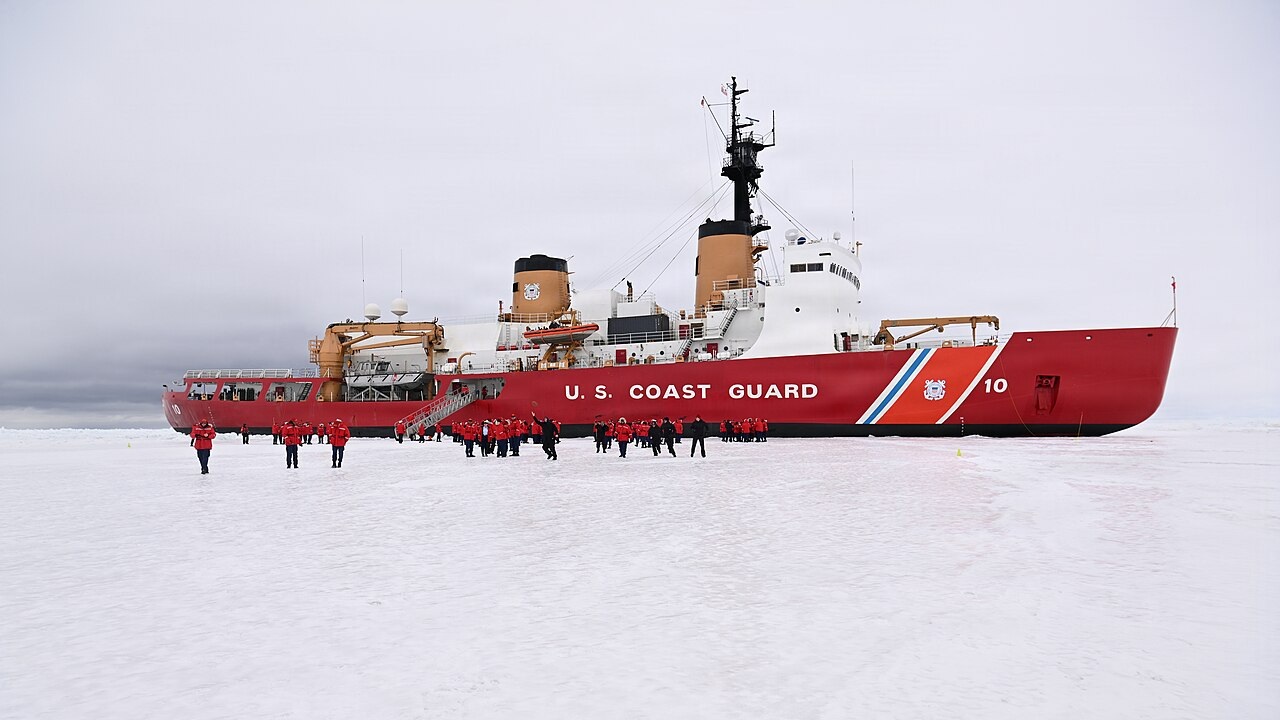
The USCGC Polar Star freed an Australian tour vessel near Antarctica on January 17—the 50th anniversary of its commissioning into the Coast Guard.
The Australian luxury cruise ship Scenic Eclipse II was sailing off the coast of Antarctica when it became stuck in ice in the Ross Sea, near McMurdo Sound, on January 17.
The ship and its passengers sat in the freezing cold, with little hope of escape—but only for a handful of hours, until a nearby US Coast Guard icebreaker was able to free them.
The somewhat anti-climactic rescue took place during what is typically Antarctica’s “warm season,” when many cruise ships pass by the uninhabited territory. The cruise ship is owned by Scenic Luxury Cruises and Tours and is typically able to accommodate 227 passengers and 176 crew members. According to media reports, passengers on the Scenic Eclipse II watched from the observation deck and drank champagne as the Coast Guard cleared the ice around it.
The Coast Guard icebreaker, the USCGC Polar Star (WAGB-10), had departed Seattle for Antarctica on Thanksgiving Day, commencing its 29th deployment to the polar region in support of Operation Deep Freeze. On January 17, it conducted two close passes, which freed the cruise ship. WAGB-10 then escorted the ship to open water.
The first Operation Deep Freeze mission began in 1955–56. Since then, it has come to be used as the general term for US operations on the continent, notably the regularly scheduled resupply missions. Active, Reserve, and Guard members of the US Coast Guard, Air Force, Navy, and Army continue to support the USAP by air and sea lift of supplies to McMurdo Station.
The Polar Star Has Been Freeing Trapped Ships for Half a Century
Coincidentally, the mission also took place on the 50th anniversary of the Polar Star’s commissioning date—January 17, 1976.
Although the heavy icebreaker will spend the next several months operating far down under, its primary mission isn’t to free pleasure seekers who want to see Antarctica up close. With each Operation Deep Freeze, WAGB-10 serves a vital role in ensuring surface access for fuel and supply ships through the Ross Sea to resupply the US Antarctic bases. It is able to break “a navigable channel through miles of dense Antarctic ice to allow fuel and cargo deliveries essential for sustaining research stations and operations,” the Coast Guard explained.
“I am constantly amazed at this crew’s tremendous energy and enthusiasm,” said Capt. Jeff Rasnake, commanding officer of USCGC Polar Star. “Despite the many challenges associated with getting and keeping this ship on mission, they remain eternally positive and committed to meeting the high standards we’ve set for ourselves.”
The mission of Seattle, Washington-based USCGC Polar Star directly protects the security, freedom, and prosperity of the US, our allies and partners, the service added. Over the past five decades, the heavy icebreaker has also conducted resupply, search-and-rescue, and environmental protection duties.
“At 50 years old, Polar Star remains the world’s most capable non-nuclear icebreaker,” added Cmdr. Samuel Blase, Polar Star‘s executive officer. “That’s a testament to the crews that have maintained it over the decades. With years of service left to give, Polar Star will continue to guide the way in the high latitudes well into the future.”
The USCGC Polar Star’s Specifications
- Year Commissioned: 1976
- Hull Construction: High-strength steel with 1.75-inch thick plating in key areas
- Length: 399 feet (122 meters)
- Beam: 83.5 – 84 feet
- Draft: 34 feet
- Displacement: ~13,000 – 13,500 tons (full load)
- Propulsion: Combined Diesel-Electric and Gas (CODGAG). Six diesel-electric engines (18,000 HP) and three aviation-grade gas turbines (75,000 HP total)
- Speed: 18 knots (maximum), 3 knots (continuous through 6-foot ice)
- Icebreaking Capacity: 6 feet (continuous), up to 21 feet (ramming)
- Crew: 140
About the Author: Peter Suciu
Peter Suciu has contributed over 3,200 published pieces to more than four dozen magazines and websites over a 30-year career in journalism. He regularly writes about military hardware, firearms history, cybersecurity, politics, and international affairs. Peter is also a contributing writer for Forbes and Clearance Jobs. He is based in Michigan. You can follow him on Twitter: @PeterSuciu. You can email the author: [email protected].
Image: Wikimedia Commons.















_celebrates_50_years_amid_Operation_Deep_Freeze_2026_9481423.jpg)