Where is the lamb?
That is what Isaac asked his father Abraham, shortly before he was almost sacrificed on an altar. Abraham answered his son, “God will provide the lamb.”
The Lamb Who Was Slain
About 1500 years later, Isaac’s question was definitively answered just off a road full of pilgrims taking their lambs to Jerusalem for Passover. It was answered when John the Baptist said: “Behold, the Lamb.”
But, as Bishop Sheen wrote:
He wasn’t the people’s lamb, or the lamb of the Jews…but the Lamb of God. When the lamb was finally sacrificed it wasn’t because he was a victim of those who were stronger than him, but rather because he was fulfilling his willing duty of love for sinners. It was not man who offered this sacrifice, although it was man who slew the victim; it was God who gave himself. (LOC, 70)
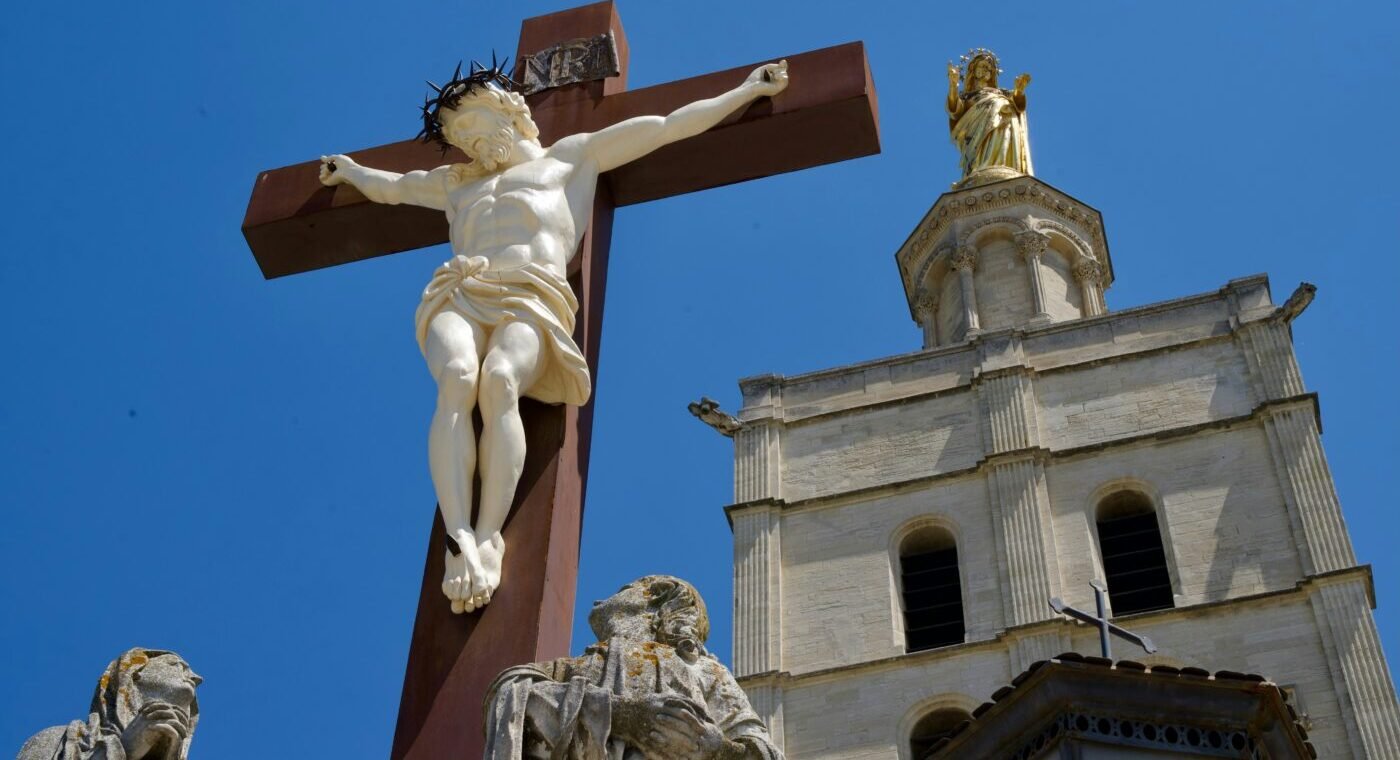
It was God who gave Himself—all of Himself. Christ could have pricked His finger and flicked a tiny drop of Precious Blood on the earth. That would have washed the whole place clean. One drop of Precious Blood, Thomas Aquinas wrote, is more valuable than all of creation. But Christ gave more. He gave all. As if being mocked and spit on wasn’t enough, He allowed Himself to be scourged for our transgressions and then hung on a cross, giving over every last drop of His Blood.
Recall that the Apostle John was at first a disciple of John the Baptist. Apostle John was standing there at the river when the Baptist said, “Behold the Lamb of God.” John was also standing on Calvary when they pierced Jesus’ side. John gazed at the Lamb, whose body had been ripped to shreds. Yellow serum oozed out everywhere, and as Christ baked on the cross in the noonday sun, He probably took on the appearance of a roasted lamb—like the thousands of Passover lambs being roasted in Jerusalem that day.
Unconfined by Time
Decades later, John wrote the Book of Revelation. He wrote about a pierced Lamb standing on His throne while the heavenly host of angels and saints adore Him. John also wrote how this Lamb was present at the beginning of the world (Rev. 13:8), that He was the beginning and the end, the alpha and the omega (Rev. 22:13). This means the Cross and Calvary were not afterthoughts, emphasized Bishop Sheen:
Redemption was in the mind of God before He even laid the foundation of the world. God, who is outside time, saw from all eternity mankind falling and being redeemed.
So, what happens at Holy Mass then? Calvary happens. But how can that be? We cannot go back in time as we are locked in the present. The Lamb, however, is not locked in time. German author Martin Mosebach wrote:
Liturgical time is different than the time that elapses outside of the church’s walls. It is Golgotha time; the time of the…unique and sole Sacrifice. It is a time that contains all time and none. (The Heresy of Formlessness, 32)
Recall that when the Jews celebrated Passover, the memorial of their escape from slavery and death in Egypt, they celebrated as if the holy event was made mystically present to them—as if no time were involved. It was as if they were back in Egypt, slaughtering unblemished lambs and smearing the blood above their doors.
Of course, the Passover was just a shadow, a prefiguring for the real thing to come—the Lamb of God, whose blood was smeared on the cross. And when Christ, through the mediation of His priests, says, “This is my Body given for you,” and “Do this in memory of me,” His Divine Act is made mystically present in a time that contains all time and none. But this is not a mere shadow, prefigurement, or good feeling. No, this is God in action for you—now.
How does that make you feel? Christ bleeds out on the cross for you; not just 2000 years ago, but now. He gives all He has for you now.
Our Response
What then is the proper response? Do you ever show up for Mass resentful that you have to make yourself present for an hour to adore God? Do you arrive late, or at the last second, as Christ the King, in the person of His priest, enters the sanctuary and ascends to His throne? Do you come dressed casually, for the sake of comfort, which tells yourself and the others around you that nothing supernatural or out of the ordinary is taking place?
Let’s be clear: You cannot show up, march forward to the altar, prick your finger, and give over a drop of your blood in offering. No, because you are not Jesus. To “give Him a drop of your blood” is to pick and choose which commandments to keep; it is to practice contraceptive Catholicism, which bears no fruit.
On the contrary, you are here on earth (for a very short time) to do God’s will. John wrote in Revelation that God spits the lukewarm out of His mouth. His will for you then is to give Him everything. To refuse His will is analogous to going on a theological welfare program.
Are we to drain the chalice and contribute nothing to its filling? Are we to receive bread without giving the wheat to be ground, to receive the wine and give no grapes to be crushed? If all we did during our lives was to go to Communion to receive Divine Life, to take it away and leave nothing behind, we would be parasites on the Mystical Body of Christ. (Sheen, Calvary and the Mass, 50)
So, what should you do now? Should you do the Lord’s will while you have time? Should you obey the One who is outside of time, or do you “get with the times,” which are evil?
It’s interesting: Christ instructed us to hate the world and love Him. The confused masses out there today have it backwards. They love the world and hate Christ. They hate Christ who is God. As the Baptist declared, “Now I have seen and testified that He is the Son of God.”
A brilliant writer once stated:
But what greater proof of His divinity could there be than the fact that He is still resisted, even hated, after 2,000 years? Nobody hates Julius Caesar anymore; it’s pretty hard even to hate Attila the Hun, who left a lot of hard feelings in his day. But the world still hates Christ and His Church. (Joseph Sobran)
The Mass, the Lamb, and Us
Christ purchased all of us on Calvary with His Blood. And that was no mere impulse buy, for the Cross and Calvary are not afterthoughts. Our redemption was in the mind of God before He even laid the foundation of the world. That means the Holy Sacrifice of Mass was in God’s mind before the foundation of the world. That is why Mass should look and feel timeless—because it is.
And so…where is the Lamb? He is here on our altar. God provides Him. He does so in His Divine Act that saves us from hell. How blessed we are to be able to participate in this Divine Action.
And we do indeed participate. For though Christ offers the sacrifice, we slay the Victim—with our sins. We then dare to approach the altar, which is the place of the great exchange. As Sheen put it: “We give Him our time, He gives us His eternity. We give Him our humanity; He gives us His divinity. We give Him our nothingness; He gives us His all.”
Photo by Tim Wilson on Unsplash