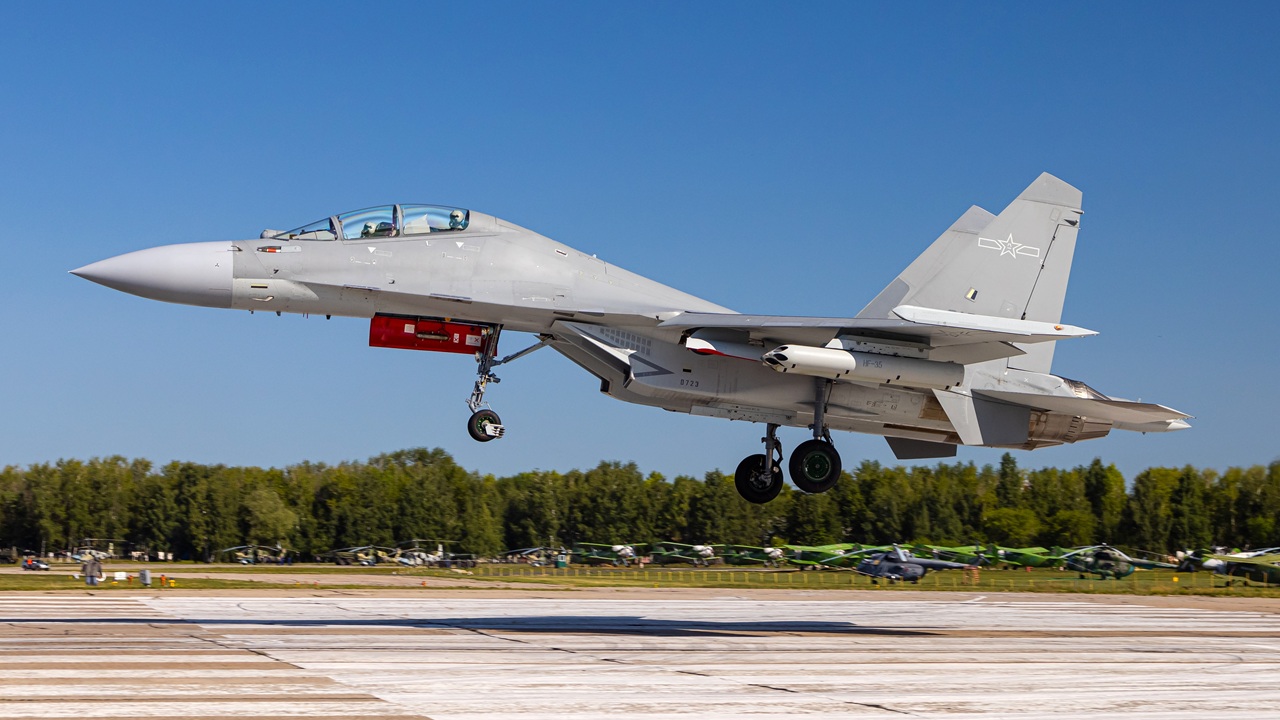
The J-16 is based on the earlier Russian Su-30 Flanker—but is packed to the brim with advanced avionics and innovative Chinese design features.
While much attention is spent on Chinese aerospace platforms like the J-20, H-20, and JH-XX, its J-16 is quietly one of the most important and capable multirole fighters in China’s inventory—arguably the platform that most represents the maturation of the PLAAF into a modern air force.
Heavily derived from the Russian Su-30MKK acquired by China in the early 2000s, the J-16—known as the “Hidden Dragon” within China and as the “Flanker-N,” given its origins as an Su-30 derivative, by NATO—is an upgraded version of the Russian fighter, rebuilt with Chinese avionics, electronic warfare systems, weapons, and materials. First entering service in 2014, the J-16 fills an important niche between China’s older fourth-generation fighters and its emerging stealth fleet, giving the PLAAF a durable, long-range platform capable of performing both air superiority and deep-strike missions.
The J-16’s Specifications
- Year Introduced: 2014
- Number Built: 200+ (production ongoing)
- Length: ≈72 ft (22 m)
- Wingspan: ≈48 ft (14.7 m)
- Weight (MTOW): ≈77,000 lb (35,000 kg)
- Engines: Two WS-10B/WS-10C turbofans (30,000 lbf)
- Top Speed: ≈1,320 mph (2,120 km/h) / Mach 2.0
- Range: ≈1,000 nmi (1,150 mi, 1,852 km) combat radius, depending on mission
- Service Ceiling: ≈55,000 ft (≈17,000 m)
- Loadout: One 30mm GSh-30-1 cannon; PL-15 and PL-10 air-to-air missiles; land-attack and anti-ship cruise missiles; precision-guided bombs; EW/jamming pods (for J-16D)
- Aircrew: 2 (pilot + weapons systems officer)
How the J-16 Fighter Jet Builds on the Russian Su-30
Technologically, the J-16 offers a substantial evolution over the Russian Su-30. It incorporates an active electronically scanned array (AESA) radar, which provides improved tracking, resistance to jamming, and multi-target engagement. The cockpit is fully digital, with large-area displays, helmet-mounted sights, and modern mission computer systems. Its airframe also uses extensive composite materials, reducing weight while marginally lowering the radar cross-section. The WS-10B or WS-10C turbofan engines provide reliable thrust and improved performance over earlier Chinese power plants.
As a multirole fighter, the J-16 carries a broad and mission-flexible range of weapons. For long-range air-to-air missions, the J-16 carries the PL-15 missile, a central component in China’s A2/AD strategy of targeting US enabler aircraft (i.e., AWACS and tankers). For aerial combat, the J-16 can field the PL-10 high-off-boresight missile. And for strike missions, the J-16 employs land-attack and anti-ship cruise missiles, precision-guided bombs, and standoff munitions like the KD-series weapons.
Within the PLAAF, the J-16 plays an important role, filling the operational gap between the older, less capable fourth-generation aircraft, and the still-limited numbers of fifth-generation J-20s. Specifically, the J-16 is used for bomber escorts, long-range patrols over the East and South China Seas, and training near Taiwan. The J-16 combines range, payload, and sensors to make it ideal for maritime strike missions; should China ever find itself in open conflict, the J-16 would likely be used for early air operations, including air superiority, interdiction, and electronic suppression.
The J-16’s Strategic Implications for China
Strategically, the J-16 strengthens China’s A2/AD (anti-access/area-denial) architecture, especially when paired with long-range missiles and integrated air-defense systems. It gives China the ability to contest the air domain without relying exclusively on limited stealth platforms. And because the J-16 can engage targets at long range, operating far from home bases, the aircraft helps China enforce off-shore locations near Taiwan, the First Island Chain, and the Western Pacific.
For the US, the J-16 presents a serious operational challenge. In a conflict, non-stealth platforms, like enabler aircraft including the AWACS, maritime patrol, and tankers, would face sustained pressure from the large numbers of J-16s. And because of the J-16s range and sensors, the platform is a credible threat to US carrier air operations—which complicates the Navy’s ability to approach contested areas without stealth support.
In short, the J-16 is numerous, capable, and versatile—and while the more advanced J-20 is likely to be the future of the PLAAF, the J-16 may well present the more serious challenge today.
About the Author: Harrison Kass
Harrison Kass is a senior defense and national security writer at The National Interest. Kass is an attorney and former political candidate who joined the US Air Force as a pilot trainee before being medically discharged. He focuses on military strategy, aerospace, and global security affairs. He holds a JD from the University of Oregon and a master’s in Global Journalism and International Relations from NYU.
Image: Shutterstock / Fasttailwind.