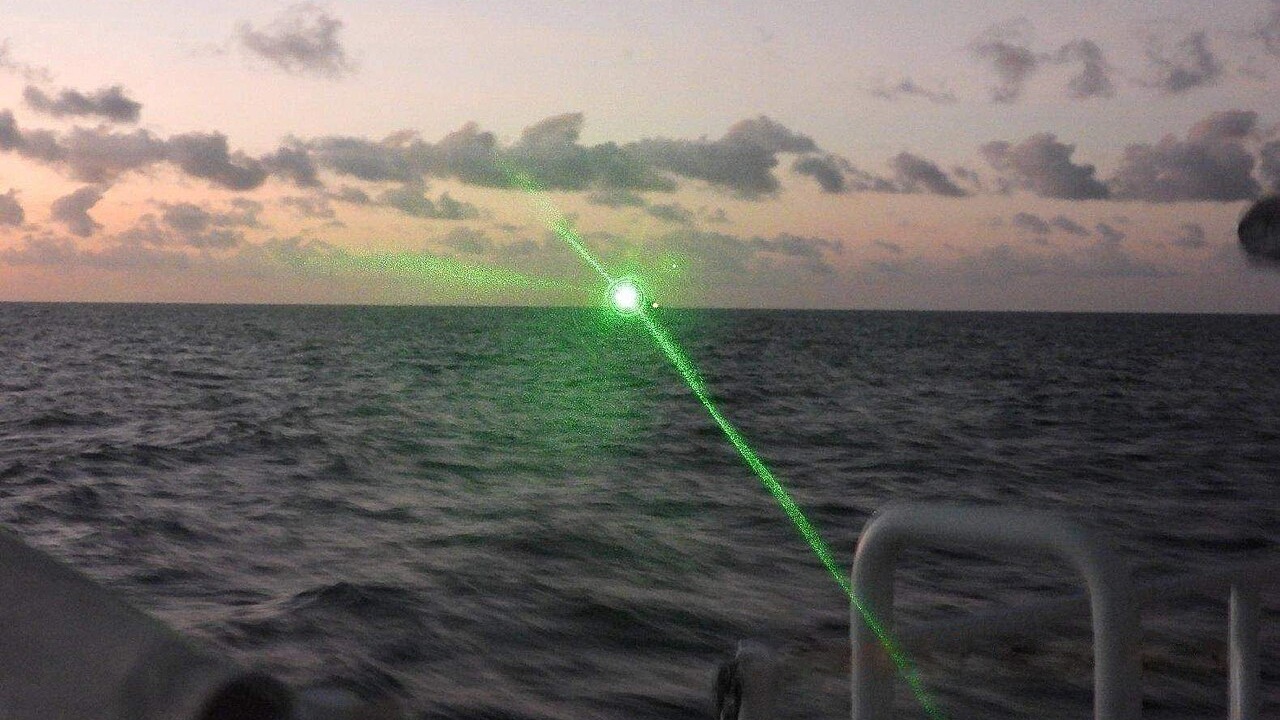
Beijing could easily outfit “roll-on/roll-off” civilian ships with laser weapons, pressing them into service to cross the Taiwan Strait in the early hours of an invasion.
New images circulating on Chinese social media reveal what appears to be a shipborne high-energy laser—identified as the LY-1—mounted on the open deck of a civilian roll-on/roll-off (“Ro-Ro”) cargo ship. The system sits atop a heavy carrier vehicle chained to the deck, crowned by a large electro-optical turret housing the laser emitter.
Beijing’s Merchant Fleet Could Become a Futuristic War Fleet
If authentic, these photos show Beijing quietly weaponizing its massive civilian fleet ahead of a future invasion of Taiwan. A laser mounted on a commercial vessel is not a novelty—it is a strategic warning shot. The Chinese military is testing whether it can transform its enormous merchant marine into an armed armada capable of fighting its way across the Taiwan Strait.
For years, Western analysts have insisted that the People’s Liberation Army Navy (PLAN) lacks the amphibious lift required to sustain a large-scale assault on Taiwan. They point to China’s limited number of purpose-built amphibious warships and conclude that Beijing will not be ready for years. This is a dangerously outdated assumption. China possesses the world’s largest civilian Ro-Ro fleet, and Beijing has already signaled that these ships would be mobilized as part of any cross-strait war.
Now, with the apparent installation of military-grade directed-energy weapons (DEWs) on these vessels, China is doing more than increasing transport capacity. Beijing is giving its logistical ships serious teeth.
The LY-1 laser system, unveiled publicly at China’s September 2025 Victory Day parade in mobile truck configuration, is designed as a point-defense weapon. It is reportedly capable of intercepting drones, light aircraft, cruise missiles, and other aerial threats at close range.
Chinese military journals describe the system as the “last line of defense” in a ship-based air-defense (AD) network. But mounting it on auxiliary or civilian ships signals a doctrinal shift with enormous implications. Beijing intends for its logistics and transport assets to operate under fire—and to survive.
Lasers at Sea: China’s New Invasion Doctrine
DEWs offer advantages no missile-based defense can match. They have a minimal cost-per-shot, can be fired repeatedly, and engage incoming threats at near-instantaneous speeds. Against the drone swarms and inexpensive precision munitions Taiwan would unleash on any invasion fleet, a laser-equipped convoy could dramatically reduce China’s vulnerability.
A single civilian Ro-Ro ship bristling with DEWs could swat away drones at a fraction of the cost Taiwan spends to field them. Multiply that across China’s enormous merchant fleet, and Beijing gains a scalable, high-endurance defensive umbrella that follows its invasion force wherever it sails.
More troubling still is the offensive potential. A shipborne laser could blind reconnaissance drones, burn out optical sensors, or disrupt Taiwan’s surveillance networks before the first landing craft reaches shore. In a conflict where information dominance and visibility determine survival, degrading Taiwan’s ability to see the invasion coming could be decisive.
Of course, questions remain about the images themselves. They have not been officially verified, and it is possible the photographed system was a mock-up or test rig rather than an operational deployment. Laser weapons also suffer performance degradation in fog, rain, sea spray, and humidity—all of which would be abundant in a Taiwan invasion scenario. The motion and vibration of a civilian ship could further complicate targeting with these systems.
Yet none of these caveats diminish the strategic implications. China possesses the LY-1 system, shipborne variants have been spotted before, and Beijing has repeatedly demonstrated a willingness to test new weapons in unconventional ways. Even a non-operational mockup implies serious interest.
At minimum, China is in Phase One a multi-stage development plan: demonstrating the feasibility of laser-equipped civilian vessels. If Beijing moves to Phase Two—successful live-fire tests from cargo and logistics ships in real-world maritime conditions—the threat will escalate dramatically. A Phase Three capability, in which these lasers are mass-produced and integrated into amphibious and sealift formations, would fundamentally alter the balance of power in the Taiwan Strait. A militarized merchant fleet—self-defending, networked, and operating in wolf-pack convoys alongside warships—would be a nightmare scenario for Taiwanese defense planners.
America Hasn’t Reacted to—or Noticed—China’s Laser Threat
Washington, meanwhile, has no comparable capability deployed at scale. The US Navy’s laser programs have advanced slowly and remain confined to limited testing. America’s overstretched global commitments, combined with political paralysis and underfunded modernization, leave little room to field a countervailing system quickly.
This is precisely what makes China’s move so consequential. It is unconventional, cost-effective, difficult to counter, and perfectly tailored to exploit American distraction. Beijing has bought itself a window of opportunity: a period in which it can develop, refine, and expand this capability before the United States wakes up to what is happening—and before Taiwan can adapt.
The images may be preliminary. The lasers may still be experimental. But the strategic intent behind them is unmistakable. China is preparing not just to invade Taiwan. Beijing intends to protect its invasion force with systems and tactics that the West has not yet learned to counter (or use themselves).
And unless Washington responds with equal creativity and urgency, Beijing will continue pushing toward phases two and three—until its civilian merchant fleet becomes the world’s most unexpected fleet of warships.
About the Author: Brandon J. Weichert
Brandon J. Weichert is a senior national security editor at The National Interest. Recently, Weichert became the host of The National Security Hour on America Outloud News and iHeartRadio, where he discusses national security policy every Wednesday at 8pm Eastern. Weichert hosts a companion book talk series on Rumble entitled “National Security Talk.” He is also a contributor at Popular Mechanics and has consulted regularly with various government institutions and private organizations on geopolitical issues. Weichert’s writings have appeared in multiple publications, including The Washington Times, National Review, The American Spectator, MSN, and the Asia Times. His books include Winning Space: How America Remains a Superpower, Biohacked: China’s Race to Control Life, and The Shadow War: Iran’s Quest for Supremacy. His newest book, A Disaster of Our Own Making: How the West Lost Ukraine is available for purchase wherever books are sold. He can be followed via Twitter @WeTheBrandon.
Image: Wikimedia Commons.