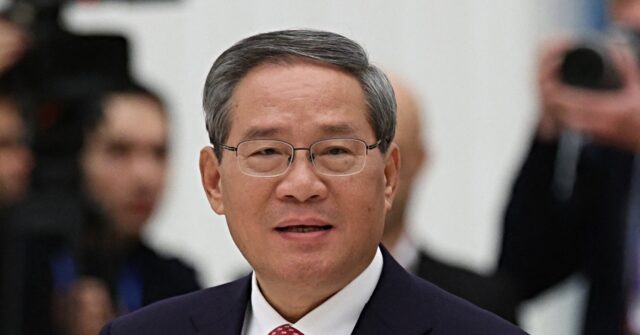
Speaking at an international forum in Beijing on Tuesday, Chinese Premier Li Qiang blamed tariffs – implicitly President Donald Trump’s tariffs – for dealing a “severe blow” to the world economy.
Many of the attendees were at least as concerned about China’s predatory trade practices, including a tidal wave of exports that boosted China’s trade surplus to over a trillion dollars.
“Starting from the beginning of this year, we’ve seen the stick of tariffs being wielded around the world with growing restrictive measures on the economy and trade, which have dealt a severe blow to the global economy,” Li said on Tuesday.
“As the situation has unfolded, the damaging consequences of tariffs hurting both others and oneself have become increasingly evident, and calls from all sides to uphold free trade have grown ever stronger,” he insisted.
RELATED — Bessent Explains Why There Was No Retaliation to Tariffs Under Trump
President Trump imposed heavy tariffs on China after he returned to office this year, and those tariffs led to a significant decline in Chinese exports to the United States. Chinese customs officials reported shipments to the U.S. declined by 28.6 percent year-on-year in November, the eighth straight month of double-digit declines. The overall net decrease in China’s export volume to the U.S. for 2025 is about 19 percent.
However, China’s exports to the rest of the world skyrocketed this year, growing by 5.4 percent, even as China’s imports from other countries declined by 0.6 percent. This left China with a trade surplus of $1.076 trillion, its highest ever recorded, and an increase of 21.6 percent from 2024.
China’s export growth has gone a long way toward lifting its economy out of the post-pandemic doldrums, with five percent annual GDP growth looking possible by the end of 2025. Some of China’s trade partners are growing uneasy with the massive trade surplus, as Reuters reported on Tuesday:
French President Emmanuel Macron said on Sunday that he had threatened Beijing with tariffs during his state visit last week, which coincided with the European Commission unveiling plans to boost Europe’s resilience to threats such as rare earth shortages and dumped imports.
Economists argue that while U.S. President Donald Trump’s decision to hike tariffs on Chinese goods was hugely disruptive for global trade, Beijing’s reluctance to reform leaves the West with few alternatives.
In short, China’s other trade partners are beginning to worry that the flood of cheap merchandise diverted from the U.S. and exported to other countries will overwhelm their economies and crush local industries.
Chinese Communist Party officials see no problem with this strategy, especially since their efforts to boost domestic consumption have yet to produce satisfactory results. In fact, analysts told Reuters that the soaring trade surplus and renewed GDP growth this year could convince Beijing to double down on its export-based economic strategy. This is a big reason why Premier Li Qiang is attempting to hector and bully China’s other trade partners out of imposing tariffs and other trade protections of their own.
“I think countries are starting to think ‘what instruments do we have to stop this?’ It’s quite clear this is why everyone is knocking at China’s door. The pressure is mounting, and China is not ready to respond,” mused Alicia Garcia-Herrero, a senior fellow at the Bruegel think tank in Brussels.
The UK Guardian argued on Tuesday that China’s export boom suggests “the huge tariffs placed by the US and China on each other’s goods has dented bilateral trade but done little to change the overall flow of goods in the global economy.”
For example, the Guardian cited experts who believe “many of the goods bound for south-east Asia ultimately end up in the U,S,, via a practice known as trans-shipment where products are sent via a third country to avoid tariffs.”
These experts said nothing that happened in the tumultuous trade year of 2025 has changed China’s trajectory toward absorbing even more global market share – possibly up to 16.5 percent of all global exports by the end of 2030, according to Morgan Stanley analysts – but China also remains extremely dependent upon foreign buyers for its goods, having made very little progress toward reviving its domestic consumer economy.