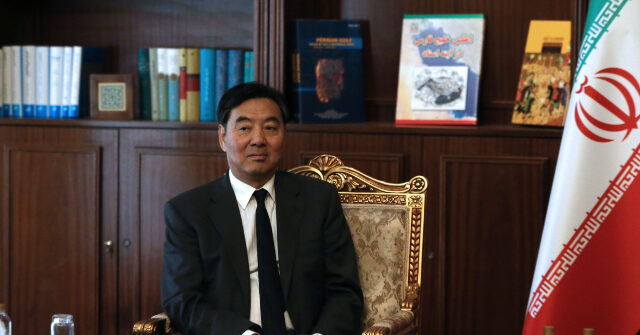
The Chinese Foreign Ministry announced on Thursday that it would send its special envoy to the Middle East, Zhai Jun, on a tour “soon” to mediate between the Iranian terror regime and its Middle Eastern neighbors, which Tehran has targeted this week with drone and missile strikes.
Foreign Ministry spokeswoman Mao Ning stated that her boss, Foreign Minister Wang Yi, had made several phone calls to various counterparts in the Middle East urging “restraint” and an end to the current hostilities in the region. Chinese Foreign Ministry officials have made several comments in the past week that, while not explicitly naming Iran, appeared to criticize its conduct, including calls to allow the safe transit of commercial ships through the Strait of Hormuz and an end to the targeting of civilian areas.
“China will send Zhai Jun, Special Envoy of the Chinese Government on the Middle East Issue, to the Middle East soon to work actively for the deescalation of the tensions,” Mao said, according to a transcript of her daily briefing on Thursday. Asked for details, she replied, “Information on the specifics of the visit of the Special Envoy of the Chinese Government on the Middle East Issue will be released in due course. Please check back for updates.”
The Chinese state newspaper Global Times reported on Thursday that Wang first discussed the tour by the country’s top Middle East diplomat in phone calls with officials in the United Arab Emirates (UAE) and Saudi Arabia. Speaking to the officials, he praised both their nations for not escalating tensions in the country at the moment and offered support in the face of Iranian strikes.
Wang “said that the red line on protecting civilians in conflicts must not be crossed, non-military targets such as energy, the economy, and people’s livelihoods should not be attacked, and the safety of shipping lanes must be maintained,” the Times reported.
“China will not give up hope for peace and will continue to play a constructive role,” he allegedly promised. “China will send its special envoy on the Middle East issue to regional countries to conduct mediation efforts and promote a return to peace and stability. China also hopes that the UAE will continue to ensure the safety of Chinese nationals and institutions in UAE.”
Speaking to Saudi Foreign Minister Faisal bin Farhan Al Saud, the Chinese foreign minister also asserted, “Regardless of the reason, indiscriminate use of force is unacceptable, and any attacks on innocent civilians and non-military targets should be condemned.”
Iran’s military has launched missiles or drones against nearly a dozen of its neighbors, among them the UAE and Saudi Arabia. Other countries targeted are Qatar, Bahrain, Jordan, Israel, Kuwait, Oman, Iraq, Cyprus, and Azerbaijan. Spokesmen for the Islamic Revolutionary Guard Corps (IRGC), a U.S.-designated terrorist organization, have insisted that Iran is only targeting American and Israeli military sites in response to the current campaign against it. Iran has also flatly denied the strike on Azerbaijan, accusing Israel of falsifying the flight of an Iranian drone out of Iran into the country without offering any evidence.
The Iranian military activity is in response to “Operation Epic Fury,” an American military engagement that began on Saturday, February 28. President Donald Trump explained in remarks on Saturday that the attack on the leadership of Iran was necessary because “Iran is the world’s no.1 state sponsor of terror and has recently killed tens of thousands of its own people.”
“We’re going to destroy their missiles and raze their missile industry to the ground. It’s going to be totally, again, obliterated,” he promised.
By Saturday night, Trump confirmed that the attacks, alongside Israel Defense Forces (IDF) operations, had killed the “supreme leader” of Iran, Ayatollah Ali Khamenei.
The operations continue, with heavy condemnation and little else from Beijing. China was among the first countries to condemn the operation as a longtime ally of the Iranian regime. The Communist Party has not, however, taken any concrete action to defend Iran and has refused to answer when asked if it would deploy its military or even use its United Nations Security Council veto power to benefit Iran.
Iran is one of several members of BRICS, an anti-American security and economic coalition largely believed to be led by China. The UAE, which Iran attacked, is also a BRICS member. Other participants include Brazil, Russia, India, South Africa, Indonesia, Egypt, and Ethiopia. None of Iran’s BRICS allies have stepped up to directly confront the United States and defend Iran from the U.S. military at press time.
Asked again on Friday if China would act to protect Iran, Foreign Ministry spokeswoman Mao Ning did not offer a direct answer.
“We support Iran in safeguarding its sovereignty, security, territorial integrity and national dignity and in upholding its legitimate and lawful rights and interests,” she stated. “China always advocates resolving issues through political and diplomatic means.”
The Middle East tour announced on Thursday by a top Chinese official mirrors actions that Beijing took in 2024, when it sent its top diplomat on Eurasian Affairs, Li Hui, on a “shuttle diplomacy” tour to Russia, Ukraine, and several European nations involved in the conflict between those two countries. Li completed stops in both Russia and Ukraine and was received politely, but China never developed any meaningful diplomatic leverage from those engagements and the Russian invasion of Ukraine continues to rage to this day. The Ukrainian government has since accused China of sending mercenaries to the front lines to aid the Russian invasion.