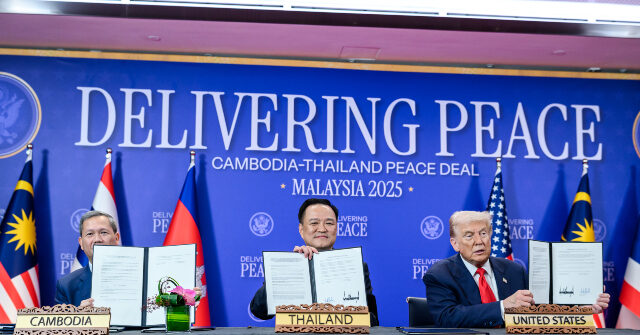
China’s state-run Global Times on Sunday sought to give Beijing credit for the ceasefire between Cambodia and Thailand negotiated by President Donald Trump.
The Global Times based its claim on the delegations from Cambodia and Thailand politely expressing “appreciation and gratitude for China’s positive role” in the negotiations that culminated in a signed ceasefire agreement on Saturday.
“International opinion widely holds that, in what has been called ‘one of the most serious armed confrontations between ASEAN countries since the end of the Cold War,’ China played a key mediating role in bringing the two sides to a ceasefire,” the Global Times boasted – and then rambled on for another 3,000 words without ever citing a single example of anyone outside of China expressing that opinion.
Instead, the editorial drifted into a kind of alternate reality daydream, in which Cambodia and Thailand ignored “traditional mediation led by Western countries” because it places such heavy emphasis on “so-called ‘human rights’ and ‘democratic transformation.’”
The Chinese Communist newspaper gave Beijing limitless credit for taking an “objective and impartial stance” to the Cambodia-Thailand conflict, “conducting multiple rounds of shuttle diplomacy,” and acting as “a friend and close neighbor to both countries.”
Later in this seemingly endless editorial demand for the world to give China some credit for negotiating peace between Cambodia and Thailand, the Global Times hinted at Beijing’s frustration that the world has not embraced it as a top-shelf global diplomatic power after it “facilitated reconciliation between Saudi Arabia and Iran” nearly three years ago.
“Unlike many past mediations dominated by the West, China does not adopt a condescending approach, impose political conditions, or seek geopolitical advantages,” the editors wrote, feverishly advertising China’s diplomatic services to a world that does not seem terribly interested in employing them.
The Global Times was correct to lament the persistence of the conflict between Cambodia and Thailand, which is driven by disputes over border territory that date back to Cambodia’s independence from French colonial rule in 1953.
There is a palpable sense that these two countries both wish to settle their differences with violence, even though the odds are rather heavily stacked against Cambodia. Each side consistently accuses the other of provoking each new round of small-arms fire and artillery exchanges. Trump had to use the kind of pressure derided by China to muscle Cambodia and Thailand into suspending a war that both of them want to fight.
Trump used tariff threats to bring both sides to the negotiating table for a ceasefire agreement in July, after dozens of civilians were killed and thousands dislocated in border skirmishes. Cambodia said this achievement was worthy of awarding Trump with the Nobel Peace Prize.
Hostilities resumed with a landmine explosion in November that injured four Thai soldiers on border patrol. Thailand blamed Cambodia for irresponsibly littering the border with mines. Several more Thai soldiers have been injured by mines since then, including another reported incident on Monday.
The new ceasefire deal signed on Saturday already looks shaky, with Cambodia accusing Thailand of conducting more airstrikes after the agreement was reached. President Trump urged both sides to return to the July agreement – and for the rest of the world, especially the United Nations, to get more involved in keeping the peace between Cambodia and Thailand – while China saw an opportunity to steal some thunder from Trump’s July deal and present itself as better positioned to mediate and monitor a durable ceasefire agreement.
China is essentially volunteering to assist a ceasefire monitoring mission by the Association of Southeast Asian Nations (ASEAN), coupled with some very modest donations of humanitarian aid to Cambodia and Thailand. Interestingly, Thailand was hesitant to accept the paltry $3 million in aid offered by Beijing.