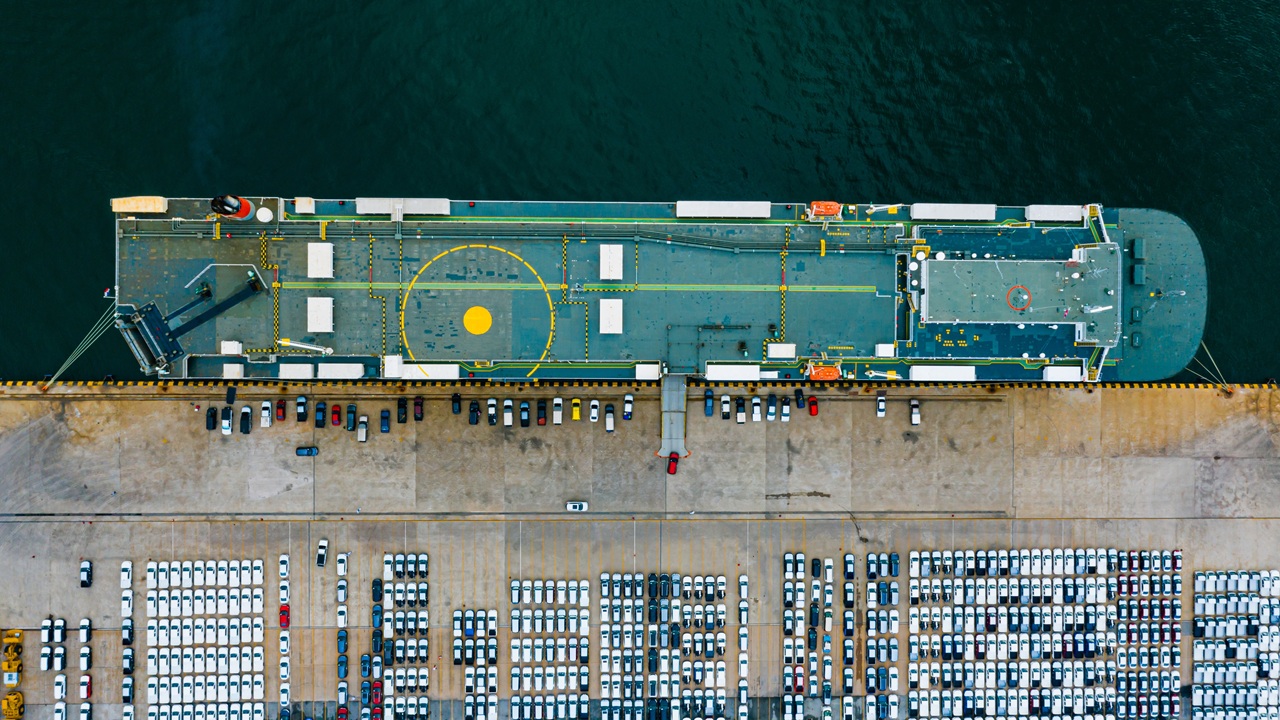
For now, the ferry’s purpose is to transport cars in Europe—but defense planners worry that it could also be used to unload military vehicles in Taiwan.
China’s shipbuilding industry is now the largest in the world, accounting for more than half of all the world’s shipping output. Much attention has been paid to how Beijing could operate half a dozen aircraft carriers by the mid-2030s, closing the gap with the United States. However, warships aren’t the only alarming thing that the Chinese shipbuilding industry is working on.
This month, Guangzhou Shipyard International Company Limited completed work on a massive car carrier capable of transporting 10,800 automobiles. Powered by liquefied natural gas (LNG), the vessel measures nearly 230 meters (754 ft) in length and 40 meters (131 ft) in width. It has 14 decks and can transport a variety of automobiles, including electric vehicles (EVs), hydrogen-powered cars, and heavy-duty trucks. It is far larger than the two previous car carriers—also built by China—each of which had space for 9,500 vehicles.
The primary role of the car carriers—at least in the short term—is to transport Chinese-made automobiles from Asia to overseas markets. Beijing has steadily gained a foothold in the global car industry, particularly with its low-cost but technically advanced electric vehicles (EVs) and hydrogen-powered cars.
Ferry Ships Are a Dual-Use Item
But in the event of a major conflict, such a massive Roll-on/Roll-off (RoRo) vessel could also have a secondary role with the People’s Liberation Army (PLA). Given its capacity and the fact that it can transport EVs and heavy-duty trucks, it could also carry armored vehicles and light tanks—and perhaps even main battle tanks (MBTs) with certain modifications.
For years, the PLA has considered ways to load massive passenger ferries, which were constructed with strengthened ramps and decks, with tanks and other assault vessels. The destination of these vessels is fairly obvious: Taiwan.
In 2021, the state-run Global Times reported that the PLA conducted an integrated military-civilian cross-sea troop-maneuvering exercise on a car ferry displacing 45,000 tons. It was much larger than similar vessels used in previous military drills. The exercise, conducted by troops from the PLA’s 81st Group Army, aimed to enhance the troops’ transport efficiency in a future battle and involved more than 1,000 personnel and vehicles.
The vessel, identified as the Chinese Rejuvenation, traveled more than 1,000 kilometers (600 miles) at sea while carrying a large number of combat vehicles including Type 96 MBTs, Type 04 infantry fighting vehicles (IFVs), and “Dongfeng Mengshi” tactical assault vehicles—as well as various support vehicles including medical vehicles, repair vehicles and engineering vehicles, reconnaissance vehicles and command vehicles.
The equipment was loaded in a predetermined sequence based on combat tasks, enabling each vehicle to be rolled out and enter combat the moment it arrived at a destination.
A Taiwanese Version of D-Day? Not Quite
The newly built RoRo car carrier would certainly not be able to carry as many tanks as cars, which are far lighter. What’s more, the ferry would still require a developed port for unloading vehicles—unlike a dedicated landing ship, which could release the tanks into the water on any beach and see them come ashore.
Still, Taiwan has a robust, highly developed maritime infrastructure that includes seven main international commercial ports and several more along both its western and Pacific coasts. If any of these ports fell into Chinese hands intact, unloading massive numbers of tanks to conquer the rest of the island in short order would be relatively straightforward.
It is for those reasons that Taiwan has seen Chinese civilian car carriers and ferries as a grave threat to its national security. With the introduction of this newest and largest car carrier built to date, the threat is even more apparent.
About the Author: Peter Suciu
Peter Suciu has contributed over 3,200 published pieces to more than four dozen magazines and websites over a 30-year career in journalism. He regularly writes about military hardware, firearms history, cybersecurity, politics, and international affairs. Peter is also a contributing writer for Forbes and Clearance Jobs. He is based in Michigan. You can follow him on Twitter: @PeterSuciu. You can email the author: [email protected].
Image: Shutterstock / AU USAnakul.