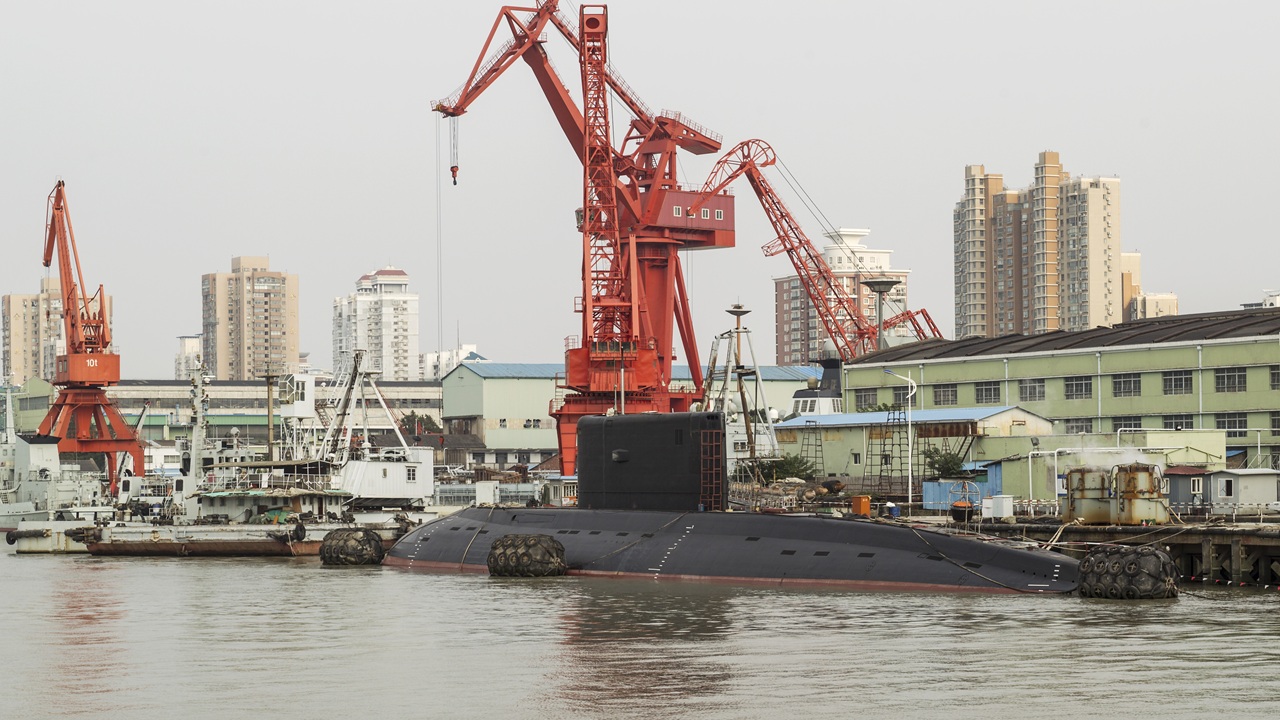
China now operates 59 submarines, compared to the US Navy’s 71—but it has expressed the clear intention to catch up.
China is expanding its submarine force to directly compete with its American counterpart, according to the US Navy’s most senior intelligence officer.
Beijing is undertaking the largest shipbuilding program in recent history in an effort to match the capabilities of the US Navy and change the balance of power in the Indo-Pacific.
China’s Submarine Force Is Growing—and Gaining Strength
“By 2040, the PLA Navy’s undersea forces may credibly challenge US regional maritime dominance, complicating crisis response, power projection, and allied defense,” Rear Admiral Michael Brookes, commander of the Office of Naval Intelligence (ONI), said on Monday in testimony to the US-China Economic and Security Review Commission, a congressional committee established to study the national security risks posed by China.
According to the chief of naval intelligence, China is aiming to have approximately 40 nuclear-powered attack submarines by 2035, including several new classes of attack submarines.
Thus far, Chinese strategy and shipbuilding have prioritized diesel-electric designs. These submarines are cheaper and easier to make. However, they can also be louder—and thus more vulnerable to detection and destruction—and also have limited range relative to nuclear submarines. The People’s Liberation Army Navy’s (PLAN) plans to have a fleet of at least 80 attack submarines.
Brookes testified before the Commission during a hearing on the balance of power in submarine warfare between the United States and China.
Beijing also plans to swell its guided-missile submarine fleet with between 20 and 30 new nuclear-powered cruise and ballistic missile submarines. The former specialize in land-attack operations, while the latter are equipped with ballistic missiles that can strike targets thousands of miles away and often carry nuclear warheads.
China’s Naval Ambitions Are Greater than Ever Before
Beijing’s current ambitions clash with Chinese naval history.
Throughout its age-old history, China has long failed to prioritize its naval forces. During its imperial era, China historically regarded itself as superior to other nations, and saw little reason to reach beyond the seas to engage with them. Unfortunately, this self-imposed isolation led China into its “Century of Humiliation,” during which it remained at the mercy of foreign powers and their navies.
After the People’s Republic of China won the country’s civil war in 1949, it focused on building a modern navy to ensure its sovereignty. However, for much of the 20th century, China’s navy focused on littoral combat—what one would call today a “green-water navy” focused on coastal self-defense, with some capability to operate deeper into the ocean but without a truly deep-ocean ability. Today, Beijing is shifting toward a “blue-water” naval force with the ability to deploy around the world and conduct sustained force projection and military operations.
“China’s approach to the maritime domain has evolved significantly. While historical narratives often focus on coastal and regional defense, today China’s military modernization reflects an ambition to operate farther from its shores, protect strategic interests, and shape outcomes in contested areas – especially in the East and South China Seas and surrounding approaches,” Vice Admiral Richard Seif, Commander, Submarine Forces, said in testimony to the commission.
China has approximately 59 submarines of all types.
China Wants to Catch Up to the US Submarine Fleet
The US Navy maintains the largest and most capable submarine fleet in the world with approximately 71 submarines. The Navy’s submarine fleet has three different categories: attack, guided-missile, and ballistic-missile subs.
A recent incident in the conflict with Iran highlighted the utility of the submarine in modern warfare. Last week, an unidentified Navy fast-attack submarine sank the Iranian frigate IRIS Dena in the Indian Ocean off the coast of Sri Lanka.
In a potential clash with China in the Indo-Pacific, the Navy’s fleet of fast-attack subs would have plenty of room and targets to hunt. But the threat of the growing Chinese submarine fleet will force the US Navy to take precautions.
About the Author: Stavros Atlamazoglou
Stavros Atlamazoglouis a seasoned defense journalist specializing in special operationsand a Hellenic Army veteran (national service with the 575th Marine Battalion and Army HQ). He holds a BA from the Johns Hopkins University and an MA from the Johns Hopkins’ School of Advanced International Studies (SAIS). His work has been featured in Business Insider, Sandboxx, and SOFREP.