Education establishment figures commonly criticize charter schools as harmful to students with disabilities. Former New York City Schools Chancellor Carmen Farina, for example, accused them of pushing out students with disabilities to keep test scores high.
New evidence from Michigan complicates this narrative, however, showing that charters improve both academic performance and attendance for these students.
Finally, a reason to check your email.
Sign up for our free newsletter today.
The study, published by the National Center for Research on Educational Access and Choice, analyzed roughly 60,000 Michigan K-8 students who switched from traditional public schools to charter schools between 2013 and 2018. After students switched, reading and math scores for those with and without disabilities improved—and at similar rates. Attendance also rose for both cohorts, with absences falling by 3.3 percentage points in the first year after charter entry.
Students with disabilities attending charter schools initially spent more time in general education classrooms, according to the study. Even several years after switching, when the overall amount of special education services resembled that provided in traditional public schools, students in charters were less likely to be assigned to intensive, costly programs that separate them from their peers.
The authors are careful, however, not to attribute academic gains to inclusion policies themselves. Instead, they note that Michigan’s special education funding model, which relies heavily on district funding with partial reimbursement from the state, may create an incentive structure that “demands innovation in a way that charter schools were theorized to provide, and which may be more apt to extend to special education.”
Given that academic gains were also observed among students without disabilities, the results likely have as much to do with overall school quality—improved order, instruction, and expectations—as with the design of special-education services. One possible explanation is that traditional public schools rely too heavily on disability classification, intensive placements, or accommodations for students with relatively mild special needs, inadvertently lowering expectations.
The Michigan results follow similar findings from a 2019 Boston study that found charters were better than traditional public schools at preparing students with disabilities to meet college-level standards. That study’s author concluded that “schools can boost the academic outcomes of special-education students without traditional specialized services.”
The Michigan study challenges entrenched assumptions about disability education and school choice. Charter schools can improve outcomes for students with disabilities, even while relying less on intensive and costly special education programs.
These results don’t mean that specialized services are unnecessary—but they do raise questions about whether public schools are deploying their resources efficiently, especially when it comes to students with relatively mild disabilities.
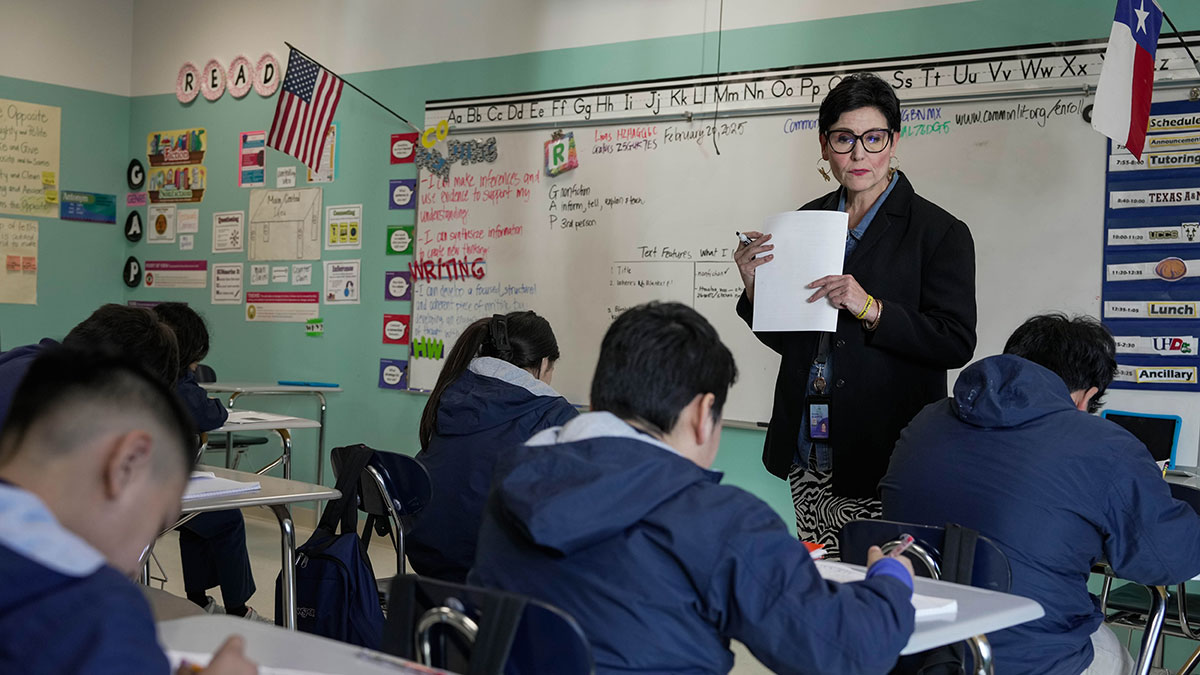
Photo by Raquel Natalicchio/Houston Chronicle via Getty Images
City Journal is a publication of the Manhattan Institute for Policy Research (MI), a leading free-market think tank. Are you interested in supporting the magazine? As a 501(c)(3) nonprofit, donations in support of MI and City Journal are fully tax-deductible as provided by law (EIN #13-2912529).
Source link