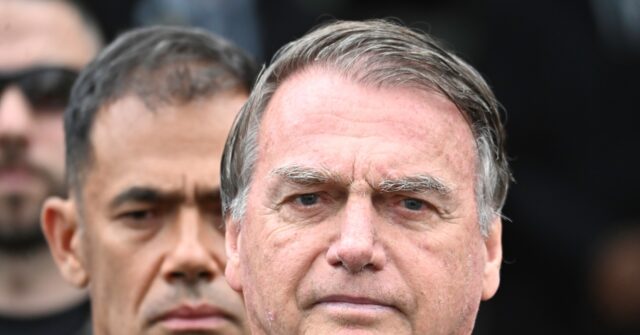
Brazilian Supreme Federal Tribunal (STF) Justice Alexandre de Moraes on Tuesday ordered conservative former President Jair Bolsonaro to begin serving his 27 year and three month prison sentence for “crimes against democracy.”
Bolsonaro officially began serving the sentence at the Regional Superintendency of the Federal Police in Brasília, where he remains detained since Saturday after tampering incident involving his electronic anklet bracelet.
“The defense allowed the deadline for new motions for clarification to pass without any response. Sentenced to 27 years and three months in prison, initially in closed custody, the former president will be held at the Regional Superintendency of the Federal Police in the Federal District, where he is already in preventive detention,” the STF’s press release read.
De Moraes’s new ruling marks the closure of the STF’s “coup” trial against Bolsonaro, in which he was convicted of conspiring with over 30 other individuals to stage a “coup” and overturn the results of the controversial 2022 presidential election. Then-incumbent Bolsonaro narrowly lost that election against radical leftist President Luiz Inácio Lula da Silva, who is serving his third term and has expressed his intention to run for a fourth term in 2026.
The STF found Bolsonaro guilty of “attempted violent abolition of the democratic rule of law, coup d’état, participation in an armed criminal organization, aggravated damage, and deterioration of listed heritage sites,” imposing a sentence of over 27 years on 70 year-old former president.
At press time, the STF has not determined if Bolsonaro will be transferred to a maximum security prison. Unnamed experts told CNN Brasil that, despite the length of the sentence, Bolsonaro could serve between five and seven years at a maximum security prison, as Brazil’s law states that first-time offenders can move from a more severe prison to a lenient one after serving a minimum portion of the full sentence. How much of the sentence needs to be completed depends on the calculations used to ascertain the severity of the five charges on which he was convicted and requires the observance of a “subjective” factor of good prison conduct.
The 27-year conviction also bans Bolsonaro from running for public office during the same time period. CNN Brasil reported that, since the conviction was issued by the Brazilian top court, Bolsonaro is also banned for an additional eight years after the end of his sentence, which effectively will make his ban from politics last 35 years. As a result, Bolsonaro will only be able to run for office again in 2060 when, if he is still alive, he will be 105 years old.
Last week, de Moraes rejected a request from Bolsonaro’s legal team seeking house arrest benefits for the former president for humanitarian reasons. Bolsonaro suffers from various medical conditions and recurring health complications, many of them stemming from a failed assassination attempt he suffered in 2018, when a man identified as Adelio Bispo de Oliveira stabbed Bolsonaro during a campaign rally. De Oliveria, a former registered member of the Socialism and Liberty Party (PSOL), claimed that he was “commanded by God” to kill Bolsonaro.
Earlier this year, Bolsonaro underwent a 12-hour emergency surgery to treat a new complication originating from the assassination attempt. His team described the procedure as the “most complex” since the initial surgery after he was stabbed in 2018. In September, the former president was diagnosed with skin cancer.
Experts consulted by CNN Brasil detailed that the possibility of house arrest will depend on medical and other reports, as well as an assessment of the care conditions in Brazil’s prison system — all of which, the experts stressed, must be reviewed by de Moraes.
“The measure would only be authorized if there is proven incompatibility between the clinical condition and the closed regime, and if the prison does not offer sufficient structure,” the experts reportedly said.
Alexandre de Moraes, widely described as Brazil’s most powerful justice, was the subject of U.S. sanctions under the Global Magnitsky Act in late July in response to his years-long persecution and censorship of Bolsonaro, his allies, and other conservative voices in Brazil, as well as to his pervasive censorship orders against American tech companies.
On Tuesday, at the request of Bolsonaro’s legal team, de Moraes authorized that Bolsonaro be allowed to receive special meals prepared outside the Federal Police facilities, but instructed that the meals can only be delivered by a person appointed by his lawyers. The Justice further ordered that Police officers inspect their contents before Bolsonaro receives them.
Former First Lady Michelle Bolsonaro recently expressed to CNN Brasil that she was concerned about her husband’s nutrition as inadequate prison meals could worsen his existing conditions. Bolsonaro reportedly refused to take food made by the police.
Bolsonaro remained under a strict house arrest since August by order of de Moraes. On Saturday, the justice ordered the police to arrest him after Bolsonaro tampered with his electronic anklet device.
The former president testified to the police that he suffered from a hallucination and used a soldering iron on the bracelet. Bolsonaro’s medical team told the police that another doctor prescribed pregabalin to Bolsonaro without the knowledge or consent of the team, which has “recognized side effects, including altered mental state with the possibility of mental confusion” if taken with medications he regularly takes to treat his conditions.
Christian K. Caruzo is a Venezuelan writer and documents life under socialism. You can follow him on Twitter here.