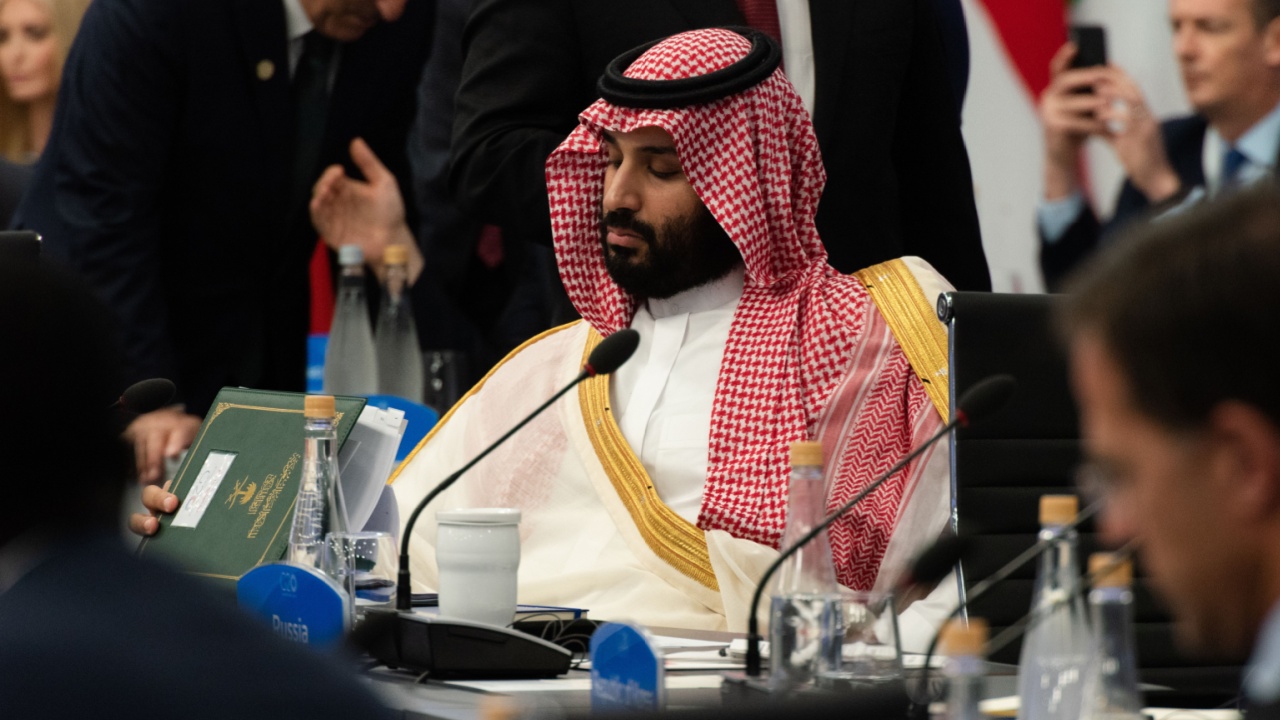
In many ways, Saudi crown prince Mohammed bin Salman is repeating the mistakes of the Shah of Iran in the 1970s.
The Saudi crown prince Mohammed bin Salman’s (MBS) recent visit to Washington has refocused attention on Saudi Arabia’s importance to the United States and on his role as the primary driver of Saudi domestic and foreign policy. Even though he is not a head of state, MBS’ reception featured a degree of pomp and ceremony that would make most heads of state visiting Washington feel jealous.
The visit from MBS’ point of view went very well. He received complete absolution for his alleged role in the murder of Washington Post columnist Jamal Khashoggi despite American intelligence reports that he had ordered the killing. Instead of being treated like a “pariah” as President Joe Biden had promised to do (a promise he later broke), he was lionized as a great friend of the United States. In fact, President Donald Trump reprimanded the ABC correspondent at the joint press conference who dared to raise the Khashoggi issue.
The visit was also a success for MBS in concrete policy terms. It augmented the strong strategic ties that already exist between the United States and Saudi Arabia. President Trump announced that he had decided to recognize Saudi Arabia as a “major non-NATO ally,” a designation that, among other things, allows Riyadh expedited access to American military hardware. President Trump also announced that he had authorized the sale of F-35 fighter jets and other military equipment to Saudi Arabia, although the jets will lack capabilities that would erode Israel’s military superiority in the region. This has been the standard American practice in weapon deals with other Middle Eastern states.
The American interest in cultivating Saudi Arabia is obvious. It is an energy powerhouse, the swing producer in the oil market, and, given the fast pace of modernization under MBS, provides vast investment opportunities to American companies. It is also the kingpin of the pro-American regional security system of the energy-rich Persian Gulf and the potential counterbalance to Iran, ruled by viscerally anti-American mullahs.
Moreover, Saudi Arabia’s participation in the Abraham Accords is essential to Israel’s integration into the Middle East. During his visit, MBS expressed interest in normalizing relations with Israel on the condition that it be accompanied by a clear path to a Palestinian state.
On the surface, the relationship works to the advantage of both sides. However, Washington needs to recognize the pitfalls that may arise from a close relationship with MBS. An autocratic regime driven by the whims and fancies of one person is not a bulwark of stability. As the Iranian revolution clearly demonstrated, domestic politics cannot be delinked from foreign relations. Changes in domestic power structures can radically alter a country’s foreign policy orientation.
The fate of Imperial Iran should act as a salutary reminder for Washington. Saudi society is undergoing rapid modernization under the direction of the crown prince, just as Iranian society was undergoing Shah Mohammad Reza Pahlavi’s “White Revolution.” Such top-down transformations disturb traditional social and political structures without allowing new ones to take root.
Moreover, modernizing societies demand responsive and accountable political institutions. As it happens, MBS’s strategy is a carbon copy of the Shah’s: societal modernization under a repressive regime that does not brook opposition and denies popular participation. This is a recipe for political instability and perhaps even regime change.
Just as the Shah alienated Iran’s clerical establishment with his social reforms, MBS is increasingly alienating Saudi Arabia’s Wahhabi imams. This may turn out to be even more dangerous for the Saudi regime than it was for the Shah, since the latter was never as dependent on religious legitimacy as the Saudi monarchy.
The Saudi state came into existence as a result of the compact between the royal House of Saud and the founder of Wahhabi theology, Muhammad ibn Abdul Wahhab. The Wahhabi ulema, led by his descendants, played a leading role in legitimizing Saudi rule over the whole peninsula. Even when the Saudi rulers deviated from strict Wahhabi religious interpretations, the Al Asheikhs, the descendants of Muhammad Abdul Wahhab, provided cover for them as long as the royal family protected their basic interests and refrained from publicly violating Islamic norms.
MBS has breached this compact and sidelined the Wahhabi establishment, threatening their social and religious status. If the Shia ulema of Iran, who were on the fringes of political power, could bring down the Shah, the Wahhabi ulema, who have traditionally been an integral part of the Saudi power structure, would have even greater incentive and opportunity to undermine the current Saudi regime. With the old compact eroding and with no nascent democratic or constitutional structures to replace it, the foundations of MBS’s rule appear extremely shaky. The absence of both religious and popular legitimacy could prove to be its Achilles heel.
There is a further twist to this tale. Since the inception of the Saudi state, the royal family, numbering in the thousands, has decided on domestic and foreign policy issues through consensus among the most powerful princes. This glue held the power structure together. The leading princes understood that if they did not hang together, they would hang separately.
King Salman broke this fundamental rule of governance when he selected MBS as crown prince and de facto ruler in 2017. To add insult to injury, MBS has treated leading members of the House of Saud in an abusive fashion, including incarcerating several of his potential competitors. In other words, the intra-royal family compact has also been broken, making his future look even gloomier. For the moment, other leading members of the House of Saud may be lying low out of deference to the aging and infirm King Salman. But once Salman leaves the scene, the knives could very well be out for MBS. It will be more difficult for MBS to remain in power as dynastic challengers converge with waning popular and religious legitimacy.
The fact that Washington has put all its eggs in MBS’s basket may boomerang eventually. Just as Iran reverberated in 1979 with the slogan “Down with the American Shah,” one cannot rule out the possibility that Saudi Arabia may one day resonate with the slogan “Down with the American Malik (King).” If this happens, the United States may have to face the prospect of dealing with two hostile regimes on both sides of the Persian Gulf.
About the Author: Mohammed Ayoob
Mohammed Ayoob is a university distinguished professor emeritus of international relations at Michigan State University and a senior fellow at the Center for Global Policy. His books include The Many Faces of Political Islam (University of Michigan Press, 2008), Will the Middle East Implode (2014), and, most recently, From Regional Security to Global IR: An Intellectual Journey (2024). He was also the editor of Assessing the War on Terror (2013).
Image: Matias Lynch / Shutterstock.com.