Bostic Is Fighting a Phantom Menace to Fed Credibility
Federal Reserve Bank of Atlanta President Raphael Bostic dissented from the Federal Open Market Committee’s December rate cut, warning that the Fed’s credibility on inflation “could be at stake.” In a strongly worded statement released Wednesday, he argued that five years of above-target inflation risks unmooring expectations and potentially requiring the kind of painful recession that Federal Reserve Chairman Paul Volcker imposed in the early 1980s to break the back of inflation.
There’s just one problem: The very data Bostic cites doesn’t support his dire warnings.
Bostic points to his own institution’s Business Inflation Expectations (BIE) survey as evidence that “inflationary expectations are not limited to importers directly affected by tariffs” and that firms “expect to raise prices well into 2026, and by substantially more than 2 percent.” He’s particularly concerned about long-term expectations, warning that “a half decade—and likely soon to be longer—of missing the inflation target could well imperil the Committee’s credibility.”
But a closer look at the Atlanta Fed’s BIE data reveals that inflation expectations are remarkably well-anchored. And instead of worsening, they’re getting better.
(Photo: iStock/Getty Images)
The One-Year Picture: Mission Accomplished
According to the BIE survey, businesses expect inflation of 2.2 percent over the next year. That’s barely above the pre-pandemic average of 2.0 percent from 2017-2019, when nobody was fretting about Fed credibility.
More importantly, expectations have declined dramatically from their April 2022 peak of 3.8 percent. That’s a 160 basis point drop, textbook re-anchoring of expectations following an inflation shock. The fact that expectations haven’t returned all the way to 2.0 percent but instead stabilized at 2.2 percent is hardly evidence of a credibility crisis. It’s evidence that the Fed’s framework is working.
These figures come from a monthly survey in which the Atlanta Fed asks businesses about ‘unit costs.’ A 2022 study by Brent H. Meyer of the Atalanta Fed and Xuguang Simon Sheng of American University found that firms’ unit cost expectations closely track actual inflation and significantly outperform household inflation expectations in forecasting future price pressures. In other words, firms are actually pretty good at forecasting inflation when they are asked to predict their own costs.
Bostic specifically worries that firms plan to raise prices “substantially more than 2 percent.” But it’s not clear that he should be paying much attention to that rather than the unit cost projections with a far more established record. The Atlanta Fed only began asking firms to project their own price increases in December of 2020 and to record their realized price changes but until recently it asked these only sporadically and now asks these questions quarterly. So far, it has asked about projected and realized price changes 16 times, which is not a very long time series.
What’s more, the answers have not been very predictive of what firms later reported or broader inflation. In December 2020, the average predicted price increase was just 1.6 percent. By November 2021, they reported that their prices had gone up 9.1 percent. The personal consumption expenditure price index was up around four percent that year. In October 2023, firms forecast they would raise prices by 3.4 percent. The following November, they said they’d raised prices by 4.1 percent, and PCE inflation showed prices up 2.5 percent.
Even if you wanted to insist on watching the responses to these survey questions, the more recent results should be reassuring. Firms now say they expect to raise prices by three percent, the lowest expected price increase since 2021. This is down from the previous quarter, which was down from the quarter before that. In other words, the projected prices changes are not showing signs of de-anchoring. They are moving in the right direction.
The Long-Term Evidence: Even Better
The real surprise comes from long-term expectations, which Bostic claims show worrying persistence.
But long-term expectations are falling, from 2.82 percent in September to 2.73 percent in December. That means that long-term expectations are now below their pre-pandemic average of 2.77 percent.
Read that again. The measure that should be most sensitive to credibility concerns—what businesses expect inflation to be five to ten years from now—is lower today than it was when the economy was supposedly in the sweet spot of 2017-2019. If Fed credibility were truly “at stake,” we’d expect to see long-term expectations rising, not falling to below pre-pandemic levels.
The Real Credibility Problem
There’s an irony in Bostic’s position. He warns that the Fed risks losing credibility if inflation stays above two percent for too long. But the most direct threat to Fed credibility right now isn’t inflation runs high. It’s that the Fed’s public pronouncements that tariffs would push up inflation have not materialized and show no sign of coming true. This could well give rise to the impression that the Fed doesn’t understand the basic dynamics of inflation.
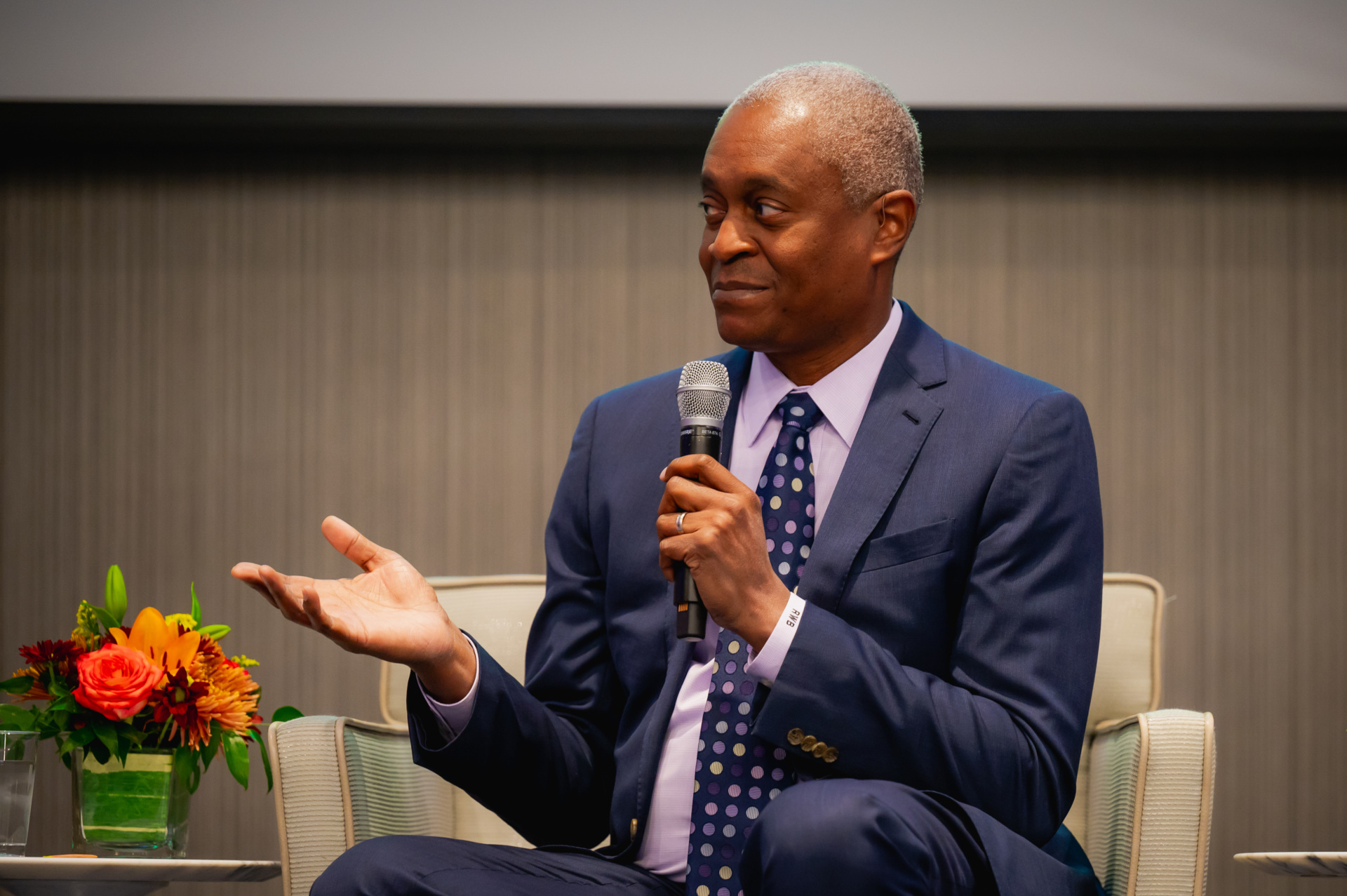
Federal Reserve Bank of Atlanta President Raphael Bostic speaks at a Fed conference in Dallas, Texas, on Oct. 31, 2025. (Desiree Rios/Bloomberg via Getty Images)
If the Fed is widely seen as holding interest rates too high to combat phantom tariff-led inflation, the public and the politicians may lose patience. Fed independence depends on faith in the Fed’s ability to read the economy. If the latter fades, there’s a good chance the former will also.
The BIE survey shows that businesses’ inflation expectations have successfully re-anchored after the pandemic shock. One-year expectations are at 2.2 percent, barely above pre-pandemic levels. Long-term expectations are at 2.73 percent, actually below pre-pandemic levels and declining. This is what success looks like.
By dissenting from the December rate cut and calling for a pause in easing, Bostic is essentially arguing that the Fed should tighten policy to address an expectations problem that his own data shows doesn’t exist. It looks like he wants monetary policy to fight his own expectation that tariffs will cause inflation, despite the lack of evidence for this belief.