The British fighter jets are in the Middle East to defend the UK’s regional military installations, most notably on Cyprus.
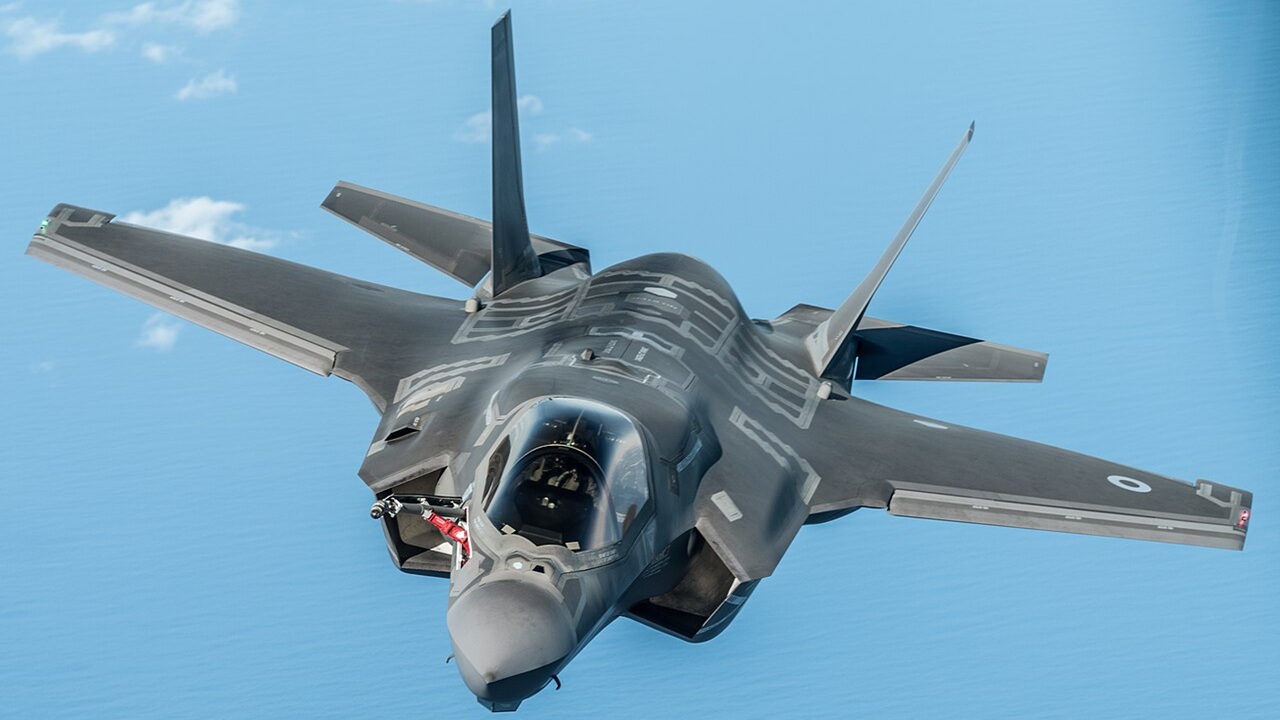
Royal Air Force (RAF) Lockheed Martin F-35B Lightning stealth fighters have reportedly scored their first aerial victory, downing Iranian drones over Jordan this week.
“RAF F-35B jets operating over Jordanian airspace shot down uncrewed aerial systems in defence of Jordan. This marks the first time the RAF F-35 has shot down a target on operations. The aircraft was supported by RAF Typhoon jets and a Voyager air-to-air refuelling aircraft as part of our defensive operation to protect British interests and allies,” the UK’s Ministry of Defence said in a post on Facebook.
The MoD did not confirm how many drones had been shot down.
What Are British F-35s Doing in the Middle East?
Though the United Kingdom is not formally a party to “Operation Epic Fury,” its military assets in the region have become the target of Iranian retaliation. The UK has also helped to defend allied Arab nations in the region—hence the presence of its fighter jets over Jordan.
Six British F-35Bs were deployed to RAF Akrotiri in Cyprus in February, augmenting the RAF’s Eurofighter Typhoons already stationed on the eastern Mediterranean island, according to international military analyst firm Janes.
“In their air-defence configuration, F-35Bs are armed with the MBDA AIM-132 Advanced Short-Range Air-to-Air Missile (ASRAAM) and the RTX AIM-120 Advanced Medium-Range Air-to-Air Missile (AMRAAM). They are not equipped with the 25 mm external gun pod as carried by other operators,” Janes reported.
The F-35B is the short takeoff and vertical landing (STOVL) variant of the multirole Joint Strike Fighter. The first British Lightning—the UK’s designation for the fifth-generation stealth fighter—arrived at RAF Marham in June 2018, with 617 Squadron “the Dambusters” becoming combat-ready in 2019. It reached Initial Operating Capability (IOC) for carrier operations in January 2021, in advance of the Royal Navy’s flagship HMS Queen Elizabeth during the aircraft carrier’s Indo-Pacific CSG21 deployment that year.
British F-35s had previously been employed in armed reconnaissance and intelligence gathering over Iraq and Syria, operating from RAF bases in Cyprus. RAF F-35Bs also flew combat sorties from HMS Queen Elizabeth in June 2021 in support of Operation Shader and US Operation Inherent Resolve, striking ISIS positions in Syria.
The F-35B Lightning II’s Specifications
The major difference separating the F-35B from the conventional F-35A and carrier-capable F-35C is its ability to land vertically—giving it greater versatility and allowing it to operate from short airstrips and even small aircraft carriers. As a STOVL aircraft, the UK’s F-35Bs can operate from the UK’s two aircraft carriers, as well as austere forward bases and even damaged infrastructure.
- Year Introduced: 2019
- Number Built: ~150+ (as of 2025; production ongoing)
- Length: 51.5 ft (15.7 m)
- Wingspan: 35 ft (10.7 m)
- Weight:
- Empty weight: ~32,300 lb (14,650 kg)
- Max takeoff weight: ~60,000 lb (27,200 kg)
- Engine: One Pratt & Whitney F135-PW-600 afterburning turbofan with shaft-driven lift fan
- Thrust: 41,000–43,000 lbf with afterburner (rear nozzle swivels for STOVL)
- Top Speed: Mach 1.6 (1,200+ mph, 1,930 km/h)
- Range: ~900 nmi (1,670 km) without refueling
- Service Ceiling: 50,000 ft (15,000 m)
- Loadout:
- Internal bays: Up to 15,000 lb (6,800 kg) of ordnance
- Hardpoints: 6 external pylons (not used during stealth missions)
- Missiles: AIM-120 AMRAAM, AIM-9X Sidewinder, future AIM-260 JATM
- Bombs: JDAM family, Small Diameter Bombs, GBU-12/31/32, nuclear-capable B61 (planned integration)
- Aircrew: 1
About the Author: Peter Suciu
Peter Suciu has contributed to dozens of newspapers, magazines, and websites over a 30-year career in journalism. He regularly writes about military hardware, firearms history, cybersecurity, politics, and international affairs. Peter is also a contributing writer for Forbes and Clearance Jobs. He is based in Michigan. You can follow him on Twitter: @PeterSuciu. You can email the author: [email protected].