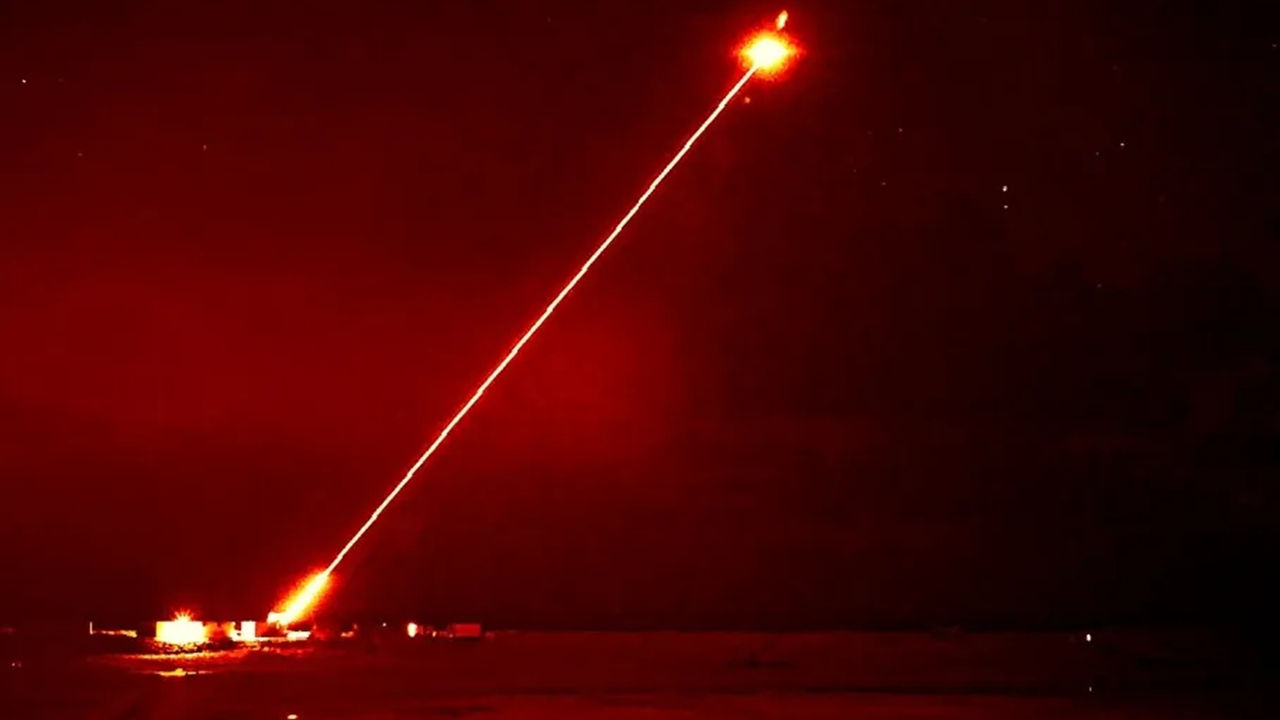
Despite the DragonFire laser’s impressive capabilities, it is not perfect; like all laser weapons, it operates only within line of sight, and can be degraded by poor weather conditions.
DragonFire is a British laser-directed energy weapon (LDEW) currently under development for the Ministry of Defense (MoD) by a joint industrial team consisting of MBDA UK, QineticQ, and Leonardo UK. The system is intended to defend against aerial threats, including unmanned aerial vehicles (drones) and potentially incoming projectiles, such as mortar rounds or even missiles.
But the project has taken on far greater importance than previously thought because of the return of the Russian military threat to Europe, as well as the desire in the UK and throughout Europe to indigenously produce new arms.
Given the threat that drones, and a variety of missiles engaged in swarming tactics have taken on during the Ukraine War, the British system is a necessary investment.
Understanding the DragonFire System
Whether the British will ever be able to make this system work, and to scale it to where it needs to be in order to remain effective against Russian drones, artillery, and missiles, is another question entirely. After all, the British defense industrial base is a shadow of its former self—even with the increased inputs from the British government.
According to a UK Defence Journal article, recent trials at the MoD Hebrides range (near Scotland) resulted in the weapon destroying high-speed drones. Targets in some trials traveled at around 650 kilometers per hour (403 mph)! The MoD stated that the system achieved a UK first in above-horizon tracking, targeting, and engagement. Back in 2022, Popular Science showed how a long-range test neutralized a small drone at around two miles away.
As of April 2024, the UK government accelerated its procurement timeline. Reuters reported that a contract was awarded for €316 million ($413 million) to MBDA UK, with installation aboard a Type 45 destroyer scheduled for around 2027.
Conventional anti-drone or anti-air missile systems cost many hundreds of thousands per shot. In contrast, DragonFire claims cost per laser shot on the order of ten pounds. Drones (especially swarms) and low-cost air threats are proliferating. A laser weapon offers a scale at lower cost revenue.
Being just a beam powered electricity means that the weapon avoids the logistical burden of missile reloads and storage. The MoD sees this as part of the future force mix. For the United Kingdom, achieving a deployable high-energy laser is a prestige and strategic defense milestone—showing it is at the technological frontier.
The DragonFire Laser Is Not a Silver Bullet
As with most laser weapons, the DragonFire’s effect for targets is within line of sight only. Lasers can be degraded by weather, dust, smoke, moisture or turbulence, all of which can impact beam quality and propagation. Delivering high-energy beams at sea (on a ship) or in a mobile land vehicle demands substantial power generation, energy storage, and cooling systems.
With fast-moving threats, the tracking, pointing, and dwell time needed to burn a target matters. The integration of sensors, beam director, and automation is critical. Adversaries may attempt to degrade or defeat directed-energy weapons via hardening, obscurants, and reflective coatings or maneuvers. But this system is harder to evade than your usual offensive weapons.
Embedding such weapons aboard ships or ground vehicles involves detailed engineering and high-cost tradeoffs.
DragonFire could shift part of Britain’s air/anti-drone defense paradigm from expensive missiles to cheaper energy blasts. On maritime platforms, like Royal Navy warships, laser defense offers a means to protect high-value assets from low-cost threats at more sustainable cost-per-engagement factors.
For a near-peer competition, directed-energy weapons become part of the “defense of the future” toolkit. The test also signals that the UK is accelerating the transition from demonstration to operational fielding—moving from lab-to-the-sea.
Britain might soon have a new system to export to its allies. After all, countries looking for advanced anti-drone or directed-energy systems might partner or procure such technology, further positioning the UK defense industry. It’s a vital step in a very concerning direction; a near-future where the enemies are far apart but still destroying each other via unmanned platforms, and where science fiction-like lasers are the only real defenses.
About the Author: Brandon J. Weichert
Brandon J. Weichert is a senior national security editor at The National Interest. Recently, Weichert became the host of The National Security Hour on America Outloud News and iHeartRadio, where he discusses national security policy every Wednesday at 8pm Eastern. Weichert hosts a companion book talk series on Rumble entitled “National Security Talk.” He is also a contributor at Popular Mechanics and has consulted regularly with various government institutions and private organizations on geopolitical issues. Weichert’s writings have appeared in multiple publications, including The Washington Times, National Review, The American Spectator, MSN, and the Asia Times. His books include Winning Space: How America Remains a Superpower, Biohacked: China’s Race to Control Life, and The Shadow War: Iran’s Quest for Supremacy. His newest book, A Disaster of Our Own Making: How the West Lost Ukraine is available for purchase wherever books are sold. He can be followed via Twitter @WeTheBrandon.
Image: Wikimedia Commons / UK Ministry of Defence.