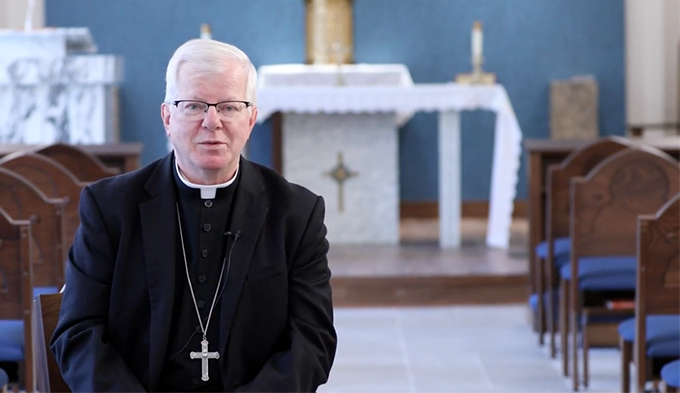
Bishop Francis Malone, 75, has served as Bishop of Shreveport, Louisiana, since 2020. Shreveport is the northernmost of the seven dioceses of Louisiana and serves nearly 40,000 Catholics. Shreveport borders Arkansas to its north, with Texas to the west and Mississippi to the east. While much of the southern region of Louisiana is Catholic, Shreveport has a large Baptist population.
Bishop Malone was raised in Philadelphia, where vocations were abundant in his youth, and recruited (with the blessing of the Archdiocese of Philadelphia) to serve in the Diocese of Little Rock, which encompasses the entire state of Arkansas, where vocations were sparse. Among the clergy serving in Little Rock was his uncle, Msgr. Bernard Malone, with whom he lived when he first came to Little Rock.
He was ordained a priest for Little Rock in 1977 and served in various capacities for 43 years until Pope Francis appointed him, at age 69, to serve as Bishop of Shreveport at the end of 2019.
Growing up, he was the fourth of nine children in a devout Catholic home. His father was a civilian working for the U.S. Army. Among the traumatic experiences in his life was losing his 37-year-old mother to a blood-clotting ailment when he was 12 and his youngest sibling was just three months old.
He was educated in Catholic schools by the Sisters of St. Joseph and the Oblates of St. Francis de Sales. He attended Holy Trinity Seminary at the University of Dallas and earned a License in Canon Law from The Catholic University of America in Washington, D.C.
Although one of his siblings has died, he and the remaining seven, all practicing Catholics, remain close and join together on Sunday evenings via Zoom to pray the Rosary.
CWR: What was the Catholic Church in Philadelphia like growing up in the 1950s and the 60s?
Bishop Francis Malone: We grew up attending the Nativity of the Blessed Virgin Mary Parish, which had its origins as an Irish church. The neighborhood was predominantly Catholic. Within a mile of us were several other parishes that initially served other ethnic communities, including the Polish, Italians, Germans, and Lithuanians.
Nativity was a large church, and the parish school had three classes per grade. There were 150 in my class. I moved on to Catholic high school. I have good memories of the neighborhood and parish. It is still vibrant today and serves a large number of Polish Americans who keep the neighborhood Catholic.
My father’s brother, Bernard Malone, grew up in the same neighborhood as I did. Because Philadelphia had many vocations, he and other young men in the area interested in the priesthood were encouraged to go to Arkansas and serve the Church there. He went to Little Rock in 1942 after high school and was ordained a priest in 1950, before I was born. He lived to be 93 and was a stellar individual.
Some people ask if he was the impetus for my vocation. While he was a great guy, my vocation more fundamentally came through the influence of the five priests who served our parish: the pastor, three associates, and one priest in residence who taught at the high school. They formed me as I was growing up. I learned Latin from them and watched them celebrate Mass. One of my most special memories of those priests was watching one come to my house to anoint my mother the night she died.
CWR: Was your family devout?
Bishop Malone: Yes. My father taught us to pray, and during Lent got us up at 6 a.m. to go to Mass. A lot of my vocation came from him as well. He was a holy, wonderful man. He was in the Legion of Mary, and he’d gather us to pray those prayers. We’d also pray the rosary together.
CWR: What are your memories of your mother?
Bishop Malone: She was a stay-at-home mom; much of my recollection of her is as a pregnant woman. Her death was very hard on the family. At age 41, when she died, my dad became mother and father to us, making sure we were schooled properly and trained domestically. My mother had taught us how to cook, wash dishes, and set the table; the boys were responsible for firing up the coal furnace in the basement. Her death is very difficult for me to talk about, even today. It was a very bad night, and there are still a lot of emotions attached to it.
CWR: How long have you been praying the rosary with your siblings?
Bishop Malone: It began six years ago when I became a bishop. My younger brother, John, organizes it. He emails us during the week to tell us which decade of the rosary we will lead. He turns it over to me when we’re finished, and I offer a reflection and a blessing. It takes just over half an hour.
We’ve always been close, but saying the Rosary has really solidified our relationship.
CWR: When did you decide you wanted to go to the seminary?
Bishop Malone: I sensed my vocation as an altar boy serving at my parish church. I was in the 4th grade, and I believe the Lord was speaking to me, saying, “I want you to be a priest.”
Young men in Philadelphia had been going from Philadelphia to Little Rock since the 1930s and 40s; by the 1950s, half of the priests in Arkansas were from Philadelphia. They’d come back to visit family in Philadelphia, and I got to know many of them. When I was ordained in 1977, they became my brother priests.
CWR: When you first came to Little Rock, you lived with your Uncle Bernard.
Bishop Malone: Yes. I was his gofer. I cleaned the rectory, and I’d serve Mass for him. It was a positive experience and gave me time to adjust to life in the Arkansas Delta. I soon became comfortable there and, once ordained, began to serve the same people my uncle did. I did miss my family in Philadelphia, but I would come home for Christmas and other holidays.
CWR: You were ordained a bishop at age 69, an age when many men are thinking about retirement. Was it difficult to make this adjustment at that point in your life?
Bishop Malone: I wasn’t expecting it. But, as the Parable of the Workers in the Vineyard (Matthew 20:1-16) reminds us, workers can be called at any time of the day.
CWR: How is the Diocese of Shreveport doing for priestly vocations?
Bishop Malone: We have six seminarians, which, for a diocese of our size and in comparison to many dioceses, is pretty good.
CWR: Before becoming bishop, you were the pastor of Christ the King Church in Little Rock for 19 years. You started having perpetual adoration…
Bishop Malone: Yes. When I came to the parish in 2001, it had produced no vocations. I went to the people and said we were starting a 24/7 perpetual adoration program, and over 90 people signed up.
My idea was to have four or five people in adoration there at a time. We almost immediately started to get vocations. When I started, we had no vocations in the parish; in the years since, we had 14 ordained to the priesthood. That can’t be a coincidence.
One time, I recall, we didn’t have people signing up for the late-night hours, and our vocations dropped off. We put out three sign-up tables for people after Mass and encouraged more people to volunteer. They did, and our vocations numbers immediately increased. I brought the same program to Louisiana.
CWR: Who are the Shreveport Martyrs? And why do you believe they are good candidates for canonization?
Bishop Malone: They are five priests originally from France who died during a yellow fever epidemic in Shreveport in 1873. While many people fled the area, these five stayed and ministered to the sick and dying. They contracted the disease themselves and ministered to one another before dying of the disease themselves.
Their story is remarkable. They could have returned to France and survived, but chose instead to stay. Shortly after their deaths, the bishop said he believed one day they’d be canonized. I hope to see them declared venerable during my lifetime.
They are presently Servants of God. I went to Rome to the Dicastery for the Causes of Saints to present their cause. All seems to be going well, but you never know when we will hear back.
CWR: What are some of the major projects you have going on in the diocese?
Bishop Malone: Whenever I come to a new place, I see the opportunity for projects. Two that I have worked on in Shreveport include the construction of a retreat center and the renovation of a high school. It’s always a challenge to get funding; you have to sell the people on what you want to do.
CWR: What do you plan to do in retirement?
Bishop Malone: I’d like to help out at the parishes during weekends. I’ll spend time with my family in Philadelphia. Hopefully, my health will be good, which it has been.
CWR: Besides your father and those priests you’ve mentioned, who are your Catholic heroes?
Bishop Malone: I’d have to say those people I’ve known who were entrusted to my care, my parishioners. Many of them live exemplary lives and have helped me to be a better priest and stay focused on the spiritual life.
CWR: How can Catholics grow in their spiritual lives?
Bishop Malone: Be immersed in the life of your parish church. Go to Mass and confession frequently, participate in perpetual adoration or a devotion, and be part of a parish organization.
Support your parish priest; pray for him. I can tell you as a parish priest, looking out from the sanctuary at the congregation, you see the same people. I can’t help but thinking these are the saints of the Church, and they’re praying for me.