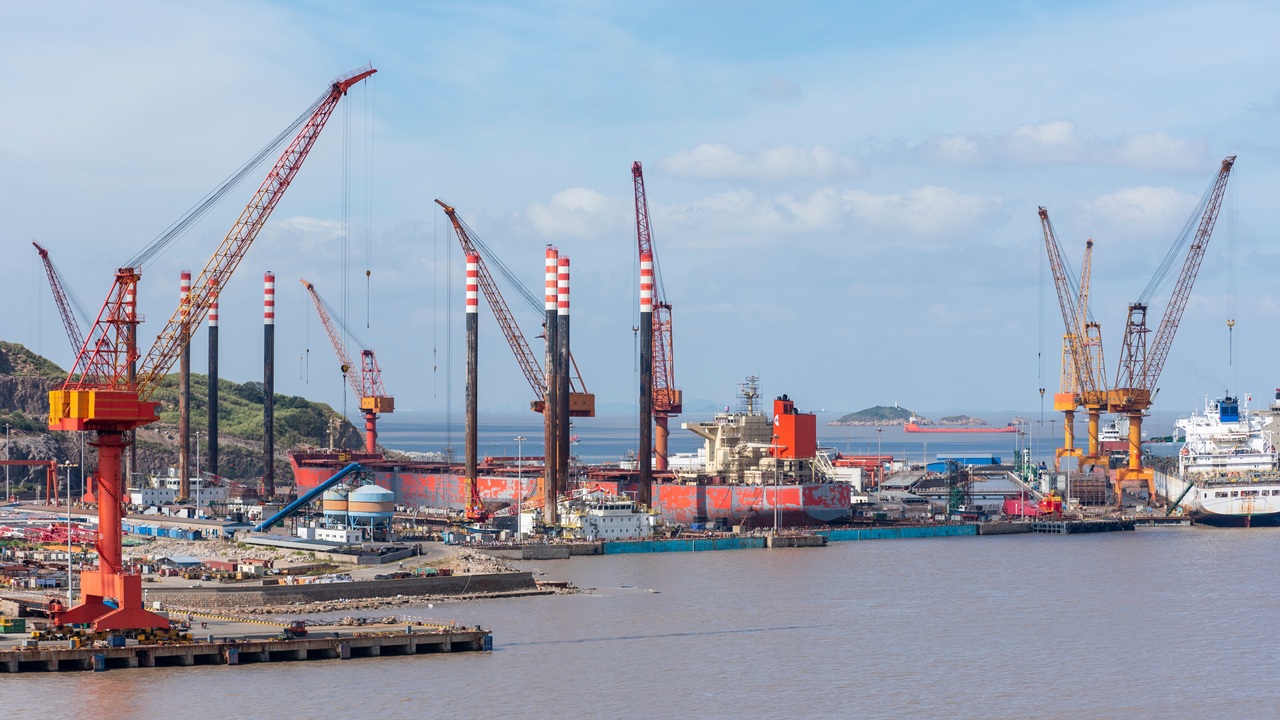
China understands that raw industrial might, not the best possible platform, is the key to victory in a future great power conflict. The Pentagon does not.
America’s admirals love to posture about “lethality,” “dominance,” and “deterrence.” But here’s the very sad—ugly—truth about America’s naval shipyards: the United States Navy cannot keep up with China when it comes to mass production of naval assets, notably warships and submarines.
America cannot keep up in terms of production speed, in terms of industrial capacity, and in terms of sheer national willpower.
The Yardstick of Power: Shipyards, Not Slogans
The People’s Republic of China has gone from being an agrarian backwater ruled by a cult of personality under Mao Zedong, to the world’s sweatshop under Deng Xiaoping, to a nation of engineers with truly next-generation industrial skill and might under Xi Jinping.
Indeed, the Communist Party of China (CPC) has built for itself the world’s greatest naval shipbuilding capacity since the United States in World War II.
Meanwhile, America’s naval shipyards look like rusting museums dedicated to a lost era of maritime supremacy—nostalgic, slow, overpriced, overregulated, and chronically behind schedule. Some people, like gCaptain editor-in-chief John Konrad IV, have been warning about this grave strategic threat for years. And to be fair, some elected officials in Congress and some experts in the Trump administration have heard his warnings loud and clear. But hearing and listening are two very different things.
What’s needed is an all-of-society approach to the naval shipyard crisis in America today. We’re getting slogans and empty promises. China, however, has not only caught up to the Americans in terms of quantity, but is starting to pull away. Slowly but surely, Chinese shipyards are now catching up in quality, too.
Although, it should be noted here that my colleague, the Russian military expert, Andrei Martyanov, recently explained to me how the Chinese are still lagging in key areas of naval power when compared to both the Americans and the Russians—particularly in submarine technology. Nevertheless, even a blind pig can find its slop bowl after a while.
China’s Not-So-Secret Weapon Is Its Commercial Juggernaut
American admirals love to remind rapt Congressional overseers that the US maintains “the world’s most advanced Navy.” But that’s not the metric that matters in a long war. What matters under those conditions is: Who can build ships faster? Who can replace losses at sea first? Who has the industrial base to scale?
China wins all three, and it isn’t even close anymore. At Shanghai’s Jiangnan Shipyard, entire warship hulls roll out like they’re coming off an assembly line. If China needs Type 052D destroyers, they’re stamped out like Fords in the 1920s. But their assembly line isn’t the kind that Henry Ford would have recognized. It’s an assembly line in a darkened factory that is increasingly, almost exclusively, manned by high-end robots run by artificial intelligence (AI).
Beijing requires greater numbers of Type 055 heavy cruisers? They’re built in parallel, and launched in pairs. Beijing is already working on next-generation CATOBAR supercarriers while the US Navy is still trying to fix Ford-class toilets.
Meanwhile, the US Navy quietly admitted over the Thanksgiving break that its Constellation-class frigate would not live up to expectations—and has, after billions of dollars and endless time wasted, finally canceled the program.
The US Navy Is Being Outbuilt into Obsolescence
It’ll take years before the Navy ever gets a new frigate. In the meantime, the Navy and America’s interests at sea are left vulnerable to the rapidly growing People’s Liberation Army Navy.
It’s true, the Americans are likely better sailors who have more experience at sea than their Chinese rivals. And that does count for something. But quantity has a quality all its own. Washington forgets that at its own peril.
US shipyards are taking anywhere from five to 10 years to build a single destroyer, and can barely manage two attack submarines per year. Labor shortages, ancient drydocks, glacial contracting processes, and environmental reviews that last longer than some presidencies have kneecapped the American shipbuilding industry.
Contrary to what the US Navy may believe, commercial shipbuilding strength equates directly to naval shipbuilding dominance. The commercial and military feed off each other. China builds around half of the world’s commercial ships. America builds less than one percent.
That commercial base gives China endless skilled labor, streamlined supply chains, modular construction at scale, and surge capacity that can flip to naval production instantly. This is why China can churn out warships like sausages and why America cannot.
Unless the United States wakes up fast, the size of China’s navy, its speed of construction, and its industrial depth will give Beijing permanent military overwatch in the Indo-Pacific. Deterrence dies when the other guy can replace his fleet ten times faster than you can lay a keel down.
The problem isn’t American workers—they’re the best in the world. The problem is the system. Congress micromanages like it’s a hobby. The Pentagon changes strategy every election. Environmental regulators treat drydock expansions like nuclear waste sites. Shipyards are aging faster than the workforce. Procurement is a labyrinth designed to create delays, not warships.
Meanwhile, China has but one goal: beat the US Navy. And every lever of the Chinese state is aligned to achieve that goal.
There Are Solutions—if the Pentagon Wants to Implement Them
There are policy fixes. But few in Washington will like it or understand how to embrace it. But here we go:
- Build new megayards—fast. Federalize or fund at least two new modern shipyards on the Gulf and East Coasts. No environmental review purgatory. No excuses.
- Double the labor force. National vocational pipelines for welders, electricians, and naval architects. These would require subsidization and fast-tracking, and it’d all be tied to military shipbuilding.
- Adopt modular, commercial-style production. America should use its commercial shipyards for hull production; naval yards for fitting out. Copy what works in Asia.
- Multi-year contracts for warship classes. Stability breeds investment. Investment creates capacity. Capacity builds real deterrence.
- Evoking my colleague John Konrad, we must rebuild the Merchant Marine. A strong commercial fleet feeds a strong naval industrial base. Period.
- Be prepared to embrace AI-driven robots at the yards, too. China is dominating world production, at least in part, because they have fully embraced a practical view of AI in the form of industrial robotics. The Americans can help make up for personnel shortages at the shipyard by doing this, too.
- Lastly, pick a 20-year strategy and stick to it. End the two-year strategic mood swings. The PLAN isn’t building ships for news cycles. It’s building ships for regional and, eventually, global dominance.
The bottom line is simple: China is winning the naval race because it is an industrial race—and China absorbed America’s industrial base decades ago (not through war but through the short-sightedness of American politicians and the greed of Wall Street). Beijing today presides over the world’s greatest industrial power since the United States in the 1940s.
If America wants to maintain the order it built after the defeat of Japan in 1945 in the Western Pacific, and to keep China’s navy from dictating terms to the world, then Washington must treat shipbuilding like the Manhattan Project of the 21st century.
But for now, America is losing before the shooting even starts. And it isn’t because China is better than us. It’s because Washington has allowed for America’s competitive advantages to wither away for decades.
About the Author: Brandon J. Weichert
Brandon J. Weichert is a senior national security editor at The National Interest. Recently, Weichert became the host of The National Security Hour on America Outloud News and iHeartRadio, where he discusses national security policy every Wednesday at 8pm Eastern. Weichert hosts a companion book talk series on Rumble entitled “National Security Talk.” He is also a contributor at Popular Mechanics and has consulted regularly with various government institutions and private organizations on geopolitical issues. Weichert’s writings have appeared in multiple publications, including The Washington Times, National Review, The American Spectator, MSN, and the Asia Times. His books include Winning Space: How America Remains a Superpower, Biohacked: China’s Race to Control Life, and The Shadow War: Iran’s Quest for Supremacy. His newest book, A Disaster of Our Own Making: How the West Lost Ukraine is available for purchase wherever books are sold. He can be followed via Twitter @WeTheBrandon.
Image: Shutterstock / Mariusz Bugno.