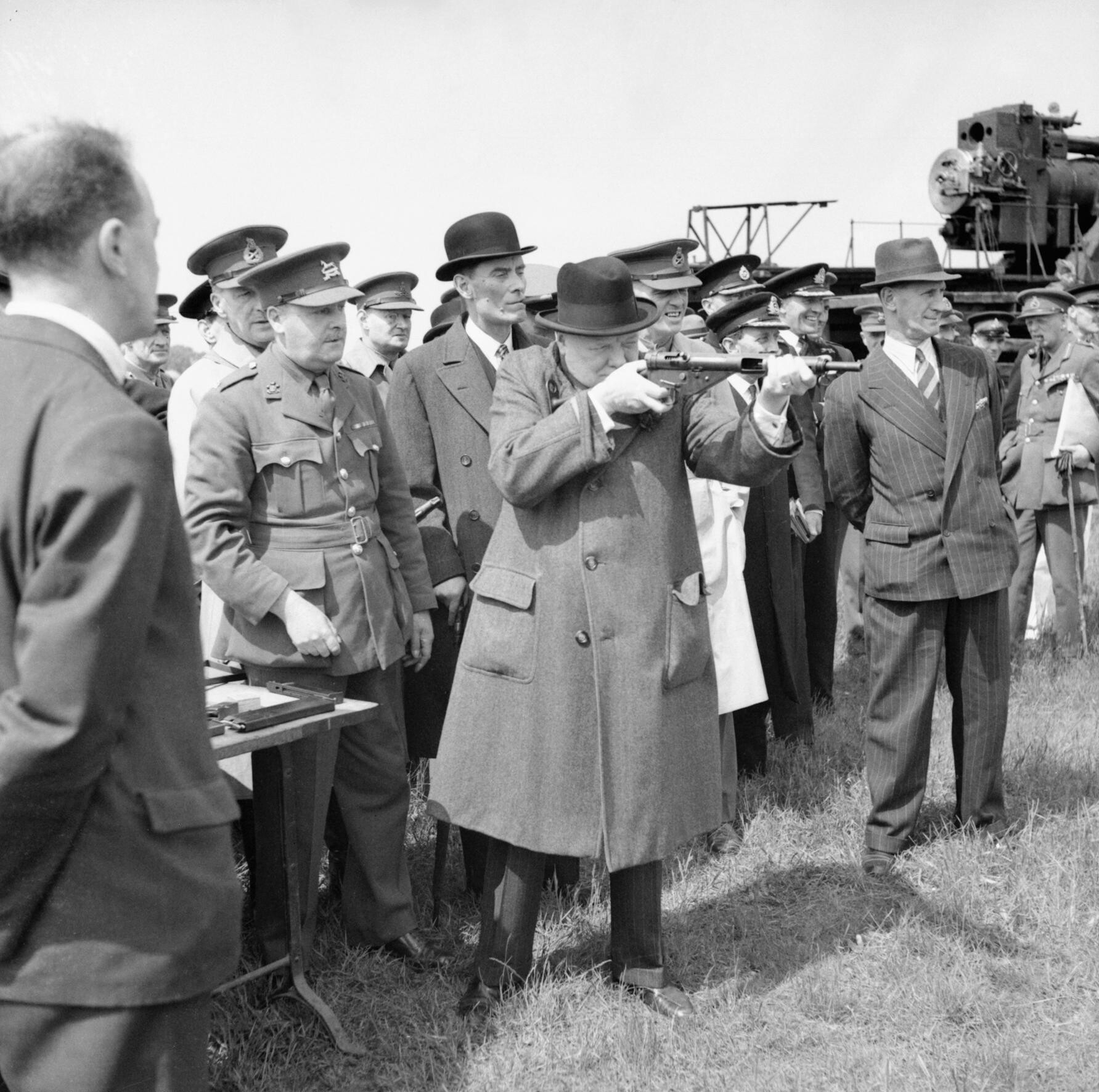
Badgers are my favorite animal. I have over the years published three scholarly articles about ancient words for these mustelids and have a house filled with brock-a-brac. I would be chuffed to see a Meles meles on an English banknote. That said, even I agree with what the leader of the Liberal Democrats, Sir Ed Davey, tweeted on March 11: Winston Churchill “deserves better than being replaced by a badger.”
What could Davey possibly mean by this? Well, a few hours before I landed at Heathrow last week, I was confronted with the latest example of English self-loathing: the decision by the Bank of England to replace the people on the reverse of the four banknotes in circulation with . . . wildlife. While the King will remain on the obverse, the plan is for Churchill to be removed from the five-pound note, Jane Austen from the ten, J. M. W. Turner from the twenty, and Alan Turing from the fifty.
Victoria Cleland, the chief cashier at the Bank of England, explains: “The key driver for introducing a new banknote series is always to increase counterfeit resilience, but it also provides an opportunity to celebrate different aspects of the UK.” Sure. Replacing humans with animals is unlikely to deter counterfeiters, and I am skeptical that most people in England truly want turtles instead of Turner and Turing. Indeed, a recent poll by JL Partners reveals that a significant majority of the 1,527 people surveyed across the United Kingdom believe Churchill to be “more appropriate” on the five-pound note than an owl.
The bank’s press release states of the focus groups it convened that “Nature was the most popular theme in the July 2025 consultation with 60% of respondents selecting it as one of their preferred themes” (italics added). (“Notable Historical Figures” was one of the popular themes at 38 percent.) Would it be too much to ask how these focus groups came about and, especially, what the full statistics look like, since there is a difference between “one of their preferred themes” and their (singular) preferred theme?
I am not alone in imagining that the impetus for the move may be pressure from activists who inexplicably consider the man who saved Britain in the Second World War to be a war criminal. I do wonder, though, whether they realize that three of the current figures are diverse, as the adjective is often understood these days: Austen was a woman, Turing was an autistic gay man, and a recent BBC documentary “raises the possibility that Turner’s singular vision was shaped by childhood trauma and neurodivergence” (I quote from a November 2025 article in The Guardian).
Unlike the portraits on the U.S. dollar, it is not uncommon for the people on the Bank of England’s paper currency to change. The previous five-, ten-, twenty-, and fifty-pound notes featured, respectively, Elizabeth Fry, Charles Darwin, Adam Smith, and Matthew Boulton and James Watt together—and Isaac Newton was on the long-discontinued one-pound note. Other important figures who have appeared on these notes include Charles Dickens, Edward Elgar, Michael Faraday, Florence Nightingale, William Shakespeare, and Christopher Wren. Not all that long ago, the notes depicted neither the monarch nor a notable historical figure: for example, the five-pound note printed between 1957 and 1963 had helmeted Britannia on the obverse, along with a small depiction of St. George and the dragon, and a large lion on the reverse.
At one level, then, it is hard to make a historical argument against having an animal on an English banknote instead of a person. But the lion, which was also found on the ten-pound note printed between 1964 and 1975, is the only non-mythical animal ever to feature prominently—and the lion is special: a symbol of England (three lions passant guardant, since Richard the Lionheart in the late twelfth century) and yet evidently not an example of local wildlife.
Yes, the current notes issued by the Royal Bank of Scotland have prominent Scottish women on the obverse and prominent Scottish animals on the reverse: mackerel on the five-pound note, otters on the ten, red squirrels on the twenty, and ospreys on the fifty. But even if England were in some sense to follow its northerly neighbor, it would be rather a different thing to do what the Royal Society for the Prevention of Cruelty to Animals has suggested, seemingly without irony: that Churchill and company be replaced by pigeons, rats, and gulls. None of these is likely to come immediately to any normal person’s mind when musing on English wildlife.
The Bank of England has not yet decided which creatures will appear on the new banknotes. If this idiotic plan goes ahead, please may the chosen animals be, say, Peter Rabbit, the Cheshire Cat, Winnie-the-Pooh, and the tiger who came to tea. This would, of course, valorize other exemplars of Englishness: Beatrix Potter, Lewis Carroll, A. A. Milne, and Judith Kerr.
Is any of this really important? After all, many people in England carry cash only rarely: two pubs I just patronized in Oxford proclaim themselves to be cashless. And yet symbols matter, as does attention to past glories, for one thing because they remind us that it is up to us to ensure that further glories lie ahead. Surely there are some people still who hold a ten-pound note in their hands, wonder about Pride and Prejudice, and decide to follow up on the quotation under Austen’s portrait, “I declare after all there is no enjoyment like reading!”
To my knowledge, there has been no move in the United States to rid our money of historical figures. Controversy has, however, surrounded the twenty-dollar bill for quite some time, and it seems likely that Harriet Tubman will before long replace Andrew Jackson. I have no problem with this. But much as I appreciate bison, moose, and grizzly bears, I would have a problem if Scott Bessent—or the American people when polled—decided that one of our indigenous animals should replace Jackson. Never say never, but whatever problems we have in this country, we have not yet moved to erase our cultural heritage to quite the extent that England and the rest of the United Kingdom have, where Parliament voted to remove the remaining hereditary peers from the House of Lords the day before the announcement about the banknotes.
Only weeks after the defiantly patriotic song “There’ll Always Be an England” was released in the summer of 1939, the Second World War broke out, Churchill became First Lord of the Admiralty, and Turing reported to Bletchley Park. Even during the Blitz, by which time Churchill was the prime minister, it did indeed seem as though there would always be an England. But today? Not (to mangle the song’s chorus) if England continues to mean so bloody little to the English.