The US Navy appears to believe that its Littoral Combat Ships are not up to the task of taking on Iranian naval mines.
President Donald Trump has suggested that the Iranian Navy’s ability to deploy sea-based mines in the Strait of Hormuz has been destroyed. Many military analysts feel otherwise—warning that the Islamic Revolutionary Guard Corps (IRGC) has hundreds of small “fast boats” that could readily deploy mines across the narrow waterway.
That would present a serious issue to commercial ships that transit the strait, where one-fifth of the world’s oil now passes through.
Tehran has denied laying mines, but the capabilities almost certainly remain, in spite of the United States’ campaign of destruction against its navy. To complicate matters further, the US Navy retired its four Avenger-class mine countermeasure ships, reasoning that their role could be taken over by the multipurpose Littoral Combat Ship (LCS). However, two of the LCSes that would be serving in this role were recently spotted in Malaysia, thousands of miles from their homeport in Bahrain.
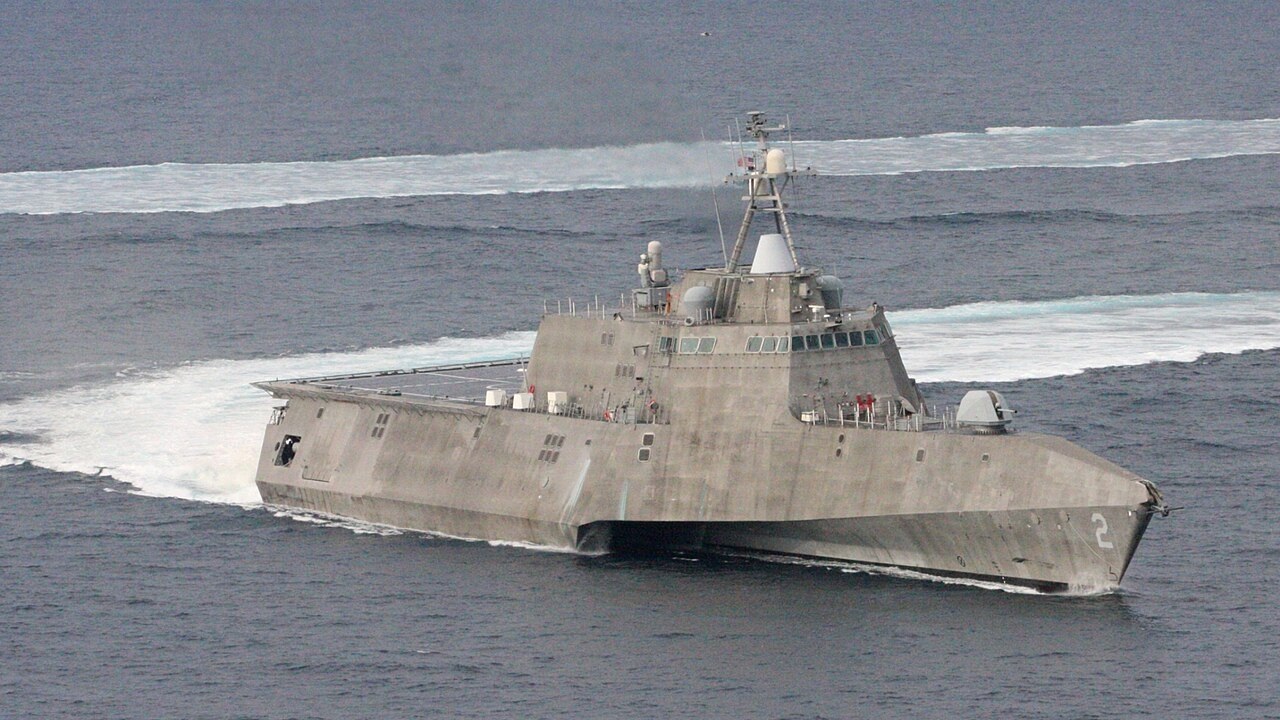
The War Zone reported over the weekend that the US Navy’s Independence-class USS Tulsa (LCS-16) and USS Santa Barbara (LCS-32) were not operating in the Middle East. Ship spotters shared images of the two vessels at the North Butterworth Container Terminal (NBCT) in the Port of Penang, Malaysia.
Which US Ships Can Hunt for Naval Mines?
LCS-16 and LCS-32 are among the vessels to have received the Mine Countermeasures Mission Package (MCM MP), allowing the small warships to operate as mine hunters. 24 ships will receive the MCM MP in total, including 15 Littoral Combat Ships and nine other vessels.
As previously reported, the MCM package is an integrated suite of unmanned maritime systems and sensors that can be used to locate, identify, and destroy mines in the littorals while increasing the ship’s standoff distance from the threat area. Embarked with the MCM MP, an LCS or another vessel of opportunity can conduct the full spectrum of detect-to-engage operations (hunting, neutralizing, and sweeping) against mine threats. These ships will use sensors and weapons deployed from the MCM Unmanned Surface Vehicle, an MH-60S multi-mission helicopter, and associated support equipment.
Why Aren’t the LCS Minesweepers Near the Persian Gulf?
It is not clear why the two vessels aren’t operating in the Middle East, and The War Zone reached out to US Central Command (CENTCOM) and the US 5th Fleet, but neither provided an answer.
It is also unclear where USS Canberra (LCS-30), the third LCS to have received the MCM MP, is currently operating.
“Since the conflict with Iran began, there have been no reports of US surface ships operating in the Persian Gulf,” USNI News wrote.
It is possible, and even likely, that the three warships were moved out of the combat zone before the US launched Operation Epic Fury more than two weeks ago. Multiple Iranian Navy vessels have been targeted in port via missiles, so the US Navy wouldn’t want the favor returned on its own port in Bahrain. However, that still wouldn’t explain why USS Tulsa and USS Santa Barbara—and perhaps USS Canberra—were sent thousands of miles away, when they could have operated alongside the US Navy’s Abraham Lincoln Carrier Strike Group instead.
The Independence-class LCS also has greater armament than the Avenger class and should, in theory at least, be able to hold its own in a combat zone. However, the LCSes have one considerable drawback relative to the Avenger class: their hulls are made of metal, exposing them to sophisticated metal detection technology embedded in some mines. The Avenger-class minesweepers were designed with wooden and fiberglass hulls to evade this problem.
What we know is that the LCS program was developed for waters like the narrow Strait of Hormuz, where the small but speedy warships could easily counter missile-armed boats and even small submarines. It was further envisioned that the stealthy surface combatants could defeat anti-access and asymmetric threats in littoral or near-shore waters.
This should be the moment when the LCS program finally proves its worth, especially given the emerging threat of mines. Instead, the US Navy seems to be second-guessing whether the Independence-class is actually up to the job—or is truly just a “Little Crappy Ship,” as its critics contend.
About the Author: Peter Suciu
Peter Suciu has contributed to dozens of newspapers, magazines and websites over a 30-year career in journalism. He regularly writes about military hardware, firearms history, cybersecurity, politics, and international affairs. Peter is also a contributing writer for Forbes and Clearance Jobs. He is based in Michigan. You can follow him on Twitter: @PeterSuciu. You can email the author: [email protected].