Following the withdrawal of the USS Gerald R. Ford from combat after a major shipboard fire, another carrier could take its place.
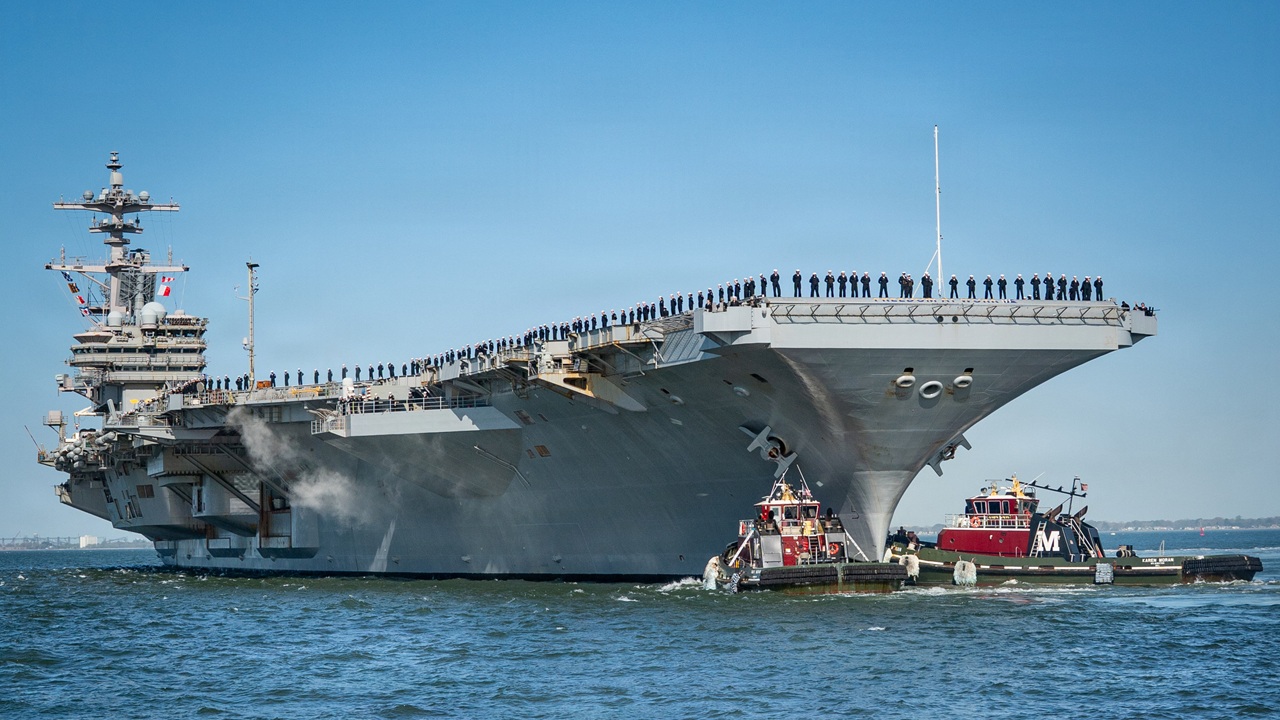
The USS George H.W. Bush, one of the US Navy’s most advanced aircraft carriers, departed for a regularly scheduled deployment on Tuesday. However, the forced withdrawal of the USS Gerard R. Ford from operations against Iran could mean that the Bush is heading to the Middle East—though the Navy has remained quiet on the matter.
The USS George H.W. Bush Is Going… Somewhere
Commissioned in 2009, USS George H.W. Bush is in many ways the second most advanced aircraft carrier in the Navy.
As the final ship of the Nimitz class, the USS George H.W. Bush incorporated more than three decades of lessons learned in shipbuilding and naval aviation. As events have developed, the Bush may end up relieving the Ford, the Navy’s most advanced carrier.
Until the middle of March, the Ford was supporting strikes against Iran alongside the USS Abraham Lincoln as part of Operation Epic Fury. This was the second combat deployment for the Navy’s newest aircraft carrier, following its participation in strikes against Venezuela as part of Operation Absolute Resolve in January.
However, a fire broke out on the flattop on March 12, causing significant internal damage. Although Navy officials stated at the time that the fire had not impacted the carrier’s combat readiness, it departed the Red Sea several days later.
As a result, the Navy is left with only one aircraft carrier in the Middle East with operations still ongoing. Moreover, the prospect of a ground operation in Iran—whether to capture Kharg Island, force the Strait of Hormuz open, or retrieve Iran’s nuclear weapons material—would likely require more firepower than one carrier and its support group could provide.
In the media release announcing the deployment, the Navy did not specify where exactly the USS George H.W. Bush was heading.
“The crew embodies our ship’s motto ‘Freedom at Work,’” Navy Captain Bob Bibeau, the commanding officer of the aircraft carrier, said. “Our Sailors are exceptionally trained, highly motivated, ready to accomplish any assigned mission, and well poised to defeat any threat while deployed.”
Rear Adm. Alexis Walker, the commanding officer of Carrier Strike Group 10, also did not provide any clues as to the specific destination of the carrier strike group.
“There is a published length of deployment, but who knows how long it’s going to take, and when our job is done around the world, then we’ll come home,” Walker told reporters at the pier after being asked whether the unit will join Operation Epic Fury against Iran.
The Bush Is Bringing a Task Force, Too
USS George H.W. Bush last deployed between August 2022 and April 2023. It spent the entirety of its eight-month deployment in Africa and Europe, including the Mediterranean Sea.
“I use the firefighter analogy,” Bibeau added. “If you call the fire station and ask the firefighters where the fire is going to be tomorrow, they don’t know. But they do know that they’re ready, they want to be there, and they’re going to solve the problem.”
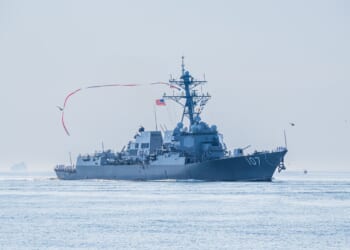
The aircraft carrier does not sail on its own. It is accompanied by three Arleigh Burke-class guided-missile destroyers—USS Ross, USS Donald Cook, and USS Mason, each of which can carry nearly 100 air defense missiles, Tomahawk land-attack cruise missiles, and anti-ship munitions.
About the Author: Stavros Atlamazoglou
Stavros Atlamazoglou is a seasoned defense journalist specializing in special operations and a Hellenic Army veteran (national service with the 575th Marine Battalion and Army HQ). He holds a BA from the Johns Hopkins University and an MA from the Johns Hopkins’ School of Advanced International Studies (SAIS). His work has been featured in Business Insider, Sandboxx, and SOFREP.