
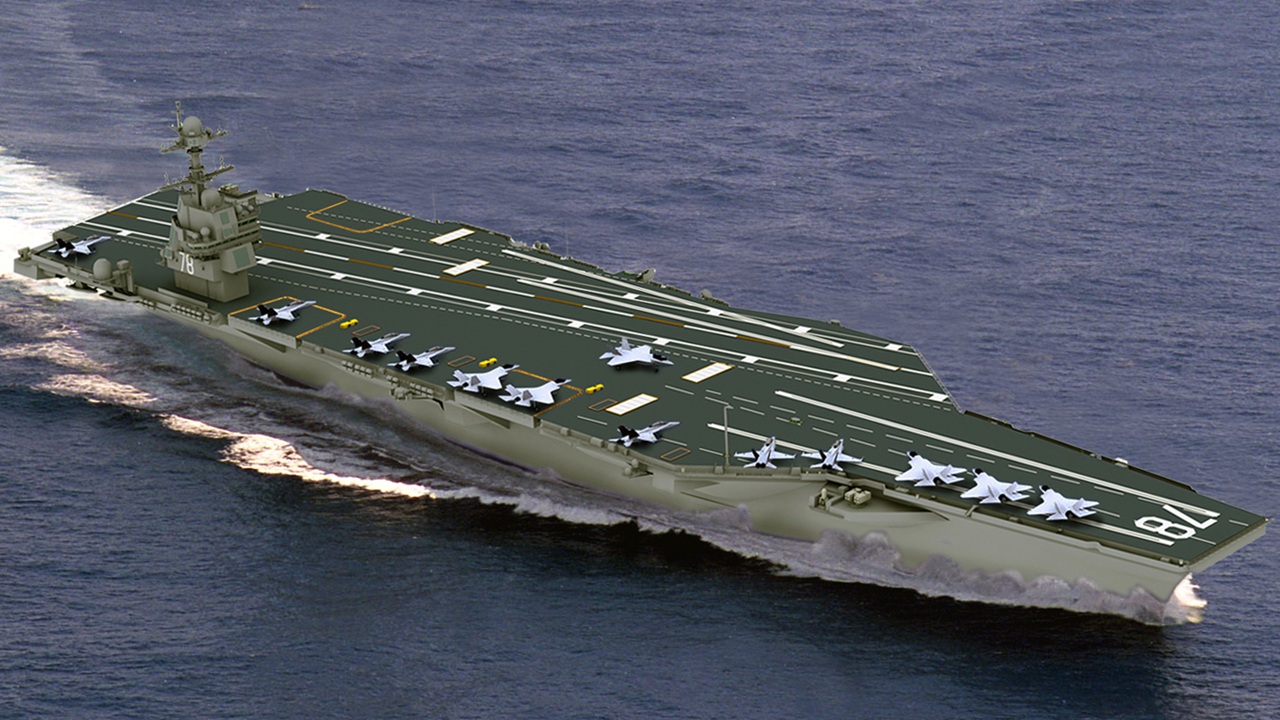
Huntington Ingalls Industries (HII) just got a bit of welcome news. It was awarded a set of contract modifications (with a combined value of more than $142 million) to support the completion and upgrade of the USS John F. Kennedy (CVN-79), the second ship of the Ford-class aircraft carriers for the United States Navy being built at its shipyard in Newport News, Virginia.
Bear in mind that the carrier hasn’t even been finished—and the Pentagon is already paying for upgrades. But for HII, this will be a major financial windfall—if the funding comes through.
The USS John F. Kennedy Will Be Born Out-of-Date
The award breaks down to four modifications:
- A $60 million cost-reimbursable modification;
- A $58 million cost-plus-incentive fee (CPIF) modification;
- A ~$21 million fixed-price-incentive modification; and
- A ~$3 million cost-plus-fixed-fee (CPFF) modification.
The reason behind this new set of contract modifications for the JFK is to “improve capability at ship delivery” while ensuring “unpriced change orders,” according to the Pentagon. All modifications are expected to be finalized by June 2026.
Notably, the contract obligations for these modifications have not yet been funded. In other words, the firm is undertaking this expansive enterprise without having been paid first. At this point, a skeptic might have the uneasy feeling that something is bound to go wrong, especially since the money has not fully changed hands. What defense contractor works on an “I owe you” without there being some hidden benefit to that contractor?
CVN-79 is the second ship in the Ford-class of carriers that are meant to replace the aging Nimitz-class aircraft carriers. The Ford-class incorporates a number of new technologies, such as the EMALS launch system, upgraded weapons handling, increased electrical power, and new island design.
These drastic upgrades to America’s carrier force are meant to improve sortie generation rates, reduce crew size (by enhancing automation), and increasing overall operational flexibility.
But the contract amounts to a clear acknowledgment by the Navy that the post-launch/all-construction work is a growing disaster for the maritime service.
The Ford Class Has Been a Fiasco for the Navy
What’s more, the issues relating to change orders, capability enhancements, and improving systems before delivery. Recall that the namesake of this new class of carrier, the USS Gerald R. Ford, was delivered late and over budget—and still required upgrades.
It is obvious that the Ford-class carrier is too complex for its own good—and America’s ailing naval shipyards simply cannot keep up with the increased demand for these wildly complex, massive systems.
In other words, this is what decline looks like. And it’s the definition of a sunk cost fallacy. But the Pentagon doesn’t exist in a world governed by hard economic realities and strategic truths.
It keeps blowing through gobs of tax dollars, adding to the national debt, and building platforms that will never deliver that which they’ve promised. At some point, the music will stop—and the US defense industrial base will be left without a seat.
Still, for HII, the Navy’s contract modifications worth over $142 million to finish outfitting capability enhancements on the USS John F. Kennedy (CVN-79), America’s second of four planned Ford-class aircraft carriers, is a windfall. Of course, they’ll have to delivery.
Sunk Costs at Sea: The Pentagon’s Endless Money Pit
They likely will—but this author remains skeptical that it will either be on time or under budget. The fact of the matter is that the Ford-class is simply too complex for its own good—and likely to be a victim of entropy, like many of America’s modern military platforms.
Hopefully, America’s elephantine and sclerotic defense industrial base proves more responsive than it has thus far and we can start producing en masse high-end, advanced systems in a timely manner (this author won’t hold his breath).
Should the United States continue struggling to produce relevant, effective, and affordable systems in a reliable and efficient manner, as American strategic rivals—such as China and Russia—have all but caught up with the United States when it comes to mass producing affordable, relevant, and effective combat systems.
About the Author: Brandon J. Weichert
Brandon J. Weichert is a senior national security editor at The National Interest. Recently, Weichert became the host of The National Security Hour on America Outloud News and iHeartRadio, where he discusses national security policy every Wednesday at 8pm Eastern. Weichert hosts a companion book talk series on Rumble entitled “National Security Talk.” He is also a contributor at Popular Mechanics and has consulted regularly with various government institutions and private organizations on geopolitical issues. Weichert’s writings have appeared in multiple publications, including The Washington Times, National Review, The American Spectator, MSN, and the Asia Times. His books include Winning Space: How America Remains a Superpower, Biohacked: China’s Race to Control Life, and The Shadow War: Iran’s Quest for Supremacy. His newest book, A Disaster of Our Own Making: How the West Lost Ukraine is available for purchase wherever books are sold. He can be followed via Twitter @WeTheBrandon.
Image: Wikimedia Commons.

















_-_2005.jpg)