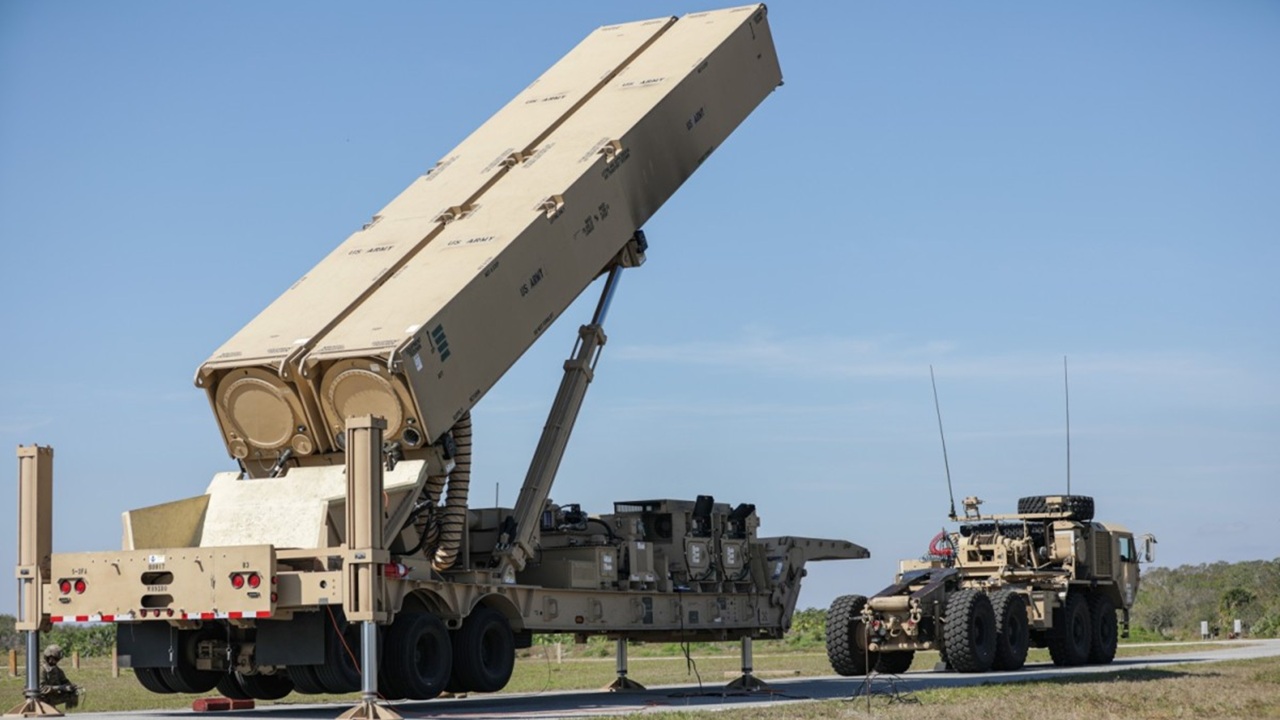
At the end of 2025, the US Army announced that its “Bravo Battery” would host batteries of the Dark Eagle hypersonic missile—replacing the M142 HIMARS it currently operates.
The US military will be deploying more hypersonic missiles in the Indo-Pacific to counter the increasingly assertive Chinese military.
The US Army recently activated a new artillery unit that will field the Dark Eagle Long Range Hypersonic Weapon (LRHW).
More Dark Eagle Hypersonic Missiles Are Coming to the Indo-Pacific
In the closing days of 2025, the Army announced that another unit will soon operate the incoming Dark Eagle hypersonic missile.
Bravo Battery, 1st Battalion, 17th Field Artillery Regiment, is the next unit in the Army’s artillery force that will field that advanced weapon system. The unit will be part of the 3rd Multi-Domain Task Force and will operate in the Indo-Pacific.
The hypersonic missile’s anticipated features mean that the new unit will be able to provide deterrence and offensive strike capabilities from several different places in the theater of operations, including mainland Japan, Okinawa, South Korea, the Philippines, Guam, and even Taiwan. The Army has also experimented with the deployment of the hypersonic munition to Australia.
The unit previously operated the M142 High Mobility Rocket Artillery System (HIMARS).
The Dark Eagle Missile Is Expensive—but Worth It
The Dark Eagle is one of the most promising advanced weapon systems in the US military.
In a recent visit to the Army’s Redstone Arsenal in Alabama, Secretary of Defense Pete Hegseth received updates on the progress of the Dark Eagle hypersonic munition. According to Army officials, the missile will have a warhead that weighs less than 30 lbs but still has the destructive capability to destroy an area the size of a parking lot.
The hypersonic missile has a reported range of between 1,725 miles and 2,175 miles and a speed that can exceed Mach 5, or nearly 4,000 miles per hour.
According to the Army, the Dark Eagle is a “land-based, truck-launched system is armed with hypersonic missiles that can travel well over 3,800 miles per hour. They can reach the top of the Earth’s atmosphere and remain just beyond the range of air and missile defense systems until they are ready to strike, and by then, it’s too late to react.”
The Army is spending increasingly more funds on the Dark Eagle munition. Last year, the service requested a total of $1.3 billion for the advanced missile system. The majority of the funds ($750 million) will go toward the procurement of the munition, while a good portion ($500 million) will go toward additional research, development, testing, and evaluation. The latest estimate is that each missile will cost approximately $41 million.
Could the Dark Eagle Be the Answer to China’s A2/AD Bubbles?
The Dark Eagle is the Army’s answer to China’s advanced anti-access/aerial-denial (A2/AD) capabilities. Through its extremely fast speed, glide path, and ability to change direction mid-flight, the hypersonic munition promises to penetrate Beijing’s most robust air defense “bubbles” covering the South China Sea and the Indo-Pacific.
The Chinese military has invested heavily in air defense and anti-ship capabilities that are meant to keep away the US military’s carrier strike groups and advanced combat aircraft. The Dark Eagle has the potential to bypass those restrictions and neutralize Chinese defenses, thus opening the way for the full might of the US military.
About the Author: Stavros Atlamazoglou
Stavros Atlamazoglou is a seasoned defense journalist specializing in special operations and a Hellenic Army veteran (national service with the 575th Marine Battalion and Army HQ). He holds a BA from the Johns Hopkins University and an MA from the Johns Hopkins’ School of Advanced International Studies (SAIS). His work has been featured in Business Insider, Sandboxx, and SOFREP.
Image: Wikimedia Commons.