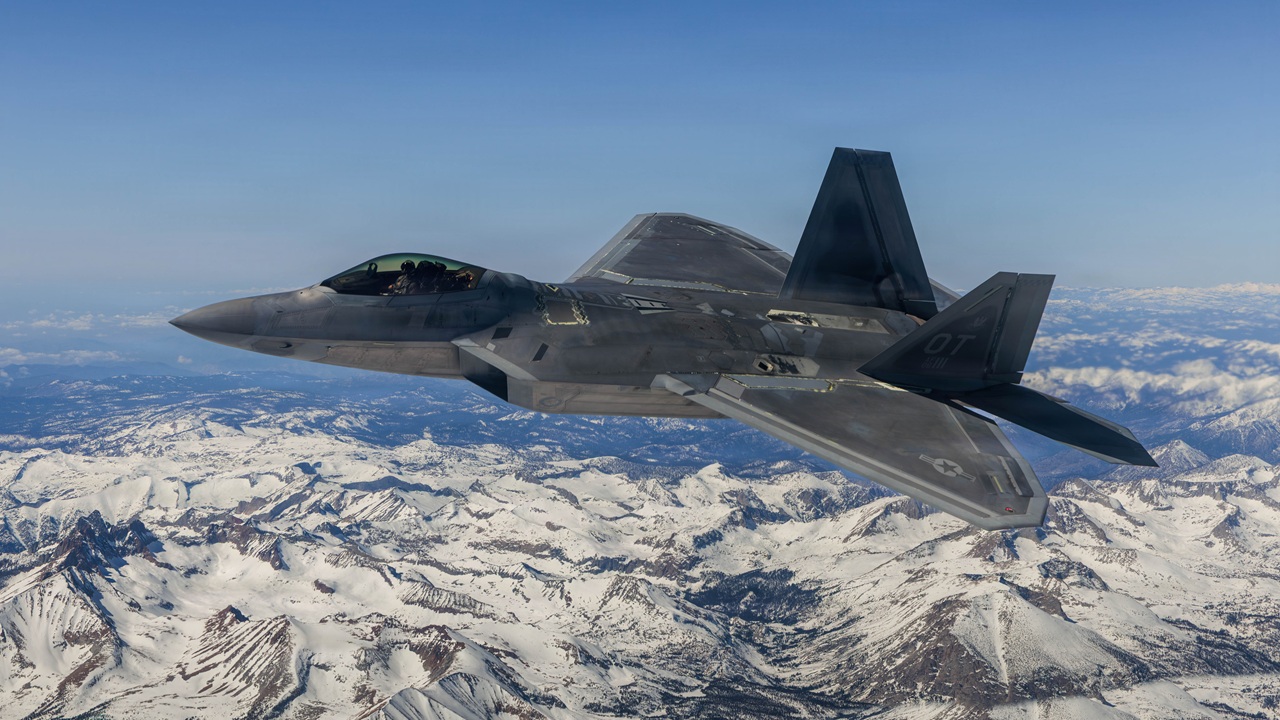
US Air Force F-22s have been spotted with new “stealth pods”—slightly increasing their radar profile, but giving them important new detection capabilities.
For the first time in decades, the F-22 Raptor has received a visible upgrade. New stealth pods and stealth tanks (the Low Drag Tank and Pylon or LDTP) were spotted on the aircraft recently, marking the biggest external change to the F-22’s distinctive silhouette since its debut in 2005. The change is substantive in nature, aimed at keeping the F-22 relevant as competing Chinese fifth-generation threats emerge.
How the F-22’s New “Stealth Pods” Keep It Relevant
The F-22 is likely still the best air superiority fighter jet in the world. When it was introduced, it was an anomaly—far stronger than anything else in any nation’s air arsenal, making it difficult to draw comparisons to. The Pentagon’s decision to suspend production after only 187 planes had been built, citing the program’s high cost, has only added to its mystique; the F-22 is likely to retire without ever seeing a superior aircraft.
Still, the F-22 was designed in the 1990s and lacks a handful of cutting-edge features—notably IRST, networking flexibility, and extended range—found on more modern aircraft. With the NGAD program delayed (predictably), the F-22 will need to stay in service—and stay relevant—until the NGAD is available. The result is the ongoing “Raptor 2.0” modernization push.
The F-22’s recent upgrades appear to take the form of new underwing stealth pods and a new Low Drag Tank and Pylon system. These are faceted, stealth-shaped external additions—which is unusual for the F-22, as the jet has historically prioritized a clean and stealthy profile. By their addition, it appears that the USAF is willing to trade perfect stealth for mission flexibility.
The stealth pod probably contains IRST (Infrared Search and Track) equipment, which detects heat signatures of other aircraft without emitting a radar signature of its own. This allows the F-22 to hunt stealth aircraft without revealing itself—a significant upgrade for the original F-22, which had operated without IRST. This upgrade should allow for better performance against China’s J-20 stealth fighter and other emerging stealth fighters.
The IRST addition would be especially important for modern air combat, which will increasingly feature stealth platforms pitted against one another. And because radar is far less reliable against low-observable aircraft, IRST becomes the primary detection method, marking a shift from radar dominance to multi-sensor fusion.
The pods likely include other features, in addition to the IRST, including electronic warfare, communications relays, and data fusion nodes. In essence, the pods act as modular capability packages, enhancing the capabilities of the F-22.
The LDTP tanks address another serious F-22 limitation. The F-22 has always been known for its limited range, which is especially relevant in the far-reaching Indo-Pacific region. The new LDTP tanks are stealth-shaped, reducing the radar cross-section relative to legacy tanks, but can remain attached during supersonic flight and maneuvering (whereas legacy tanks had to be dropped before combat). This means the F-22 will now have extended range without significant sacrifices made to the aircraft’s survivability.
The Air Force Is Preparing the F-22 for War with China
These modernizations are especially important within the Indo-Pacific context. The theater features massive distances, and the Chinese J-20 was designed with long range in mind. The F-22 was not, previously relying upon tanker support and accepting limited persistence. But now, the F-22 has more operational flexibility and deeper penetration capability—a vital metric against China’s A2/AD envelope.
In short, the addition of external pods increases the F-22’s radar signature—though not by much—while adding significant improvements to its capabilities. This tradeoff represents a strategic shift from an emphasis on perfect stealth towards better detection, range, and networking. Strategically, the modernization is likely to extend the life of the F-22s into the 2030s, helping to maintain a technological edge over China while reducing pressure on the NGAD timeline.
About the Author: Harrison Kass
Harrison Kass is a senior defense and national security writer at The National Interest. Kass is an attorney and former political candidate who joined the US Air Force as a pilot trainee before being medically discharged. He focuses on military strategy, aerospace, and global security affairs. He holds a JD from the University of Oregon and a master’s in Global Journalism and International Relations from NYU.