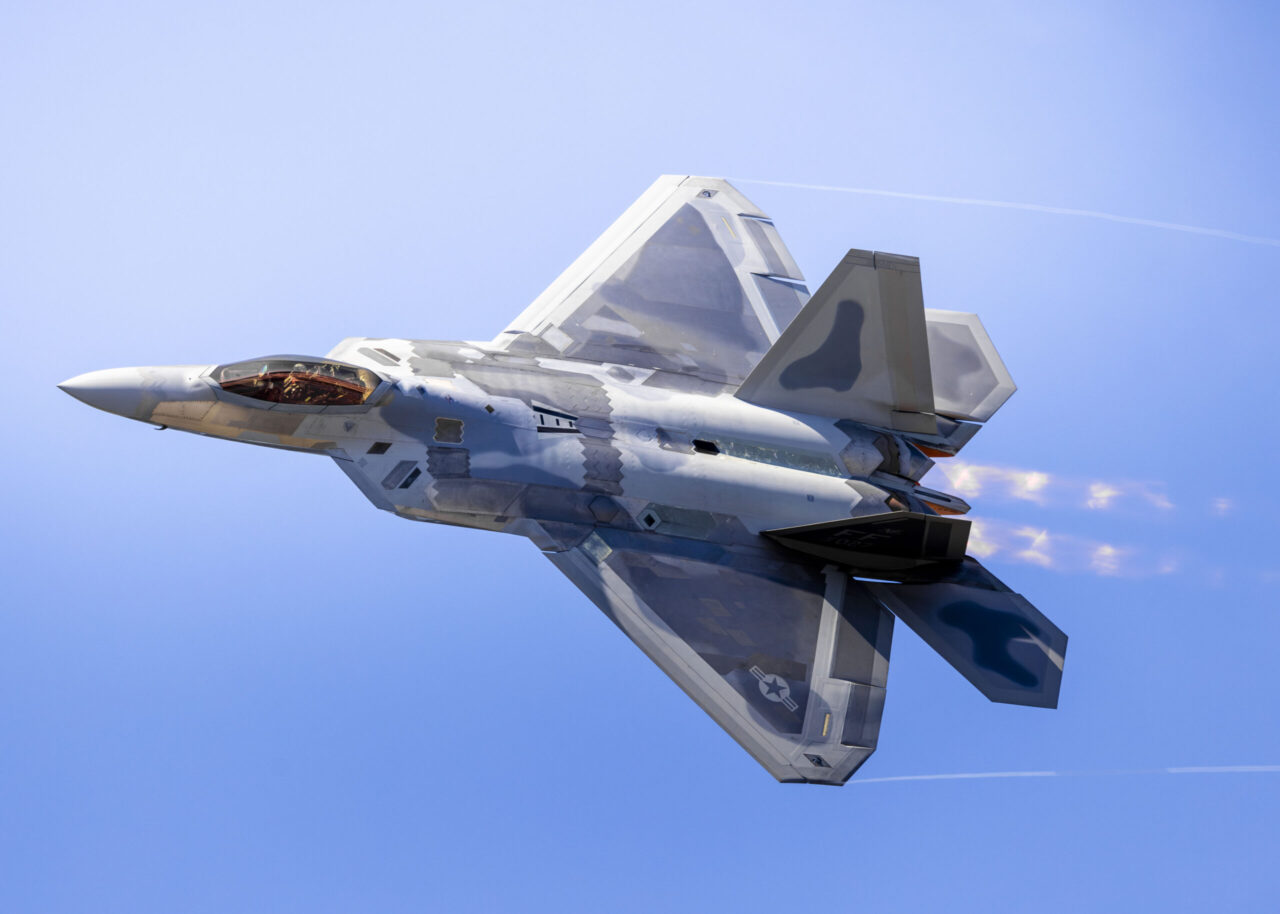
It wasn’t until September 2014 that an F-22 Raptor even took part in combat, carrying out an airstrike on ISIS positions in Syria.
On December 15, 2005, 20 years ago this month, the Lockheed Martin F-22 Raptor achieved initial operating capability, becoming fully operational for the United States Air Force. It ushered in the fifth-generation era, becoming the world’s first stealth air superiority fighter.
On December 15, 2011, the final F-22 Raptor was completed, ending production of the aircraft.
“Since 2005, the Raptor has set the global standard for air superiority, delivering unmatched capability, readiness, and mission success, ensuring the US Air Force remains dominant. Its strength comes from the people who maintain, operate, and innovate every aspect of the aircraft,” explained Lockheed Martin, acknowledging the two decades of the Raptor’s service.
Video: 20 Years of the F-22 Raptor: More Dominant than Ever
The F-22 Raptor’s Specifications
- Year Introduced: 2005
- Number Built: 195 total (187 operational + test aircraft)
- Length: 62 ft 1 in (18.9 m)
- Wingspan: 44 ft 6 in (13.6 m)
- Weight (MTOW): ~83,500 lb (37,875 kg)
- Engines: Two Pratt & Whitney F119-PW-100 turbofans (≈35,000 lbf / 155.7 kN each with afterburner)
- Top Speed: ~1,500 mph (2,414 km/h) / ≈ Mach 2.0
- Range: ~1,600 mi (2,575 km) with external tanks; ~460–600 mi (740–965 km) combat radius
- Service Ceiling: ~50,000+ ft (15,240+ m)
- Loadout: Internal bays for up to 6× AIM-120 + 2× AIM-9; external pylons optional for non-stealth loads
- Aircrew: 1
History of the F-22: A Program That Never Had a Chance
The Lockheed Martin F-22 Raptor could be described as being developed at the wrong time, but it was never actually the wrong weapon. It was both ahead of its time and late for the changing world order. Development of the F-22 began in the 1980s as part of the United States Air Force’s Advanced Tactical Fighter (ATF) program.
The YF-22 won out over the competing YF-23, developed by Northrop and McDonnell Douglas. Now, more than 25 years after the YF-22 made its first flight, the single-seat, twin-engine, all-weather, stealth tactical aircraft is widely regarded as the most capable air superiority fighter in service worldwide. Its design even won the 2006 Robert J. Collier Trophy from the American National Aeronautic Association.
In 2002, the Air Force redesignated it as the F/A-22 to reflect its multi-mission capability, enabling it to perform both ground attacks and air-to-air missions. However, the designation was updated again to F-22A in 2005 when it entered service.
F-22 Program Cut Short
The US Air Force had initially planned to buy 750 of the fighters, but the world was very different in the early 1990s. The Cold War was over, the Soviet Union collapsed, and then 9/11 happened. The United States wasn’t thinking about near-peer adversaries like China or Russia, and instead was involved in the Global War on Terror.
An air superiority fighter wasn’t needed to fight an enemy that was employing improvised explosive devices and fighting an insurgent campaign in Iraq and Afghanistan. The F-22 program was scaled back to 187 operational production aircraft, and the last F-22 was delivered in 2012.
Despite its capabilities, the F-22 lacks a significant combat record.
It also wasn’t until September 2014 that an F-22 even took part in combat, carrying out an airstrike on ISIS positions in Syria. Its first “air-to-air” engagement was nearly a decade later, when in February 2023, a Raptor shot down a Chinese surveillance balloon off the eastern coast of the United States.
Earlier this year, the US Air Force selected a Boeing stealth fighter, designated the “F-47,” to replace the aging F-22. Set to enter service later this decade, the F-47 could be the right aircraft at the right time, unlike the F-22.
About the Author: Peter Suciu
Peter Suciu has contributed over 3,200 published pieces to more than four dozen magazines and websites over a 30-year career in journalism. He regularly writes about military hardware, firearms history, cybersecurity, politics, and international affairs. Peter is also a contributing writer for Forbes and Clearance Jobs. He is based in Michigan. You can follow him on Twitter: @PeterSuciu. You can email the author: [email protected].
Image: DVIDS.