The BTF mission to Spain was likely the final such mission of 2025—but this is not known for certain, as the missions are never announced in advance.
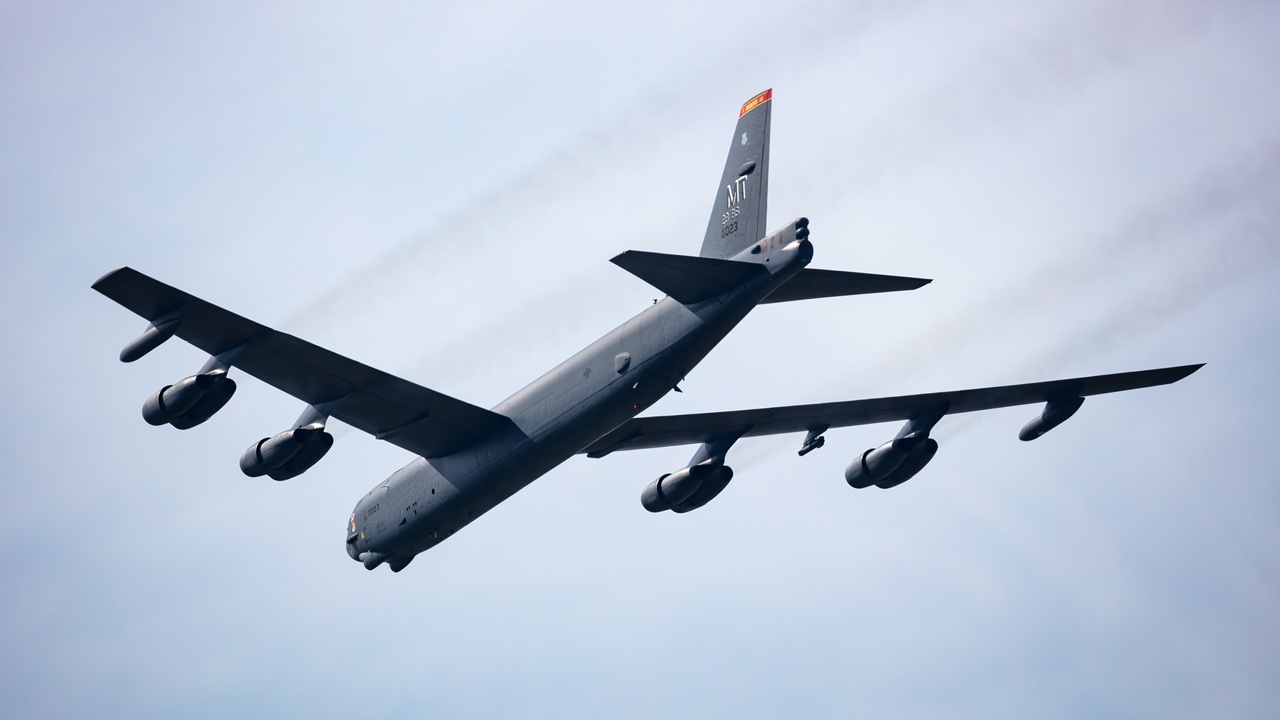
The first Bomber Task Force (BTF) Europe mission for fiscal year 2026 (FY26) has concluded. The United States Air Force’s Boeing B-52H Stratofortress returned to Barksdale Air Force Base (AFB), Louisiana, on Monday, US Air Forces in Europe – Air Forces Africa (USAFE-AFAFRICA) announced. The B-52 spent approximately two weeks deployed to Morón Air Base, Spain, as part of BTF Europe 26-1.
Three bombers, which flight trackers identified with the call signs CAGER 11, CAGER 12, and CAGER 13, were supported by US-based KC-46 Pegasus and KC-135 Stratotanker refueling aircraft during the flight to Europe earlier this month.
It is unclear when the other two B-52s returned to Barksdale AFB; however, it isn’t uncommon for the aircraft to make separate flights to and from Europe during the BTF deployments. While operating from Morón Air Base, the B-52s took part in “a series of complex, high-end training scenarios with Allies and partners across the U.S. European Command, U.S. Africa Command and U.S. Central Command areas of responsibility,” the Air Force confirmed.
Understanding the B-52 Stratofortress
- Year Introduced: 1955
- Number Built: 744 (all variants); ~76 B-52H airframes still in service
- Length: 159 ft 4 in (48.5 m)
- Wingspan: 185 ft 0 in (56.4 m)
- Weight (MTOW): ~488,000 lb (221,000 kg)
- Engines: Eight Pratt & Whitney TF33-P-3/103 turbofan engines (~17,000 lbf / ~76 kN thrust each); planned/announced re-engining programs (e.g., Rolls-Royce F130/BR700 family derivatives) for future service life extension
- Top Speed: ~650 mph (1,046 km/h) / ~Mach 0.86 at altitude
- Combat Radius: Mission- and load-dependent; typical practical combat radii vary widely (roughly several thousand miles / ~3,000–7,000 km depending on payload, routing, and aerial refueling)
- Service Ceiling: ~50,000 ft (15,240 m); varies depending on loadout
- Loadout: ~70,000 lb (31,500 kg) of mixed ordnance
- Aircrew: 5 (pilot, co-pilot, weapon systems officer, navigator, electronic warfare officer); varies based on loadout / mission parameters
The first B-52s entered service in June 1955, and by the time production of the Stratofortress ended in 1962, a total of 744 had been built. Currently, there are 58 B-52 bombers in active service, with another 18 in reserve and another dozen or so in long-term storage.
The bombers have flown under various commands during their 67 years of service—mostly with the Strategic Air Command (SAC) —until it was disestablished at the end of the Cold War in 1992, and its aircraft were absorbed into the Air Combat Command (ACC). Since 2010, all B-52 Stratofortresses have been assigned to the Air Force Global Strike Command (AFGSC).
US “Bomber Task Force” Missions Are Joint Operations with Allies
BTF Europe 26-1 saw the Cold War-era long-range strategic bombers carry out training alongside aircraft from NATO nations, including Finland, Lithuania, and Sweden. Exercises included anti-access, area-denial (A2AD) operations, with simulations that focused on the find, fix, track, and target (F2T2) process, which is used to locate and strike threats in real time.
“This Bomber Task Force demonstrated our ability to seamlessly integrate with Allies and partners across USEUCOM, USAFRICOM, and USCENTCOM, showcasing the U.S. Air Force’s commitment to Allied combat power and regional security,” said Lt. Col. Matthew Dougherty, 96th Expeditionary Bomb Squadron commander.
In addition, the bomber aircraft conducted aerial refueling at remote bases and austere locations to further prepare for combat.
“From enhancing our beyond-line-of-sight find, fix, track, and targeting process to countering anti-access, area-denial environments, we are strengthening partnerships in Africa and the Middle East, and maintaining freedom of maneuver with Allied integration in USEUCOM,” said Maj. Adam Carr, 96th Expeditionary Bomb Squadron director of operations.
BTF Missions Will Continue in 2026
BTF Europe 26-1 was the first deployment of B-52 bombers to Spain since May, lasting just over a week and highlighting the unpredictability of these missions. The deployments are typically not announced in advance to give as little warning as possible to regional adversaries, including Russia.
Still, given the historical schedule of BTF missions, this is likely the final such deployment to Europe for calendar year 2025—but the B-52 or Rockwell B-1B Lancer could head to Europe in January or February.
Four B-1Bs from Dyess AFB, Texas, were also dispatched to Japan in October, but the Air Force hasn’t confirmed if the bombers have returned to the United States or if the mission is running longer than usual.
About the Author: Peter Suciu
Peter Suciu has contributed over 3,200 published pieces to more than four dozen magazines and websites over a 30-year career in journalism. He regularly writes about military hardware, firearms history, cybersecurity, politics, and international affairs. Peter is also a contributing writer for Forbes and Clearance Jobs. He is based in Michigan. You can follow him on Twitter: @PeterSuciu. You can email the author: [email protected].
Image: Shutterstock / Soos Jozsef.