
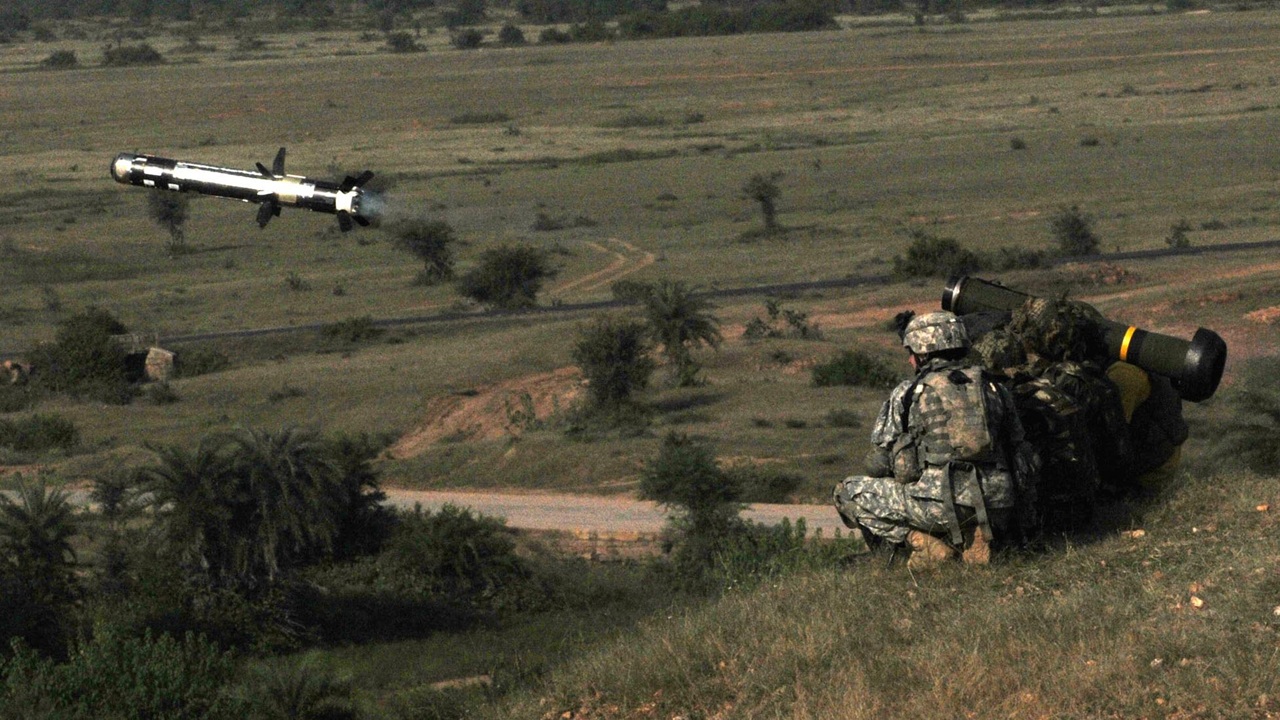
Although Russia remains India’s largest foreign defense partner, the United States has sought to make inroads—including through a recent sale of Javelin and Excalibur handheld missile launchers to New Delhi.
Russia remains India’s largest supplier of military hardware, but over the past decade, the United States has sought to increase its sales to New Delhi. On Wednesday, the United States Defense Security Cooperation Agency (DSCA) announced that the US State Department approved a Foreign Military Sale (FMS) to India valued at approximately 93 million, with Congress being notified.
New Delhi had requested 25 FGM-148 Javelin launchers, including Command Launch Units (CLU) or Lightweight CLU (LW CLU), along with 100 rockets. The deal was valued at $45.7 million. In a separate notification, the DSCA confirmed that India had sought to purchase 216 M982A1 Excalibur tactical projectiles and “ancillary items” including primers and propellant charges.
Both deals included technical assistance, data, maintenance, and support. RTX Corporation/Lockheed Martin Javelin Joint Venture (JJV) was named as the principal contractor for the Javelins, and RTX Corporation was named as the prime contractor for the Excalibur projectiles.
“There will be no adverse impact on US defense readiness as a result of this proposed sale,” the DSCA stated regarding both sales.
About the Javelin Missile
The FGM-148 Javelin is a fire-and-forget platform that utilizes an automatic infrared guidance. That allows the user to take cover and avoid counterfire immediately after launch. The system consists of three components:
- The Launch Tube Assembly;
- The Command Launch Unit (CLU—pronounced “clue”), the targeting component of the two-part system, which has three views to find, target, and fire the missile; and
- The missile itself.
About the Excalibur Missile
The US-made M982 Excalibur is a GPS- and inertial-guided munition capable of being employed in close support situations within 75 to 150 meters (250 to 490 feet) of friendly troops. The ordnance can be used in poor weather with bad visibility, while the high-explosive round can also be delayed to penetrate buildings or bunkers. Ukrainian forces have widely employed it to target Russian artillery.
America and India Already Have Some Defense Ties
The announcement of the approved FMS weapons packages, including ordnance, comes nearly nine months after Indian Prime Minister Narendra Modi met with President Donald Trump, when both leaders expressed a desire to “advance defense ties.”
However, Trump’s tariffs on India earlier this year, including a 50 percent tariff on many Indian imports, and India’s continued buying of Russian oil, led New Delhi to pause its planned purchase of US Arms. However, last month, Washington and New Delhi signed a framework agreement to expand defense cooperation over the next decade.
India has already been slowly reducing its reliance on Russian arms, and its share of Russian arms exports declined from 62 percent to 34 percent between 2017 and 2013, the BBC reported. Yet New Delhi and Moscow remain committed to key platforms, notably small arms. Moreover, India now has deals with Russia to produce some platforms domestically, notably the Sukhoi Su-30MKI (NATO reporting name “Flanker-H”) jet fighter, which is manufactured in India by the Hindustan Aeronautics Limited (HAL).
Russian state-owned arms conglomerate Rostec has sought to close a similar deal that could see India produce the Sukhoi Su-57 (NATO reporting name “Felon”), and recently signed an agreement with Moscow to build the civilian SJ-100 jetliner.
About the Author: Peter Suciu
Peter Suciu has contributed over 3,200 published pieces to more than four dozen magazines and websites over a 30-year career in journalism. He regularly writes about military hardware, firearms history, cybersecurity, politics, and international affairs. Peter is also a contributing writer for Forbes and Clearance Jobs. He is based in Michigan. You can follow him on Twitter: @PeterSuciu. You can email the author: [email protected].
Image: Wikimedia Commons.














.jpg)