The contract for the two dozen aircraft—altogether worth $8.6 billion—has led to complaints from some pro-Palestinian groups, who are worried about how they might be used.
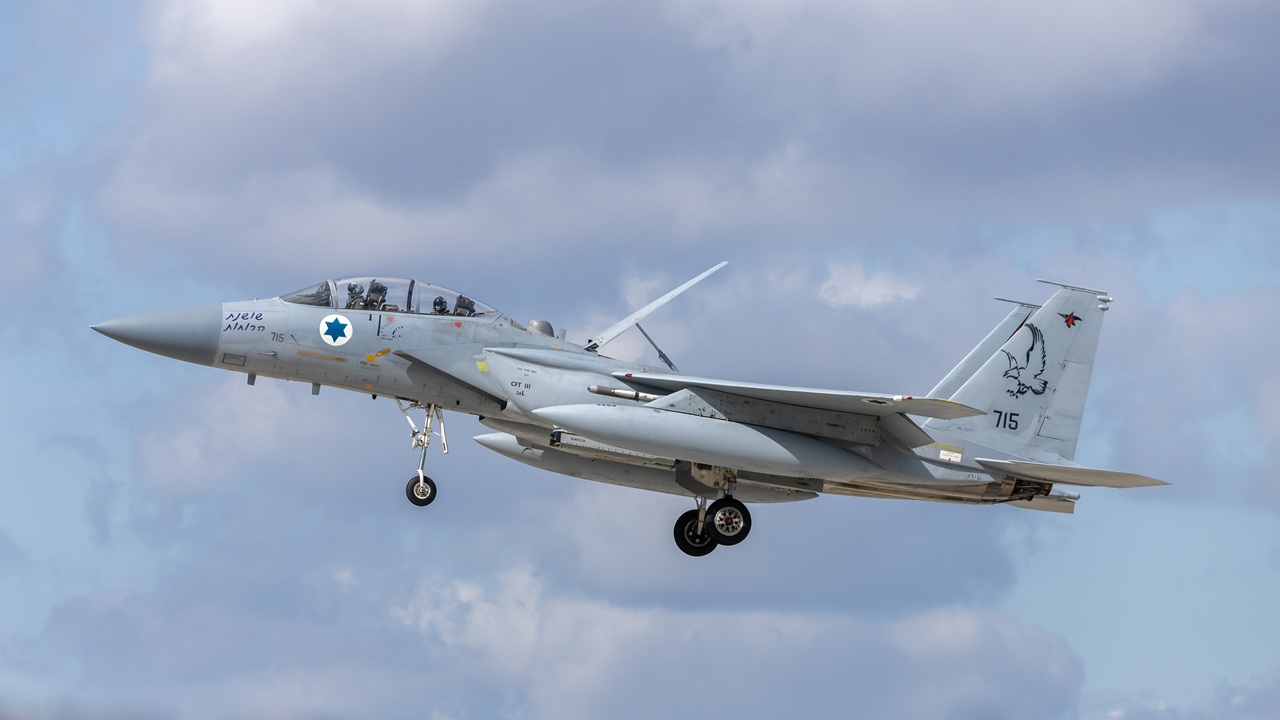
Earlier this week, the United States military’s Air Force Life Cycle Management Center, Wright-Patterson Air Force Base (AFB), Ohio, awarded aerospace giant Boeing an $8.6 billion “hybrid cost-plus-fixed-fee, fixed-price incentive” contract for 25 F-15IA aircraft, the modernized variant of the F-15 for the State of Israel. The contract also included an option for 25 additional fighters.
The deal was funded under a Foreign Military Sales (FMS) agreement with Israel. It was signed on December 29, following a meeting between President Donald Trump and Israeli Prime Minister Benjamin Netanyahu at Trump’s Mar-a-Lago estate in Florida.
The sale of upwards of 50 F-15IAs was approved in August 2024 during the Biden Administration. Work will be performed at Boeing’s St. Louis, Missouri, facilities, and delivery of the aircraft is expected by the end of 2035.
About the F-15EX Eagle II Fighter Jet
- Year Introduced: 2021
- Number Built: 129+ (ongoing production)
- Length: 63.8 ft (19.44 m)
- Wingspan: 42.8 ft (13 m)
- Weight (MTOW): 81,000 lb (36,740 kg)
- Engines: Two General Electric F110-GE-129 afterburning turbofans
- Top Speed: 1,650 mph (2,655 km/h) / Mach 2.5
- Range: Approx. 2,762 mi (4,445 km)
- Service Ceiling: ~60,000 ft (18,300 m)
- Loadout: One internally mounted M61A1 20 mm six-barrel cannon with 500 rounds, 23 hardpoints for external fuel and ordnance (29,500 lb payload capacity)
- Aircrew: 2 (pilot and weapons systems officer)
More Eagles Are Heading to the IAF’s Nest
The F-15IA is the local designation of the F-15EX Eagle II. The Israeli Air Force (IAF) had first issued a Letter of Request (LoR) for the Eagle II in January 2023.
In addition, the close Middle Eastern ally has sought upgrade kits for its fleet of F-15I Ra’am (Hebrew for “Thunder”), the customized version of the US Air Force’s F-15E Strike Eagle. The Ra’am first entered service in January 1998. Developed to incorporate many of the features of the F-15E, the Ra’am was also adapted to utilize an Elbit display and sight helmet (DASH) system. The F-15I had been regarded as being among the most advanced F-15 models, with the possible exception of the F-15EX Eagle II, which is now entering service.
Beyond being equipped with the LANTRIN targeting system first employed on the Strike Eagle (and F-16 Fighting Falcon), FLIR night vision sensor, and terrain-following radar, the Ra’am was outfitted with an EW suite designed and built by Elisra specifically for the F-15I. The upgrade kits will further enhance Ra’am’s capabilities to the F-15I+ standard.
Pro-Palestine Activists Denounce the F-15IA Sale
The sale of the aircraft, funded by the US Department of Defense (DoD) under long-term US defense assistance agreements, has already drawn significant criticism.
Pro-Palestine supporters and anti-war activists have been critical of the arms sale. That has included the Council on American-Islamic Relations, a Muslim civil rights and advocacy organization.
“The Pentagon’s decision to funnel billions of American taxpayer dollars and advanced weaponry to the Israeli military is morally indefensible,” CAIR National Deputy Director Edward Ahmed Mitchell said in a statement, The Seattle Times reported.
“This Boeing contract sends a clear message that US defense contractors and foreign governments can profit from Israel’s crimes against humanity without consequence,” Mitchell added. “It is a reward for genocide, paid for by American taxpayers.”
The Seattle paper of record also noted that Boeing has a long history of supporting Israel, “dating back to 1948,” when the IAF was provided with Boeing B-17 Flying Fortress bombers built during World War II. El Al, Israel’s national airline, operates an all-Boeing fleet.
The aerospace firm donated $2 million in humanitarian aid to Israel following the October 7, 2023 terrorist attack against the Jewish state.
About the Author: Peter Suciu
Peter Suciu has contributed over 3,200 published pieces to more than four dozen magazines and websites over a 30-year career in journalism. He regularly writes about military hardware, firearms history, cybersecurity, politics, and international affairs. Peter is also a contributing writer for Forbes and Clearance Jobs. He is based in Michigan. You can follow him on Twitter: @PeterSuciu. You can email the author: [email protected].
Image: Shutterstock / Clive117.