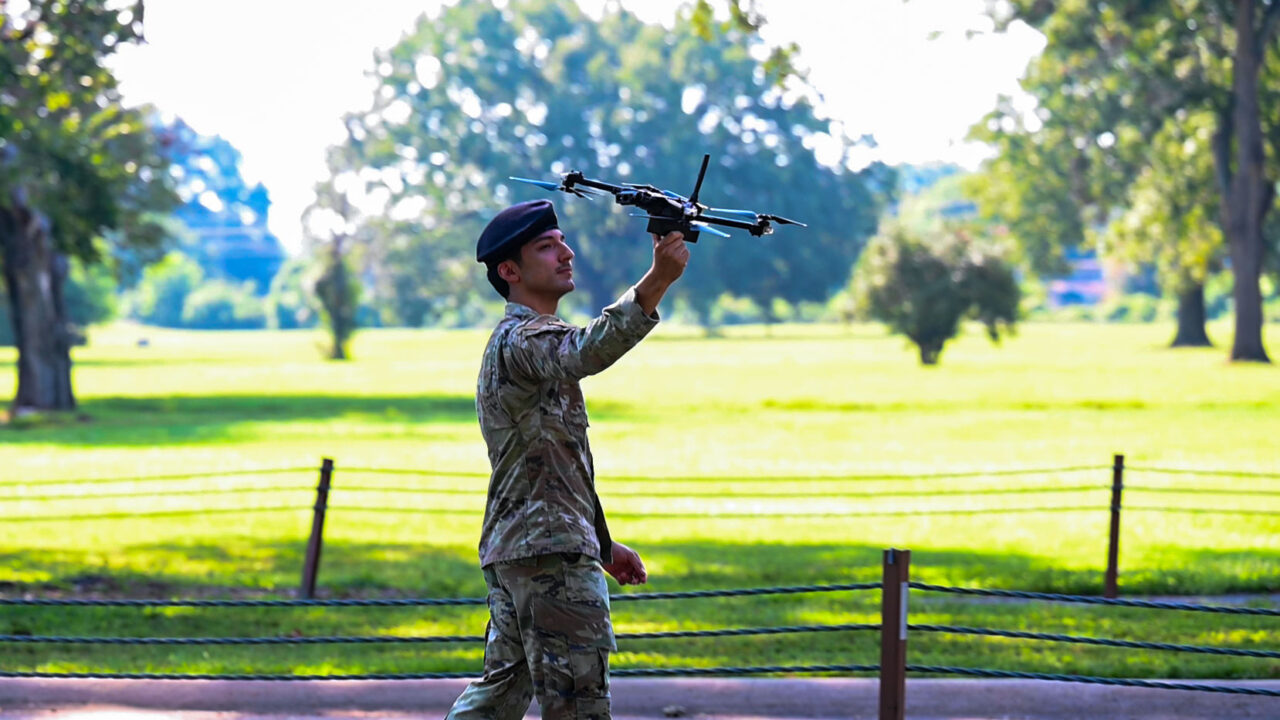
The project aims to equip larger drones with smaller drones to take out battlefield targets.
The Air Force awarded a multi-million dollar contract for small unmanned aerial systems that can support special operations forces.
The service awarded Anduril Industries a $50 million contract for small drones that can be deployed from larger unmanned aerial systems.
Small Drones to Support Special Operators
The Air Force awarded a Life Cycle Management Center contract to Anduril for the ALTIUS 600 unmanned aerial system. The final goal is to equip MQ-9 Reaper drones with several ALTIUS 600 loitering munitions to increase battlespace coverage and offer commanders more options.
Under the contract, Anduril will also provide support for the loitering munition, payloads, data links, launch tubes, and training and technical support.
The ALTIIUS 600 has been part of the Air Force Special Operations Command’s (AFSOC) Adaptive Airborne Enterprise (A2E). The project aims to equip larger drones with smaller drones, which would essentially act as drone munitions able to take out targets across the battlefield.
Former AFSOC leaders characterized the A2E project as one of the command’s top acquisition priorities, highlighting the need for the special operations command to adapt its capabilities for potential near-peer conflicts with China or Russia.
“AFSOC has shifted its priority from Counter-Violent Extremist Organization operations to also being capable of countering near-peer and peer adversaries in contested or denied environments. A2E is a result of that shift, marking an evolution beyond using the MQ-9 exclusively for Intelligence, Surveillance and Reconnaissance (ISR) and strike operations,” AFSOC has said about the A2E concept.
For several years, the MQ-9 Reaper has provided special operations units with critical intelligence, surveillance, and reconnaissance (ISR) capabilities. During the Global War on Terror, the unmanned aerial system (and its predecessor, the MQ-1 Predator) helped commanders and troops on the ground get a better understanding of the battlefield. Oftentimes, they were also armed with AGM-114 Hellfire air-to-surface missiles and conducted targeted kinetic strikes and close air support missions. Broadening the MQ-9 Reaper’s arsenal with the addition of loitering munitions offers more strike options to commanders and units on the ground.
But the loitering munition is not limited to deployment by another drone. The ALTIUS 600 can deploy from fixed-wing and rotary-wing aircraft, such as AC-130J Ghostrider gunships and UH-60 Black Hawk helicopters.
Moreover, the ALTIUS 600 has proven its combat capabilities in Ukraine, which offers the most realistic combat environment for unmanned aerial systems in the world.
Special Operations Forces and Drones
US special operations forces were some of the first to field one-way attack unmanned aerial systems on the tactical level. Special operators carried the Switchblade 300 and 600 suicide drones to combat in the Middle East during counterterrorism and counterinsurgency operations. The same suicide drones have been used to great effect by the Ukrainian military against Russian troops and heavy weapon systems, including main battle tanks, armored personnel carriers, and infantry fighting vehicles.
The attempt to equip larger unmanned aerial systems with smaller drones that can provide close air support to special operations forces is just another step toward a closer interaction between special operators and unmanned aerial systems.
About the Author: Stavros Atlamazoglou
Stavros Atlamazoglou is a seasoned defense journalist specializing in special operations and a Hellenic Army veteran (national service with the 575th Marine Battalion and Army HQ). He holds a BA from the Johns Hopkins University and an MA from the Johns Hopkins’ School of Advanced International Studies (SAIS). His work has been featured in Business Insider, Sandboxx, and SOFREP.
Image: DVIDS.