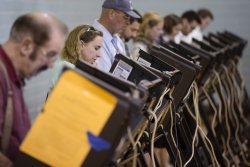
On Friday, at the annual meeting of the American Dialect Society (ADS) in New Orleans, a vote will be taken and the 2025 Word of the Year announced. The longest-running such enterprise—it began in 1990 with “bushlips,” a word, enshrined in no standard dictionary, that no one uses and few remember—it is far from the only one. Indeed, other academic and lexicographical organizations have already weighed in on the 2025 winner. Take Dictionary.com, which styles itself “The Dictionary for the Real World”: it crowned “67,” the Gen-Z interjection “used to indicate swagger or insider status in internet and youth culture.” Over in England, Cambridge chose “parasocial” and Oxford “rage bait.” And down under, the Macquarie Dictionary announced “AI slop” as the choice of both its committee of specialists and the wider public.
Now, some will say that “rage bait” is two words, on the grounds that a word is something that, when written in conventional form, has a space on either side (or, in certain contexts, a punctuation mark after it, or possibly before). They may also say that “67” is two words because it is pronounced “six seven” rather than “sixty-seven” and that “AI slop” is two words as well, or maybe even three, since it includes the abbreviation of “artificial intelligence.” But, to quote Oxford, “We’re not rage baiting you by choosing two words”: all organizations that choose a Word of the Year consider a word to be, as Oxford puts it, “a singular word or expression, which our lexicographers think of as a single unit of meaning.”
Still, it is worth noting that some choices have really pushed boundaries. In 1998, ADS members voted for the prefix “e-”; in 2012 they voted for “#hashtag”; and, most strikingly, in 2015 Oxford chose the “Face with Tears of Joy” emoji.
While there is consensus, more or less, about what can count as a word for the purpose at hand, it is clear that the groups that engage in the yearly linguistic fun do not necessarily think alike. I appreciate the differences, which come about in part, no doubt, not only because of geography but also from different methods of selection. For example, anyone may submit a nomination to the ADS, but only members of the society are eligible to participate in the final vote, which friends tell me is something of a jamboree.
In Oxford, by contrast, the decision is clinical: “candidates . . . are drawn from evidence gathered by our extensive language research program . . . which gathers around 150 million words of current English from web-based publications each month,” and the final selection—which since 2013 is supposed to “capture the imagination on both sides of the Atlantic”—is “made by the Oxford Languages team.” Meanwhile by the shores of the Pacific, in Sydney, both experts and everyone else get to weigh in, as we have seen, and it turns out that the shared choice of “AI slop” is only the fourth time since 2007 that there has been agreement.
Unsurprisingly, sometimes more than one organization picks the same winner. “Fake news” was the Macquarie experts’ choice in 2016 and the choice of both the ADS and the Collins English Dictionary in 2017. The ADS voted for “truthiness” in 2005, a year before it was Merriam-Webster’s pick; both organizations went with “bailout” in 2008; and the ADS voted for the pronoun “they” in 2015, which Merriam-Webster came around to in 2019, when the ADS crowned “(my) pronouns” and Oxford and Collins chose “climate emergency” and “climate strike” respectively.
Then came 2020: the ADS picked “Covid,” Cambridge picked “quarantine,” Collins picked “lockdown,” Dictionary.com and Merriam-Webster both picked “pandemic,” and in Australia one of the experts’ two (!) choices was “rona,” and one of the people’s two choices was “covidiot.” Follow-ups in 2021 included “vaccine” (Merriam-Webster) and “vax” (Oxford and The Economist).
Incidentally, Oxford’s lexicographers were even more overwhelmed than Macquarie’s in 2020 and declined to make anychoice after concluding that “the phenomenal breadth of language change and development” meant that it was “a year which cannot be neatly accommodated in one single word.” Viral words under consideration, aside from the literally viral ones, included “Black Lives Matter” (the ADS had voted for “#blacklivesmatter” already in 2014) and “cancel culture” (the prescient choice of the Macquarie experts in 2019).
Jump to 2023: Collins picked “AI,” the Macquarie people’s choice was “generative AI,” and The Economist plumped for “ChatGPT.” There are reasons why the staggering rise that year in the capabilities of and general interest in artificial intelligence could have been viewed as mostly positive, but strong warning signs were already apparent. And some of these signs were linguistic: Cambridge and Dictionary.com both chose to crown “hallucinate” (referring to erroneous material generated by AI), while Merriam-Webster’s “authentic” was in part a sign of the popular response to such hallucinations.
Nvidia and some of its competitors have been making investors a lot of money, though there are significant concerns about an AI bubble. But even if the bubble doesn’t burst, it is evident that normal people are worried. One way to recognize this is through Words of the Year. Yes, Collins picked “vibe coding” for 2025, which is not inherently negative, but Merriam-Webster and The Economist chose “slop,” and Macquarie (as already noted) “AI slop.”
Furthermore, Cambridge’s choice of “parasocial,” an adjective for a state that I believe we should all find unappealing, reflects the fact that “in June [2025], lookups . . . surged due to media coverage about Meta and OpenAI and the potential effect of their chatbots on children and mental health. By September of 2025, the Cambridge Dictionary definition of parasocial was updated to include the possibility of a relationship with an artificial intelligence.” And Casper Grathwohl, the president of Oxford Languages, which chose “rage bait,” notes that “As technology and artificial intelligence become ever more embedded into our daily lives . . . we’re increasingly aware of the manipulation tactics we can be drawn into online.”
What word will ADS members vote for later this week? I fear it may be “67.” Certain, however, is that kids will soon enough tire of yelling “67! 67! 67!” By contrast, my fear that the choice will be something like “AI slop” (a strong nominee for the ADS’s “Digital Word of the Year” in 2024) is existential. We need to recommit to using our own authentic words—and to teaching our children to use their own authentic words—rather than relying on bot slop.