About ten years ago, my elderly mother received a phone call from a scammer pretending to be her grandson, William. I happened to walk into her room and, seeing her visibly shaken, took the phone and asked who was calling. The man, who was clearly at least 20 years older than William, and of a different ethnic background, proceeded to try to scam me. I berated him for his shameful abuse of an elderly woman, and he hung up. I assured my mother that William was fine and that the call was just an attempt to steal money. Mom was embarrassed. “I can’t believe I fell for that, but that man sounded just like William.”
Ten years later, fraudulent industries flourish. Using AI generated media, deceitful people manipulate for motives as simple as greed and as complex and nefarious as changing what we believe. Bypassing our intellect via fear and other emotions, they cast lies, and we fall for them hook, line, and sinker.
Would Cardinal Sarah Say That?
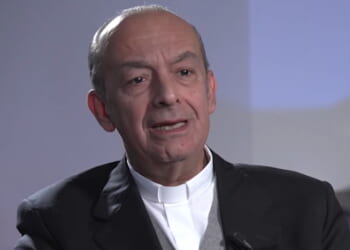
Recently, two very faithful Catholics sent me a video purporting to be of Cardinal Sarah who described an experience with Blessed Mother. The words and tone were consoling, but were they consistent with what Cardinal Sarah would release publicly? Was this the voice, were these the mannerisms of the good cardinal?
I did a little research and found that the video came from an account that was in no way connected to the cardinal or his office. Digging a little further, I found an earlier EWTN interview which appears to be the “raw material” for this bogus AI creation. Watching that legitimate video, one can see and hear a seasoned, erudite Cardinal Sarah soberly discussing his book, The Sacraments are the Pillars of the Catholic Church. The AI-generated cardinal looks and sounds younger, and more importantly, is saying words Cardinal Sarah never said.
I explained to the two faithful Catholics that they had unfortunately been duped. One expressed confusion and disturbance, saying, “but his voice was so soothing.” Another person who viewed the video said, “I think God would approve of those words.” Reverently, I respond that deceit can only sow bad seeds. We must reject it and learn to be discerning in this disorienting world.
Discernment Maintains the Truth
What seems innocuous can in fact inoculate us against truth. Listening to false voices that seem friendly to the Church is akin to allowing the proverbial Trojan Horse into the fortress of our hearts. It is only a matter of time before manipulators steer us away from what we stand on: Scripture, the Magisterium, and Sacred Tradition. By disregarding such discernment and continuing to view material that is false, we set ourselves up for confusion, further deception, and loss of trust in the true voices of the Church.
AI is a relatively recent technology. In five years, it may advance to the point that it will be all but impossible to tell the difference between real and AI images. One can foresee a time when fake videos could be hacked into trusted sources, like EWTN or even the Vatican, causing harm before they are removed.
What is a Faithful Catholic To Do?
As Jesus’ disciples, we have ordinary tools of Christian life. Let’s use them. Instead of being unwitting abettors of confusion, let’s choose to be lighthouses in the fog.
Employ time; be patient. Rather than giving in to the impulse to share with others, slow down and verify sources first. Guard yourself and others from confusion and doubt of authentic Church voices. Do not rush to spread information that may turn out to be false. If something appears sensational, scandalous, or teaches a departure from Church teaching, patiently wait for the truth to be revealed.
Employ wisdom; be, “as wise as serpents and simple as doves.” If an account has an unrecognized name or uses startling words and graphics, be suspicious. The world of media is not the place to be overly trusting. Wise discernment asks questions like; would a cardinal’s office use tabloid-style wording and graphics? Would a cardinal release a video about a vision he just had the day before? When in doubt, read the transcript. Sometimes a video has more emotional impact than text. Reading the text may reveal falsity.
Employ self knowledge; know yourself. Be aware of your own biases. Do you seek out the mystical? While we are called to believe in the mystical aspects of our Faith, St. Paul warns us to test every spirit. The Church has a process by which it carefully evaluates the value of things purported to be mystical. Trust the Church and give Her time.
My friend’s use of the word “soothing” to describe the AI cardinal’s voice is interesting. To soothe is to placate or appease, neither of which is necessarily compatible with truth. Being aware of our own bias includes being alert to what soothes us. A video may speak to what we want to hear but still be false. Conversely, rage-baiting can draw us into false information. By raising our emotions, a channel can garner views and make much money at the cost of our peace and our Church’s reputation.
Employ prayer and study. Wisdom increases with consistent prayer and study. Pray the rosary. Refer to the Catechism. Spend time in adoration. Speak to a priest. Know the Faith. With the two indispensable tools of prayer and study, we will be less likely to accept something we should approach with a healthy skepticism. Instead, we will say, “I think I had better investigate this. It does not align with what I know about Church teaching/this Cardinal/etc.”
Employ the virtue of obedience. Always defer to Church authority. If you believed something that turned out to be false, accept what the Church has determined. Consider any mistake you make to be grace toward humility and obedience.
Dispel deception for others. Instructing the ignorant is an act of mercy for God’s beloved children. They may be faithful but have simply fallen prey to the rapid change of AI media. It is uncomfortable to do this, but mercy requires it.
Report false videos. On a practical level, we can support the Church by reporting videos to the host platform. I reported the fake Cardinal Sarah video to YouTube, who removed it and shut the account down. Less than a week later, another fake channel was up with the same material. It may feel like fighting the tide, but reporting slows the criminals down and cuts into their profits. Reporting defends the Church and only takes a few moments.
Finally, employ digital breaks. Nothing disrupts the power of media in our lives like simply powering down. Disengaging allows us to engage with the people, the creation and the ideas that are worth our time. Let us choose to give our attention to what God has given us instead of the counterfeit and the artificial. Limiting digital time and increasing prayer and study attunes us to the Truth we are called to know, love and serve.
God chose us for this strange time. He will give us the grace we need to live it for His glory.
Photo by Igor Omilaev on Unsplash